
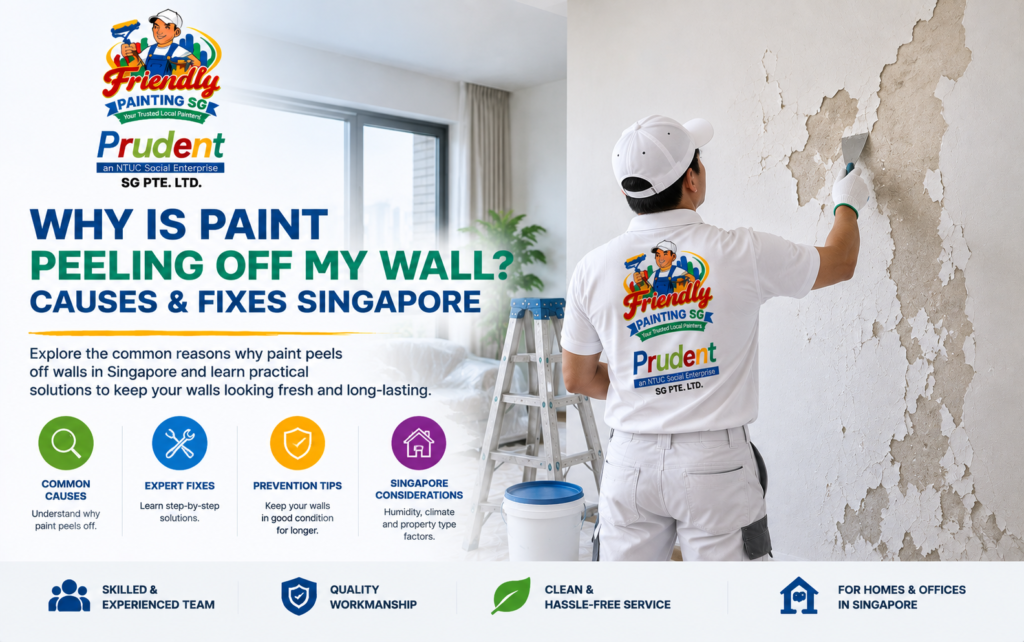
Why is paint peeling off my wall? In most cases, peeling happens because the new or existing paint has lost adhesion to the surface underneath. Moisture, poor surface preparation, powdery walls, unsuitable primer, old loose paint, cracks, and recurring mould or condensation can all cause the coating to bubble, flake, or peel away.
The important point is that peeling paint is usually a symptom. Simply covering it with another coat may make the wall look better temporarily, but the problem can return if the underlying cause remains.
This is especially relevant in Singapore homes, where HDB notes that paint peeling and mould are commonly associated with moisture and humidity, and can also result from improper surface preparation before painting. HDB home-maintenance guidance on paint peeling and mould
Before repainting, use this quick guide:
| What You See | Possible Cause | Repaint Immediately? |
|---|---|---|
| Small dry flakes | Old or poorly bonded paint | No |
| Paint bubbling | Moisture behind coating | No |
| Powder comes off on your hand | Chalky/weak substrate | No |
| Peeling around cracks | Wall movement or failed repair | No |
| Peeling near bathroom/kitchen | Humidity or moisture | Find cause first |
| Paint lifts shortly after repainting | Poor preparation/primer issue | No |
| Stable wall after loose paint removal | Surface may be ready after preparation | Yes, after proper prep |
1. Moisture Is Getting Behind the Paint
Moisture is one of the first things to investigate when paint repeatedly peels from the same area.
Paint forms a film over the wall. If moisture moves through the wall or becomes trapped behind that film, adhesion can weaken.
Eventually you may see:
- Bubbling
- Blistering
- Soft paint
- Flaking
- Dark stains
- Mould
- Peeling around corners or ceilings
Where does the moisture come from?
Possible sources include:
- Plumbing leaks
- Bathroom moisture
- Ceiling leaks
- External wall water penetration
- Condensation
- Air-conditioning condensation
- Poor ventilation
- Water entering around windows
- Previous dampness that was painted over too early
The location of the peeling can provide a clue.
Peeling close to the bathroom ceiling may have a different cause from peeling below a window or on an external-facing bedroom wall.
Should you repaint a damp wall?
No.
A fresh coat of paint does not stop an active water problem.
The moisture source should be identified and corrected first. The wall then needs enough time to dry before the damaged coating and surface are prepared for repainting.
Otherwise, the new paint may fail again.
2. The Wall Was Not Properly Prepared Before Painting
Good painting starts before the paint tin is opened.
If a wall contains dust, grease, loose paint, old filler, dirt, or unstable material, new paint may not bond correctly.
This is particularly common when someone paints directly over an old wall to save preparation time.
At first, the new wall may look fine.
Later, sections can begin to:
- Lift
- Crack
- Bubble
- Flake
- Peel in strips
Surface preparation may include:
- Removing loose paint
- Cleaning dust and dirt
- Repairing holes
- Filling suitable cracks
- Sanding rough patches
- Smoothing repaired areas
- Removing loose or powdery material
- Applying a suitable primer or sealer where required
Not every wall needs exactly the same process.
A stable previously painted bedroom wall needs different preparation from a damp ceiling, chalky plaster wall, or newly repaired cement surface.
That is why Friendly Painting Singapore assesses the existing wall condition before deciding how much preparation is required.
3. The Wall Is Powdery or Chalky
Run your hand across the wall.
Does a fine white or coloured powder appear on your fingers?
If yes, the surface may be chalky or powdery.
This matters because paint needs to bond to something stable.
If you apply new paint directly onto a loose powder layer, the coating may technically bond to the powder rather than firmly to the wall underneath.
The result can be poor adhesion.
Signs of a chalky wall include:
- Fine powder after touching the surface
- Paint that rubs off easily
- Old faded coating
- Weak plaster surface
- Patchy-looking walls
- New paint peeling together with the layer underneath
What should happen before repainting?
The unstable material should be removed as appropriate and the remaining surface assessed.
Depending on the condition, the wall may need:
cleaning → preparation → stabilising/sealing → repainting
Simply adding two more coats of finishing paint does not solve an unstable substrate.
This is one reason Friendly Painting’s surface-preparation process matters as much as the final colour.
4. The Wrong Primer or No Primer Was Used
Primer is not needed in exactly the same way for every repainting project.
However, some surfaces benefit significantly from the correct primer or sealer.
These may include:
- Bare plaster
- Cementitious surfaces
- Repaired areas
- Chalky walls
- Strong colour changes
- Stain-affected surfaces
- Previously problematic walls
The purpose is not simply to add another coat.
A suitable primer or sealer can help create a more consistent surface for the finishing paint.
What happens if primer is skipped?
Depending on the wall, you may get:
- Uneven absorption
- Patchy colour
- Weak adhesion
- Repair marks showing through
- Premature peeling
- Higher paint consumption
This does not mean every peeling wall can be fixed by applying primer over the top.
If the existing coating is already loose, it must first be dealt with.
Primer should go onto a properly prepared, sufficiently stable surface—not over paint that is already coming away from the wall.
5. New Paint Was Applied Over Old Loose Paint
This is one of the simplest causes of repeated peeling.
Imagine the original coating has already lost adhesion.
A new painter applies a fresh coat directly over it.
The new coat may bond perfectly well to the old paint.
But the old paint is still poorly bonded to the wall.
Eventually:
wall → weak old coating → new paint
comes away together.
How do you know old paint is unstable?
Look for:
- Flaking edges
- Bubbling
- Hollow-looking sections
- Paint lifting when lightly scraped
- Multiple old layers separating
- Cracked coating
- Large sheets peeling away
The loose material should not simply be hidden.
It needs to be removed back to a stable edge before repair, sanding, priming or repainting continues.
Can you paint over one tiny peeling patch?
You can repair a local area if the problem is genuinely local.
However, first inspect the surrounding coating.
If a small peeling patch is only the visible part of a much larger adhesion problem, spot repainting may not last.
6. Cracks or Failed Wall Repairs Are Damaging the Paint
Sometimes the paint itself is not the original problem.
The wall underneath is moving or cracking.
As a crack opens, the paint film crossing it can split and begin to lift around the damaged area.
Common situations include:
- Hairline cracks
- Cracks around material joints
- Old filler cracking again
- Poorly repaired holes
- Uneven plaster
- Loose patching material
Can paint hide wall cracks?
Paint may make a very fine defect less noticeable, but it is not a structural repair product.
If a crack requires filling or plaster repair, complete that work before repainting.
For wider, recurring, or unusual cracks, the underlying cause may need investigation rather than repeated cosmetic filling.
Friendly Painting Singapore lists wall crack repair and plastering among its available painting-related services, which makes crack assessment a natural part of preparing damaged walls before repainting.
7. Humidity, Condensation or Mould Keeps Affecting the Area
If peeling appears together with mould, the wall needs more than a colour change.
Singapore’s indoor conditions can make moisture management particularly important in:
- Bathrooms
- Kitchens
- Bedrooms using air-conditioning heavily
- Poorly ventilated rooms
- Corners behind furniture
- Ceilings
- Areas near external walls
HDB specifically identifies moisture and humidity as common factors in mould growth and paint peeling in flats.
Does mould cause paint to peel?
Mould itself may appear on the surface, but the more important issue is often the moisture condition that allows mould to grow.
If a wall stays damp or experiences repeated condensation, the coating system may deteriorate.
Painting directly over mould without addressing the condition can result in:
- Staining returning
- Mould returning
- Bubbling
- Peeling
- Poor coating adhesion
What should happen first?
The area should be assessed for:
- Moisture source
- Ventilation
- Condensation
- Leak history
- Existing coating failure
- Surface contamination
Once the underlying problem has been addressed, the wall can be properly treated, prepared and repainted.
Friendly Painting Singapore also offers anti-mould treatment and painting for suitable wall conditions.
Why Is My Paint Peeling Soon After Repainting?
If the paint starts peeling weeks or months after a recent repaint, do not automatically blame the final paint product.
The failure could have started underneath.
Possible causes include:
- Old loose paint was not removed
- Dust remained on the wall
- Wall was still damp
- Wall was not sufficiently cured or dry
- Powdery substrate was not stabilised
- Primer was unsuitable or omitted where needed
- Cracks were painted over
- Moisture entered after painting
- Different coating layers were incompatible
The useful question is:
Which layer is failing?
If the newest coat separates from the previous paint while the older coating remains firmly attached, the problem may involve adhesion between coatings.
If both new and old paint come away together, the underlying coating or wall surface may be the weak point.
That difference can help determine the correct repair.
Can You Just Paint Over Peeling Paint?
Usually, no.
If paint is already loose, applying more paint over it creates a new finish on an unstable base.
That can leave the wall looking acceptable temporarily, but the weak material underneath can continue separating.
The better process is:
identify cause → remove loose coating → repair substrate → prepare → prime/seal if required → repaint
When might a simple repaint be enough?
If the paint failure is:
- Very small
- Dry
- Localised
- Not related to moisture
- Surrounded by stable paint
- On a sound wall
then local preparation and repainting may be enough.
When does the wall need more investigation?
Be more cautious when you see:
- Repeated peeling in the same area
- Large bubbles
- Damp patches
- Mould
- Water stains
- Wide cracks
- Loose plaster
- Peeling ceiling paint
- Paint falling in sheets
- Peeling after several previous repaints
Those symptoms suggest that another issue may be affecting the coating.
Paint Peeling vs Paint Bubbling: Are They the Same?
They can be related, but they are not exactly the same.
Paint bubbling
A bubble forms when part of the paint film separates from the wall while remaining attached around the edges.
It may contain:
- Air
- Moisture
- Poorly bonded coating underneath
Paint peeling
Peeling happens when the detached coating begins to break away from the wall.
A bubble can therefore develop into peeling.
If you see bubbles, avoid simply pressing them flat and painting over them.
The reason for the loss of adhesion should be assessed first.
Why Is My HDB Ceiling Paint Peeling?
Ceiling peeling deserves particular attention because several different conditions can create a similar appearance.
Possible causes include:
- Humidity
- Condensation
- Previous moisture
- Poor surface preparation
- Old paint
- Ceiling leaks
- Deteriorated coating
- Concrete or plaster defects
Check the appearance carefully
A dry flaking ceiling and a ceiling with:
- Brown staining
- Dampness
- Soft patches
- Mould
- Bulging
- Recurring wet areas
should not be treated as the same problem.
If there is evidence of active water intrusion, solve that issue before repainting.
Likewise, if the concrete itself looks cracked, bulged, or damaged rather than merely painted badly, the situation may require repair beyond ordinary painting.
Does Peeling Paint Mean There Is a Water Leak?
Not always.
Water is only one possible cause.
A perfectly dry wall can still peel because of:
- Poor preparation
- Old paint
- Chalking
- Adhesion failure
- Incompatible coatings
- Missing preparation steps
However, moisture becomes more likely when peeling appears together with:
- Water stains
- Dark patches
- Mould
- Soft plaster
- Bubbling
- Damp smell
- Peeling that returns repeatedly in the same wet area
The goal is not to assume every peeling wall has a leak.
It is to rule out moisture before repainting.
What Should Be Done Before Repainting a Peeling Wall?
A professional repaint should start with the wall condition, not the new paint colour.
A typical process may include the following.
Step 1: Inspect the Area
Check:
- How much paint is loose
- Whether the wall is damp
- Whether mould is present
- Whether cracks exist
- Whether plaster is stable
- Whether the problem is local or widespread
Step 2: Identify the Likely Cause
Peeling caused by moisture requires a different response from peeling caused by old loose paint.
Do not use one repair method for every wall.
Step 3: Remove Loose Paint
Unstable coating should be removed until the surrounding edges are sound.
Step 4: Repair Suitable Surface Defects
Depending on the condition, this may include:
- Crack filling
- Hole filling
- Plaster repair
- Local smoothing
Step 5: Sand and Clean
The repaired surface should be prepared so that dust and loose material do not remain between the wall and the coating system.
Step 6: Apply Primer or Sealer Where Required
The wall condition determines whether a specific primer/sealer is appropriate.
Step 7: Apply Finishing Paint
Once the surface is stable and ready, the finishing coats can be applied.
Step 8: Inspect the Finished Wall
Check for:
- Coverage
- Repair visibility
- Uneven finish
- Missed edges
- Remaining defects
This is closer to a durable painting process than simply rolling new paint over the peeling area.
Repaint or Repair First? A Quick Decision Guide
| Situation | Recommended Direction |
|---|---|
| Old paint flaking on a dry, sound wall | Prepare and repaint |
| One small hairline crack | Repair, prepare, repaint |
| Many recurring cracks | Assess cause before repainting |
| Mould + peeling | Address moisture/mould first |
| Damp patch + bubbles | Investigate moisture before painting |
| Powdery wall | Stabilise/prepare before repainting |
| Loose plaster | Repair wall first |
| Large ceiling damage | Assess whether repair beyond painting is needed |
| Stable wall with faded paint only | Normal repainting may be sufficient |
How to Reduce the Chance of Paint Peeling Again
No paint system lasts forever, but good preparation can significantly reduce avoidable failures.
Before repainting:
- Do not paint over active moisture
- Remove unstable coating
- Repair cracks appropriately
- Clean dust and contaminants
- Deal with powdery areas
- Allow suitable repairs to dry
- Use primer/sealer where the substrate requires it
- Avoid treating mould as only a colour problem
- Check recurring leak or condensation areas
- Make sure the surface is stable before finishing coats
Also remember that different parts of the same home can need different preparation.
A dry living-room wall and a bathroom ceiling should not automatically receive identical treatment.
When Should You Call a Professional Painter?
A straightforward repaint is one thing.
Repeated coating failure is another.
Consider professional assessment when:
- Peeling covers a large area
- The problem keeps returning
- Mould is widespread
- Cracks require repair
- Plaster has become loose
- Several old paint layers are failing
- The wall needs extensive surface preparation
- You cannot identify whether moisture is present
- The ceiling is affected
- You are repainting an entire HDB, condo or landed property
A painter can assess whether the surface mainly needs coating preparation or whether another repair should happen before painting begins.
How Friendly Painting Singapore Handles Peeling Walls
For suitable painting projects, Friendly Painting SG can assess the wall before applying new paint.
Depending on the condition, the preparation may include:
inspection → removal of loose coating → minor crack or surface repair → sanding/cleaning → primer or sealer where required → finishing coats → final inspection
Friendly Painting SG’s current services include:
- Interior painting
- HDB painting
- Condo painting
- Landed house painting
- Ceiling painting
- Anti-mould treatment and painting
- Wall crack repair and plastering
- Surface preparation
The scope should always depend on the actual condition of the property rather than assuming every peeling wall needs the same treatment.
Frequently Asked Questions About Peeling Paint
Why is paint peeling off my wall?
Paint can peel when adhesion between the coating and wall breaks down. Common causes include moisture, poor surface preparation, chalky walls, unsuitable primer, loose previous coatings, cracks and mould or condensation-related problems.
Can I paint directly over peeling paint?
You should not paint directly over loose coating. Remove unstable paint and prepare the surface first. If moisture, cracks or another wall defect caused the peeling, address that issue before repainting.
Why does my paint keep peeling in the same spot?
Repeated peeling usually means the underlying cause has not been corrected. Possible causes include moisture, a recurring crack, weak plaster, chalking or a poorly bonded older paint layer.
Why is new paint peeling after only a few months?
The problem may involve inadequate preparation, dust, moisture, old unstable coating, a powdery substrate or unsuitable primer. The fact that the top coat is new does not necessarily mean the failure started in the new paint.
Does humidity cause paint to peel?
Humidity can contribute to conditions that affect coatings, especially where condensation or poor ventilation keeps the wall damp. Moisture should be assessed before repainting areas that repeatedly peel.
Does peeling paint always mean there is a leak?
No. Dry walls can peel because of poor preparation, old paint, chalking or adhesion failure. However, water stains, mould, dampness or repeated bubbling make moisture more likely.
Why is my HDB ceiling paint peeling?
Possible causes include humidity, condensation, previous leaks, old paint, poor preparation or deterioration of the surface underneath. If the ceiling also shows water staining, dampness, bulging or concrete damage, investigate the underlying issue before repainting.
Do I need primer after removing peeling paint?
It depends on the wall condition. Bare, repaired, chalky or difficult surfaces may require a suitable primer or sealer. A stable previously painted surface may need a different preparation approach.
Can mould cause paint to peel?
Mould often appears where moisture conditions exist, and those same conditions can also contribute to coating deterioration. Treat the moisture or condensation problem instead of simply covering mould with new paint.
Can Friendly Painting Singapore repair and repaint peeling walls?
Friendly Painting Singapore provides surface preparation, minor wall repairs, wall crack repair, anti-mould treatment and painting services for suitable residential and commercial projects. The correct approach depends on the cause and condition of the peeling area.
Final Thoughts
If you are asking “why is paint peeling off my wall?”, do not begin by choosing another colour.
Begin with the surface.
Look for:
moisture → loose coating → powdering → cracks → mould → preparation problems
A dry wall with one small area of old loose paint may only need local preparation and repainting.
A wall with recurring bubbles, dampness or mould requires more investigation.
A cracked or powdery wall needs the substrate prepared before the finishing coats go on.
That distinction is what separates a temporary cover-up from a properly prepared repaint.
For HDB flats, condos, landed homes and other Singapore properties, Friendly Painting Singapore can assess peeling walls, prepare suitable surfaces and carry out the required repainting work based on the actual condition of the wall.