
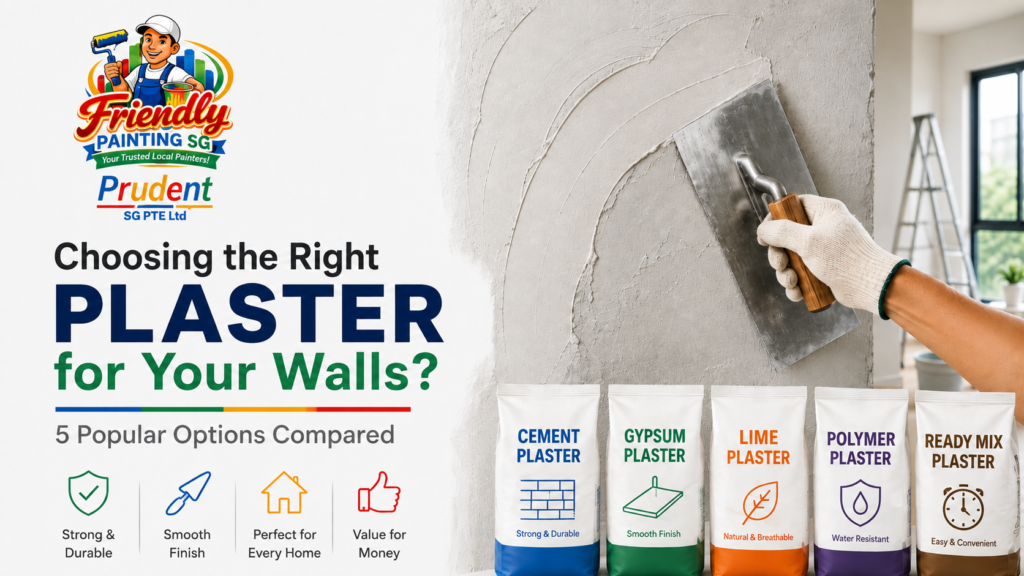
If you are wondering which plaster is best for walls, the answer depends on the wall material, moisture exposure, required finish, repair depth, and whether the surface is indoors or outdoors. For most dry interior walls, gypsum plaster is often the most practical choice for achieving a smooth paint-ready finish. However, cement-based plaster is generally better suited to masonry, tougher conditions, and areas where greater moisture resistance is required.
There is no single plaster that performs best in every Singapore property. For example, an HDB bedroom wall may only need gypsum-based skim plaster to correct minor unevenness. Meanwhile, a damaged brick or block wall may require a cement-sand base before finishing. Similarly, a feature wall designed for a luxurious textured appearance may use Venetian plaster instead of conventional levelling plaster.
Therefore, choosing the correct wall plaster should start with the substrate and problem—not with the material name alone.
This guide compares five common plaster options: gypsum plaster, cement plaster, lime plaster, drywall plaster systems, and Venetian plaster. In addition, it explains which option suits interior walls, brickwork, feature walls, repairs, and different Singapore property conditions.
Quick Answer: Which Plaster Is Best for Walls?
For most projects, the best choice can be simplified like this:
| Plaster Type | Best Use | Main Advantage | Main Limitation |
|---|---|---|---|
| Gypsum plaster | Dry interior walls | Smooth finish and efficient application | Not ideal for persistent damp |
| Cement plaster | Brick, block, masonry, tougher areas | Strong and moisture-tolerant | Heavier and slower to finish |
| Lime plaster | Breathable or traditional walls | Flexible and vapour-permeable | Requires experienced application |
| Drywall plaster / joint system | Plasterboard partitions | Fast, lightweight interior finishing | Not intended to rebuild damaged masonry |
| Venetian plaster | Decorative feature walls | Premium polished texture | Decorative rather than structural repair material |
So, if your priority is a smooth bedroom or living-room wall, gypsum is usually a strong starting point. However, for brick wall plaster, external masonry, or surfaces requiring a stronger base, cement-based plaster may be more appropriate.
Meanwhile, Venetian wall plaster is mainly chosen for appearance rather than basic wall correction.
What Is Wall Plaster?
Wall plaster is a material applied over a wall or ceiling to create a smoother, more consistent, protective, or decorative surface.
Depending on the system, plaster may:
- Fill surface irregularities
- Cover masonry joints
- Create a level wall
- Provide a base for paint
- Repair selected damaged areas
- Improve surface hardness
- Create decorative texture
However, plaster is not a universal solution for every defect.
For example, applying fresh plaster over an actively leaking wall does not stop the water source. Likewise, plastering over unstable or loose material can produce a smooth appearance temporarily while leaving a weak layer underneath.
Therefore, good plastering begins with surface assessment.
The contractor should determine:
- What the wall is made from
- Whether moisture is present
- How deep the damage is
- Whether existing plaster is stable
- What final finish is required
- Which coating will be applied afterward
USG, a major manufacturer of plaster and gypsum wall systems, similarly distinguishes between conventional plaster, veneer plaster, gypsum bases, drywall systems, and bonding products according to substrate and performance requirements.
Why the Best Plaster Depends on the Wall
People sometimes choose plaster based entirely on recommendations such as:
“Gypsum is best.”
or:
“Cement is stronger.”
Both statements can be true in the right context, yet neither tells the complete story.
A plaster must be compatible with what lies beneath it.
For example, plaster may be applied over:
- Concrete
- Brick
- Concrete block
- Existing plaster
- Gypsum board
- Cement board
- Selected masonry surfaces
USG notes that appropriate plaster systems can be used on substrates including gypsum, concrete block, stone, drywall panels, and cement board, although bonding agents or specific base materials may be required depending on the application.
Consequently, a successful plaster system includes more than the finishing material itself. Surface preparation, bonding, thickness, drying, and final coating all matter.
1. Gypsum Plaster: Best for Smooth Interior Walls
For many dry indoor spaces, gypsum plaster is one of the best choices.
Gypsum-based plaster is commonly used to smooth walls before painting because it can produce a fine, relatively even finish. Moreover, it can be applied as part of conventional or veneer plaster systems depending on the substrate and product.
USG’s plaster systems include gypsum basecoats designed for strong interior applications and veneer systems designed to create durable, smooth finished surfaces.
Where Gypsum Plaster Works Well
Gypsum plaster can be appropriate for:
- Bedrooms
- Living rooms
- Dining areas
- Offices
- Interior corridors
- Concrete interior walls
- Previously plastered walls
- Selected ceiling repairs
Furthermore, its smooth surface makes it particularly useful when the final finish will be standard interior paint.
Why Gypsum Is Popular
Gypsum plaster has several practical advantages.
It can provide:
- A smooth finish
- Good workability
- Fine surface correction
- Efficient interior application
- A suitable base for paint
- Less coarse texture than many traditional cement renders
Therefore, when someone asks which plaster is best for walls inside a home, gypsum is often a sensible answer when the wall is dry and structurally sound.
When Gypsum Is Not the Best Choice
Gypsum should not automatically be applied over surfaces affected by:
- Active water leakage
- Persistent dampness
- Wet exterior exposure
- Unstable old plaster
- Severe structural cracking
If moisture remains trapped inside the wall, the finish may deteriorate regardless of how well the plaster was applied.
Therefore, the source of water should be repaired first.
2. Cement Plaster: Best for Masonry and Tougher Conditions
Cement-based plaster is commonly used over brick, concrete block, masonry, and other mineral surfaces where a stronger and more robust base is required.
A typical traditional system combines cement, sand, and water in appropriate proportions. However, modern premixed cementitious plaster products may include additives that improve workability, adhesion, or water resistance.
People searching wall plaster cement are generally trying to determine whether cement-based plaster is suitable for their walls. The practical answer is yes when the wall requires a tougher mineral base, although the exact product and mix should match the substrate.
Where Cement Plaster Works Best
It may be selected for:
- Brick walls
- Concrete-block walls
- Masonry repairs
- More uneven substrates
- Selected kitchens or utility areas
- Exterior wall preparation
- Areas requiring a harder base
However, waterproofing and plastering should not be confused.
Cement plaster can tolerate different conditions from gypsum, but ordinary cement plaster does not automatically stop active water penetration.
Advantages of Cement Plaster
Cement plaster offers:
- Strong mechanical performance
- Good compatibility with masonry
- Ability to build greater thickness
- Suitability for irregular brick or block surfaces
- Greater tolerance for demanding environments
As a result, it is often the stronger choice when substantial wall levelling is required.
Potential Disadvantages
Cement plaster can also require more labour.
For example, it may need:
- Careful mixing
- Proper curing
- Longer drying before finishing
- Additional skim coating for a very smooth paint finish
Furthermore, shrinkage or cracking can occur when mixing, substrate preparation, thickness, or curing is poorly controlled.
Therefore, stronger does not automatically mean easier.
Gypsum Plaster vs Cement Plaster
For many homeowners, this is the most important comparison.
| Factor | Gypsum Plaster | Cement Plaster |
|---|---|---|
| Best location | Dry interiors | Interior/exterior masonry depending on system |
| Surface finish | Naturally smoother | Often needs further finishing |
| Application | Efficient for interior finishing | Better for heavier levelling |
| Moisture exposure | Less suitable for persistent damp | Generally more suitable |
| Brick/block use | Possible with compatible system | Common choice |
| Drying/curing | Usually faster | Generally slower |
| Decorative paint base | Excellent | Good after proper finishing |
| Thick correction | Depends on system | Often more appropriate |
Therefore, use gypsum when the priority is a smooth dry interior surface. In contrast, use cement plaster when the substrate and conditions require a more robust masonry-based solution.
3. Lime Plaster: Best When Breathability Matters
Lime plaster is a traditional wall finish produced using lime-based binders.
Unlike dense cement-rich finishes, suitable lime plaster can allow greater vapour movement through a wall system. Consequently, it is commonly associated with heritage buildings, older masonry, and applications where breathability matters.
However, lime plaster should not be confused with decorative limewash paint. Although both use lime-related materials, they perform different functions.
When Lime Plaster Makes Sense
Lime plaster may be appropriate for:
- Traditional masonry
- Selected older buildings
- Walls where vapour permeability matters
- Restoration work
- Natural-texture interiors
Moreover, lime can accommodate some movement differently from rigid cement-rich finishes.
However, successful application requires knowledge of:
- Substrate moisture
- Mix composition
- Coat thickness
- Curing
- Final finish
Therefore, it is not always the simplest option for a modern HDB or condominium repaint.
Lime Plaster vs Cement Plaster
Cement plaster generally provides greater hardness and is widely used in modern masonry construction.
Lime plaster, meanwhile, can offer:
- Greater vapour permeability
- Traditional compatibility
- A softer natural texture
- Different movement characteristics
Consequently, the choice should reflect the existing wall construction rather than current design trends.
4. Dry Wall Plaster: Best for Plasterboard Systems
The related term dry wall plaster is often used loosely. Technically, drywall or plasterboard systems usually use gypsum panels combined with joint compounds, finishing plasters, or veneer plaster rather than conventional thick plaster applied directly to brick.
Therefore, it is important to distinguish between:
Plastering a solid wall
and
Finishing a drywall partition
They are not the same process.
USG produces dedicated gypsum-base panels for veneer plaster systems, while its plaster bonding systems can also be used on suitable drywall and other interior substrates.
How Drywall Finishing Works
A typical plasterboard partition may involve:
- Installing the board
- Treating board joints
- Applying joint tape
- Applying joint compound or finishing plaster
- Sanding
- Priming
- Painting
Therefore, most of the wall is already relatively flat. The plastering process focuses heavily on joints, screw locations, surface consistency, and final finishing.
Advantages of Drywall Systems
Drywall construction can provide:
- Fast installation
- Lightweight partitions
- Smooth interior surfaces
- Easy service routing
- Flexible room layouts
However, standard drywall finishing is not an appropriate replacement for thick masonry plaster where a damaged brick or block wall needs rebuilding or levelling.
Common Drywall Problems
Painters may encounter:
- Visible board joints
- Screw pops
- Cracks at joints
- Torn paper
- Damaged corners
- Poor previous patching
These defects require the correct repair technique before painting.
Simply applying a thick layer of ordinary plaster over the entire wall may create new problems.
5. Venetian Wall Plaster: Best for Decorative Feature Walls
Venetian wall plaster is very different from basic levelling plaster.
Rather than serving primarily as a hidden preparation layer, Venetian plaster is selected because the plaster itself becomes part of the finished design.
Traditional Venetian-style systems often use lime-based materials applied in thin layers and polished to create depth, movement, and a stone-like appearance. Modern products may also contain different mineral or acrylic formulations, so the exact composition should always be checked.
What Does Venetian Plaster Look Like?
Depending on technique, it can create:
- Soft cloudy movement
- Marble-like variation
- Polished surfaces
- Natural tonal depth
- Subtle texture
- High-end feature walls
Therefore, it is popular in:
- Living rooms
- Entry foyers
- Dining rooms
- Luxury bedrooms
- Restaurants
- Boutiques
- Showrooms
- Reception areas
Is Venetian Plaster Good for Every Wall?
No.
It is usually a decorative finish, not a substitute for proper wall repair.
Before applying it, the substrate should normally be:
- Stable
- Properly prepared
- Relatively smooth
- Free from active water problems
- Suitable for the selected product
If the wall contains severe cracks or loose plaster, those problems must first be corrected.
Moreover, Venetian finishes rely heavily on workmanship. The application pattern, trowel pressure, coat sequence, and polishing technique all influence the final appearance.
Consequently, two installers can produce noticeably different results using the same product.
The 5 Wall Plaster Options Compared
| Type | Smoothness | Strength | Moisture Suitability | Decorative Value | Best Overall Use |
|---|---|---|---|---|---|
| Gypsum | Excellent | Good | Low–moderate | Moderate | Dry interior walls |
| Cement | Good after finishing | High | Higher | Low | Masonry and tough substrates |
| Lime | Good | Moderate | Breathable system dependent | High | Traditional/breathable walls |
| Drywall finishing | Excellent | System dependent | Product dependent | Moderate | Plasterboard walls |
| Venetian | Premium decorative | Finish dependent | Product dependent | Very high | Feature walls |
The correct material therefore depends on what you expect the plaster to do.
Which Plaster Is Best for Brick Walls?
For brick wall plaster, cement-based systems are often among the most practical choices because they can level brickwork and provide a strong mineral base.
However, the wall must first be inspected.
A brick wall may have:
- Uneven mortar joints
- Dust
- Loose material
- Salts
- Moisture
- Cracks
- Previous coatings
Therefore, applying plaster directly without suitable preparation can reduce adhesion.
A typical process may involve:
- Inspecting the brickwork
- Removing loose material
- Cleaning dust
- Correcting moisture problems
- Applying suitable bonding or surface preparation
- Applying the plaster base
- Levelling
- Finishing or skim coating
- Allowing adequate drying
- Priming and painting
USG likewise notes that plaster systems require substrate-specific bonding and that some gypsum plasters can be applied over concrete block and other approved mineral bases when the correct system is used.
Which Plaster Is Best for Concrete Walls?
Concrete walls can be finished using different plaster systems depending on their condition.
For a reasonably level interior concrete wall, a thin finishing or skim system may be sufficient. However, a heavily uneven wall could require a thicker corrective base.
Furthermore, smooth concrete may need a bonding treatment before some plaster products will adhere properly.
USG specifically identifies plaster bonding agents for structurally sound interior surfaces such as monolithic concrete, drywall, gypsum plaster, stone, and cement board.
Therefore, the correct answer is not simply “use gypsum” or “use cement.”
The contractor must first determine:
- Surface roughness
- Existing coating
- Moisture condition
- Desired plaster thickness
- Finish requirements
Which Plaster Is Best Before Painting?
For dry interior rooms requiring a fine surface, gypsum-based finishing or compatible skim-coat systems are often excellent choices.
However, the plaster must be fully ready before paint is applied.
Painting too early can create:
- Uneven colour
- Poor adhesion
- Moisture marks
- Blistering
- Patchy absorption
Therefore, drying time should follow the product and site conditions rather than an arbitrary schedule.
What a Paint-Ready Wall Should Look Like
Before primer, the wall should generally be:
- Dry
- Stable
- Smooth
- Dust-free
- Free from loose particles
- Properly sanded where necessary
- Free of active moisture problems
Next, a compatible primer or sealer can be applied before the finishing paint.
Plastering vs Skim Coating: What Is the Difference?
These terms are often confused.
Plastering can refer to building or repairing a substantial wall layer.
Skim coating usually involves applying a thinner finishing layer to improve surface smoothness.
For example, a heavily uneven brick wall may first receive cement plaster. Afterward, a finer skim layer may be used before painting.
Meanwhile, a generally sound interior wall with minor imperfections may need only skim coating.
Therefore, skim coating can reduce unnecessary work when the underlying plaster is already stable.
When Wall Plaster Should Be Repaired Instead of Replaced
Not every crack or damaged patch requires complete replastering.
HDB’s maintenance guidance notes that hairline cracks can arise from differential movement between materials, while wider cracks should be assessed and repaired appropriately.
Minor repair may be sufficient for:
- Small screw holes
- Localised dents
- Minor chipped plaster
- Stable hairline cracks
- Small uneven patches
However, more extensive work may be required when:
- Plaster sounds hollow
- Large areas are loose
- Cracks repeatedly reopen
- Water has damaged the substrate
- Surface layers are separating
- Significant unevenness remains
Consequently, repairing only the visible top layer may not solve a deeper adhesion problem.
Warning Signs of Failing Wall Plaster
Inspect the wall carefully when you notice:
- Bubbling paint
- Hollow sounds
- Flaking
- Large cracks
- Powdery surfaces
- Damp patches
- Mould
- Swelling
- Repeated staining
- Pieces of plaster breaking away
However, these symptoms can have different causes.
For example, bubbling may result from moisture rather than incorrect plaster. Likewise, cracking can result from differential movement between concrete and blockwork. HDB specifically notes that differences in material expansion and contraction can contribute to cracks around wall joints.
Therefore, diagnosis should come before cosmetic repair.
How Singapore’s Humidity Affects Wall Plaster
Singapore’s warm, humid climate makes moisture assessment particularly important.
Nevertheless, humidity alone does not automatically mean gypsum plaster will fail or cement plaster must always be used.
Indoor walls inside a properly ventilated, weather-tight home can remain perfectly suitable for gypsum-based finishing.
The real concern is persistent moisture caused by issues such as:
- Plumbing leakage
- External water penetration
- Condensation
- Bathroom moisture
- Air-conditioning drainage
- Poor ventilation
Therefore, the wall should be dry and the underlying cause resolved before plaster repair and painting begin.
Moreover, mould should not simply be covered with fresh plaster or paint. Moisture and ventilation conditions should be investigated first.
Wall Plaster in HDB Flats: What Should You Check?
Plastering inside an HDB flat should be considered within the wider renovation rules.
HDB states that flat owners are responsible for ensuring renovation work follows current guidelines and that renovation contractors must be selected according to applicable HDB requirements.
HDB also maintains specific guidance covering:
- Walls
- Wall finishes
- Household shelters
- Bathrooms
- Other renovation work
Furthermore, the household shelter requires particular caution because its walls, floor, ceiling, and door are strengthened protective elements.
For some household-shelter contexts, HDB documentation specifically restricts plastering and other wall finishes on designated internal surfaces. Therefore, homeowners should check the current rules for their flat before modifying those areas.
Before Plastering an HDB Wall
Check:
- Whether the wall is structural or non-structural
- Whether it forms part of the household shelter
- Whether moisture damage exists
- Whether hacking is involved
- Whether the existing finish is stable
- Whether the proposed work falls under current HDB requirements
Do not assume every internal wall can be treated identically.
Which Plaster Works Best for HDB and Condo Interiors?
For ordinary dry HDB or condo living areas, the most practical combination is often:
Stable existing wall → local repairs → suitable skim/gypsum finishing → primer → interior paint
However, deeper defects may require cementitious repairs or other specialised materials first.
For example:
Minor unevenness
A skim coat may be enough.
Deep damaged patch
A stronger base repair may be needed before finishing.
Brick/block surface
Cement plaster may be more appropriate for initial levelling.
Plasterboard partition
Use the appropriate drywall joint or finishing system.
Decorative feature wall
Venetian plaster or another specialty finish may be selected after proper preparation.
Therefore, the wall condition determines the system.
How to Choose Wall Plaster in Singapore
When comparing wall plaster Singapore options, use a practical decision process.
Step 1: Identify the Wall Material
Determine whether the substrate is:
- Concrete
- Brick
- Block
- Drywall
- Existing plaster
This narrows the suitable materials immediately.
Step 2: Check for Moisture
Look for:
- Staining
- Peeling
- Mould
- Damp smell
- Blistering
- Soft plaster
If moisture exists, resolve its source before finishing.
Step 3: Measure the Damage
Minor defects may require patching.
However, extensive hollow or unstable areas may need removal and replacement.
Step 4: Decide the Desired Finish
Are you looking for:
- Smooth painted walls?
- Tough masonry protection?
- Breathable traditional finish?
- Decorative texture?
The final appearance influences the plaster choice.
Step 5: Consider the Room
A bedroom, bathroom-adjacent wall, exterior wall, and retail feature wall have different requirements.
Step 6: Choose the Full System
Do not select only the plaster.
Confirm:
- Surface preparation
- Bonding agent
- Base coat
- Finish coat
- Primer
- Paint or decorative finish
A compatible system is more important than one individual product.
Common Wall Plaster Mistakes
Applying Plaster Over Active Leaks
Fresh plaster does not repair plumbing or waterproofing failures.
Therefore, fix the leak first.
Plastering Over Loose Paint
The new layer will depend on the weak material beneath it.
Consequently, unstable coatings should be removed.
Using Gypsum Everywhere
Gypsum is excellent for many interior applications. However, moisture-prone masonry may require a different system.
Assuming Cement Is Always Better
Cement can provide strength, but it may be unnecessary for a minor smooth-wall repair.
Moreover, it may require more finishing work before painting.
Applying Thick Skim Coat to Correct Major Unevenness
Skim coating is a finishing process, not a substitute for rebuilding severely uneven wall surfaces.
Ignoring Drywall Joints
Plasterboard joints require an appropriate joint-treatment system.
Otherwise, cracks may reappear.
Choosing Venetian Plaster to Hide Damage
Decorative plaster needs a stable base.
Therefore, underlying cracks or moisture should be fixed first.
What Affects Wall Plaster Cost in Singapore?
The cost depends on the wall and scope rather than one universal rate.
Important factors include:
- Surface area
- Existing plaster condition
- Crack severity
- Removal of loose material
- Plaster type
- Required thickness
- Number of coats
- Access
- Drying requirements
- Decorative finish
- Final painting
For example, repairing several isolated cracks requires a different amount of work from removing and replastering an entire damaged wall.
Likewise, hand-applied Venetian plaster involves considerably more decorative labour than ordinary skim coating.
Therefore, compare quotations using the same scope.
How to Compare Plastering Quotations
A useful quotation should describe more than “repair wall.”
Ask the contractor to specify:
- What caused the visible defect?
- What material will be removed?
- Which plaster or filler will be used?
- How thick will the repair be?
- Is bonding treatment required?
- Is sanding included?
- Is primer included?
- Is painting included?
- How much drying time is needed?
- What workmanship support applies?
Furthermore, clarify which defects are excluded.
For example, waterproofing, structural crack repair, and major concrete repair may require separate specialists.
How Friendly Painting Service SG Approaches Wall Preparation
Friendly Painting Service SG, operating online as Friendly Painting SG, publishes wall crack repair and plastering among its painting-related services. Its current service information also includes surface preparation, crack and hole filling, sanding, plastering, primer where required, and final painting.
Therefore, homeowners can request an assessment when walls have:
- Cracks
- Small holes
- Uneven patches
- Damaged existing plaster
- Previous poor repairs
- Surfaces requiring preparation before repainting
The company’s published pricing guide separates wall crack repair and plastering into different service levels depending on project condition. More importantly, it states that final quotations vary according to surface preparation and site requirements.
That distinction matters because plaster repair should be based on what the wall actually needs rather than forcing every property into one package.
Choosing Plaster Before a Painting Project
If plastering is part of a larger repaint, coordinate both stages from the beginning.
A practical workflow is:
- Inspect the walls.
- Identify active moisture problems.
- Remove unstable material.
- Repair deeper defects.
- Apply the appropriate plaster.
- Allow the material to dry or cure.
- Sand and refine the surface.
- Apply suitable primer.
- Apply finishing coats.
- Inspect under normal lighting.
This sequence helps reduce visible patching after the paint dries.
Moreover, darker or higher-sheen paint can expose wall irregularities more clearly. Therefore, surface preparation becomes particularly important when the final colour or finish is less forgiving.
Best Plaster by Situation
For a quick decision, use this guide:
Best for Smooth Dry Interior Walls
Gypsum plaster
It produces a refined finish and is well suited to many living spaces.
Best for Brick or Block Walls
Cement-based plaster
It provides a strong base and can correct substantial masonry unevenness.
Best for Breathable Traditional Walls
Lime plaster
It can suit compatible masonry where vapour permeability is important.
Best for Drywall Partitions
Drywall joint compound or compatible veneer plaster system
Use a material specifically designed for plasterboard.
Best for Luxury Feature Walls
Venetian plaster
Choose it when the final textured or polished plaster itself is the design feature.
Final Verdict: Which Plaster Is Best for Walls?
So, which plaster is best for walls?
For most dry interior walls in Singapore homes, gypsum plaster or a compatible gypsum-based skim system is generally the most practical choice when the goal is a smooth paint-ready surface.
However, it is not the universal winner.
For masonry and brick wall plaster, a cement-based system may provide the stronger base. Meanwhile, lime plaster can be useful when breathability and traditional wall compatibility matter. Dry wall plaster systems are designed primarily around plasterboard joints and thin interior finishing, while Venetian wall plaster is best treated as a decorative premium finish.
Therefore, the correct decision should be based on:
- Wall material
- Moisture
- Damage depth
- Interior or exterior use
- Required finish
- Existing coatings
- Final paint or decorative treatment
Most importantly, plaster should never be used to hide an unresolved leak, unstable substrate, or serious structural crack.
For homeowners comparing wall plaster Singapore solutions, Friendly Painting Service SG can assess wall preparation, crack repair, plastering, and the final painting requirements before recommending the appropriate scope. Its published services include wall crack repair and plastering alongside full surface preparation and painting.
Frequently Asked Questions
1. Which plaster is best for walls inside a home?
Gypsum plaster is often one of the best choices for dry interior walls because it can create a smooth surface suitable for painting. However, deeper masonry repairs may require cement-based plaster first.
2. Is gypsum plaster better than cement plaster?
Neither is universally better. Gypsum is particularly useful for smooth interior finishing, whereas cement plaster is generally more suitable for robust masonry work and higher moisture exposure.
3. Which plaster is best for brick walls?
Cement-based plaster is commonly suitable for brick walls because it can level masonry and provide a strong base. Nevertheless, brick condition, moisture, bonding, and final finish should be assessed before application.
4. What does wall plaster cement mean?
The phrase wall plaster cement generally refers to cement-based wall plaster or cement-sand plaster. It is commonly used over masonry surfaces that need strong levelling and a durable base before final finishing.
5. What is dry wall plaster?
Dry wall plaster usually refers to joint compounds, skim coats, or veneer plaster systems used to finish plasterboard or drywall panels. It is different from thick plaster applied directly to brick or block walls. USG produces dedicated gypsum-base panels and veneer plaster systems for this type of construction.
6. Is Venetian wall plaster suitable for an entire home?
It can be used extensively, but Venetian plaster is usually selected as a decorative finish rather than basic wall preparation. Therefore, many homeowners use it selectively on feature walls or important visual areas.
7. Can plaster fix wall cracks permanently?
It depends on the cause. Small stable defects may be repaired successfully. However, cracks caused by ongoing movement, moisture, or structural issues can return unless the underlying cause is addressed. HDB advises engaging appropriate help for wider cracks rather than treating them as simple cosmetic defects.
8. Can I plaster over old paint?
Not automatically. Loose, chalky, glossy, or unstable paint may prevent good adhesion. Therefore, the existing surface should be assessed and prepared before plastering.
9. Which wall plaster is best in Singapore’s humid climate?
There is no single humidity-specific plaster for every wall. Gypsum can work well in dry conditioned interiors, while cement-based systems may suit tougher masonry conditions. However, active water leakage or dampness must be corrected regardless of the plaster selected.
10. Does Friendly Painting Service SG provide wall plastering?
Friendly Painting SG’s published services include wall crack repair and plastering, surface preparation, sanding, crack and hole filling, primer where required, and painting. Customers can request a site-specific assessment because the necessary work varies according to wall condition.