
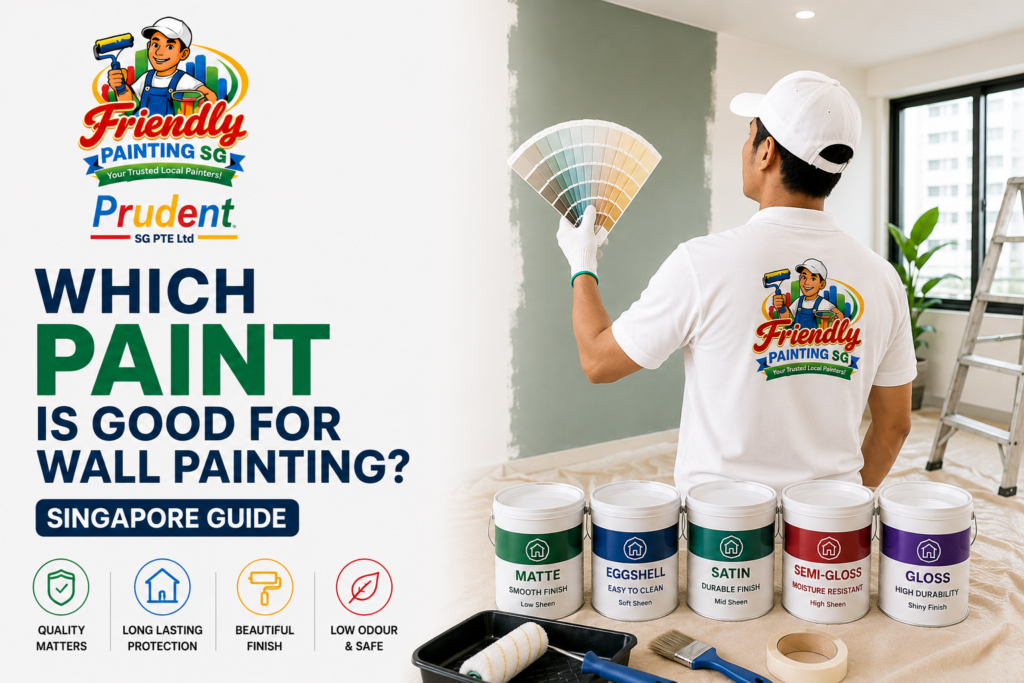
For most interior walls, a good-quality water-based acrylic emulsion paint is the most practical all-round choice. It works well on common plastered and masonry walls, dries relatively quickly, is available in low-odour and washable formulations, and can be selected in different finishes depending on the room.
However, there is no single paint type that is best for every wall.
A bedroom may need a comfortable low-odour matt paint, while a kitchen benefits more from washability and stain resistance. Bathrooms need greater resistance to humidity and mould growth, children’s rooms need easier cleaning, and exterior walls require an entirely different weather-resistant coating system.
For Singapore homes, the decision should also consider humidity, ventilation, wall condition, mould history, cleaning frequency and the existing surface.
So when asking “Which paint is good for wall painting?”, the better question is:
Which type of paint is right for this particular wall and room?
The table below gives you the answer quickly.
Best Paint Type for Different Rooms
| Room or Situation | Recommended Paint Category | Main Reason |
|---|---|---|
| Living room | Washable acrylic emulsion | Balanced appearance and maintenance |
| Bedroom | Low-odour acrylic emulsion | Comfortable for everyday living spaces |
| Children’s room | Washable, stain-resistant wall paint | Easier removal of marks and fingerprints |
| Hallway | Durable washable interior paint | Better for frequent contact |
| Kitchen | Washable, moisture-tolerant paint | Easier cleaning around everyday splashes |
| Bathroom | Moisture- and mould-resistant interior paint | Better suited to humid conditions |
| Newly plastered wall | Suitable sealer/primer + compatible topcoat | Helps prepare the fresh substrate |
| Uneven wall | Proper repair + lower-reflection wall paint | Helps reduce emphasis on minor imperfections |
| Feature wall | Decorative interior coating or suitable wall paint | Chosen according to desired visual effect |
| Exterior wall | Exterior masonry/weather-resistant paint | Designed for outdoor exposure |
The most important distinction is that paint type and paint finish are not the same thing.
First choose the right paint formulation for the wall and room. After that, choose whether you want matt, low sheen or another suitable finish.
What Type of Paint Is Best for Interior Walls?
For most normal interior walls, water-based acrylic emulsion paint is the safest starting point.
It is commonly used on surfaces such as:
- Plastered walls
- Cement-rendered walls
- Concrete masonry surfaces
- Previously painted interior walls
- Suitable plasterboard surfaces
Its popularity comes from practicality rather than one single feature.
Acrylic-emulsion wall paint can offer:
- Relatively fast drying
- Easy application
- Lower odour than many traditional solvent-based systems
- Good colour selection
- Washable options
- Matt and low-sheen finishes
- Formulations designed for humid environments
But even within the same general category, different products can be designed for very different purposes.
That is why homeowners should not choose paint based only on colour or price.
1. Standard Acrylic Emulsion Paint
Standard acrylic emulsion is suitable for many ordinary interior spaces.
It is commonly used in:
- Living rooms
- Bedrooms
- Study rooms
- Dining rooms
- General HDB interiors
- Condo interiors
For walls that are already in good condition and do not face unusually high moisture or frequent cleaning, this category is often sufficient.
The main benefit is balance.
You get an interior coating designed for wall surfaces without paying for specialist properties that the room may not need.
However, wall preparation still matters.
Even a good acrylic emulsion cannot compensate for:
- Loose plaster
- Peeling paint
- Active moisture
- Serious cracking
- Powdery surfaces
- Untreated mould
The substrate needs to be stable before the finishing paint is applied.
2. Washable Wall Paint
Washable interior paint is designed for spaces where walls are more likely to become marked.
This category can be useful in:
- Living rooms
- Hallways
- Dining areas
- Children’s bedrooms
- Family rooms
- Frequently used HDB spaces
Everyday marks can come from:
- Hands
- Furniture
- Children’s activities
- Shoes
- Bags
- Food
- General household contact
A washable formulation allows suitable marks to be cleaned more easily than they would be from a delicate conventional finish.
However, the word “washable” should not be misunderstood.
It does not mean the wall should be scrubbed aggressively with harsh chemicals.
Always follow the care instructions for the selected coating.
3. Stain-Resistant Paint
Stain-resistant wall paint goes one step further than basic washability.
It can be particularly useful where the walls are exposed to frequent contact or everyday household stains.
Typical applications include:
- Dining rooms
- Children’s rooms
- Busy corridors
- Family living spaces
- Selected kitchen wall areas
This type of coating can be a better investment than basic paint when the homeowner expects frequent cleaning.
The right choice depends on how the room is actually used.
A rarely used guest bedroom probably does not need the same cleaning performance as a home with young children.
4. Moisture- and Mould-Resistant Paint
Singapore’s humid climate makes this category especially relevant.
Bathrooms, poorly ventilated rooms and other moisture-prone spaces may benefit from wall paint formulated to resist fungal or mould growth.
Suitable areas may include:
- Bathrooms
- Kitchens
- Bedrooms with previous mould issues
- Walls near windows
- Poorly ventilated spaces
- Areas affected by condensation
However, an important distinction needs to be made:
Mould-resistant paint does not repair a moisture problem.
If mould is caused by:
- Water leakage
- Persistent condensation
- Plumbing problems
- Waterproofing failure
- Damp substrate
- Poor ventilation
the underlying issue should be addressed before repainting.
Otherwise, the wall may look clean temporarily while the original problem continues behind or beneath the coating.
5. Low-Odour or Low-VOC Interior Paint
Low-odour interior paint can be useful when the home remains occupied while painting work is being carried out.
This category is particularly worth considering for:
- Bedrooms
- Children’s rooms
- HDB flats
- Condominiums
- Home offices
- Elderly residents
- Homes where rapid return to normal use is important
Low-odour does not mean there is absolutely no smell during painting.
Ventilation is still important.
But choosing a suitable low-odour interior formulation can make the painting process more comfortable compared with traditional high-odour coatings.
6. Exterior Wall Paint
Interior wall paint and exterior wall paint should not be treated as interchangeable.
Exterior walls face conditions that indoor walls generally do not.
These include:
- Direct sunlight
- UV exposure
- Rain
- Heat
- Repeated wetting and drying
- Greater biological growth
- Outdoor pollution
Exterior masonry paint is therefore formulated differently.
A good exterior coating should be suitable for the substrate and intended outdoor conditions.
Using leftover interior paint outdoors simply because the colour matches is not a good way to save money.
The coating may not provide the durability required.
7. Decorative and Feature-Wall Paint
Some walls are chosen primarily for visual impact rather than ordinary background colour.
Feature-wall options can include:
- Contrasting solid colours
- Textured coatings
- Cement-look finishes
- Limewash-style finishes
- Colour blocking
- Painted arches
- Two-tone designs
- Special decorative effects
The right product depends on the effect being created.
Decorative coatings should still be selected according to the substrate, location and expected maintenance.
A beautiful texture applied over a cracked or unstable wall will not solve the underlying surface problem.
Preparation remains the foundation.
Which Paint Is Best for Living Room Walls?
For most living rooms, a washable acrylic emulsion is a strong choice.
Living-room walls usually need to balance appearance and durability.
The space may experience:
- Frequent family use
- Furniture contact
- Guests
- Natural light
- Air-conditioning
- Regular cleaning
A washable matt or low-sheen finish often works well because it keeps the room visually comfortable while still allowing reasonable maintenance.
For households with children or pets, stronger stain resistance may be worth considering.
Wall Painting Ideas for Living Rooms
Once the correct paint category has been selected, colour and design can be considered.
Popular approaches include:
- One deeper feature wall
- Warm neutral walls throughout
- Soft green or blue accents
- Two-tone walls
- Painted arches
- Colour-block sections
- Tone-on-tone combinations
The important point is to choose the technical paint system first and the decorative effect second.
A colour may look excellent in a photograph but still be unsuitable if the underlying product is wrong for the wall.
Which Paint Is Best for Bedroom Walls?
Bedrooms generally experience less wear than kitchens and busy corridors.
For most bedrooms, a low-odour acrylic emulsion with a matt or soft low-sheen appearance is practical.
The priorities are usually:
- Comfortable appearance
- Lower visual reflection
- Low odour
- Easy maintenance
- Good colour coverage
For children’s bedrooms, the priority changes slightly.
A washable or stain-resistant formulation may be more practical because walls are likely to receive:
- Fingerprints
- Pencil or crayon marks
- Food marks
- Furniture contact
Therefore, the best bedroom paint depends partly on who uses the bedroom.
Which Paint Is Good for Kitchen Walls?
Kitchen walls need greater cleaning performance than ordinary bedroom walls.
Cooking can introduce:
- Grease
- Steam
- Condensation
- Food splashes
- Smoke residue
- Frequent wiping
A washable and stain-resistant interior wall paint is therefore usually more suitable for general kitchen walls.
Moisture tolerance is another useful property.
However, paint should not be expected to replace an appropriate backsplash or other protective surface directly around areas exposed to heavy grease, repeated water or strong heat.
Ordinary painted walls and dedicated splash-zone materials perform different jobs.
Which Paint Is Best for Bathroom Walls?
Bathrooms should be treated differently from normal dry rooms.
A suitable bathroom wall paint should ideally be formulated for:
- Humidity
- Condensation
- Moisture exposure
- Mould resistance
But the wall itself needs to be inspected before painting.
If the bathroom has existing mould, first determine whether it is related to:
- Poor ventilation
- Leakage
- Condensation
- Damp plaster
- Waterproofing problems
Painting directly over active mould is not a proper repair.
The correct sequence is:
identify moisture → clean/treat affected area → repair substrate → prepare wall → apply suitable paint system.
Which Paint Is Best for HDB Walls?
Most HDB interior walls can be painted with a suitable acrylic-emulsion wall system.
But HDB walls can vary considerably depending on:
- Age of the flat
- Previous renovations
- Existing paint layers
- Plaster condition
- Past water damage
- Mould history
- Wall repairs
- Previous colours
A newer wall with sound paint requires a different preparation process from an older wall with chalking or flaking paint.
So instead of simply asking:
“What paint should I use for HDB?”
the first step should be:
“What condition is the HDB wall currently in?”
Paint performs best on a clean, dry, stable and properly prepared surface.
What Paint Is Best for Uneven Walls?
Paint cannot make a structurally uneven wall flat.
If the wall contains:
- Deep dents
- Poor plaster patches
- Loose plaster
- Wide cracks
- Raised repairs
- Significant waviness
surface repair should happen first.
Once the wall is properly prepared, a lower-reflection finish such as matt can make small imperfections less noticeable than a highly reflective coating.
This is because stronger sheen can highlight shadows and surface variation when light hits the wall.
But paint should never be treated as a substitute for plaster repair.
What Paint Should You Use on Cracked Walls?
Again, the first decision is not paint.
It is crack assessment.
Fine cosmetic cracking and larger recurring cracks should not automatically be treated in the same way.
Before repainting, a cracked wall may require:
- Inspection
- Opening or cleaning of the crack
- Suitable filling
- Drying
- Sanding
- Sealing or priming
- Repainting
Simply applying another layer of paint over an untreated crack may only hide it temporarily.
A useful rule is:
repair first, paint second.
Do You Need Primer Before Wall Painting?
Primer or sealer is not automatically required in exactly the same way for every repainting project.
Its necessity depends on the wall.
A suitable primer or sealer may be particularly useful for:
- Fresh plaster
- Cementitious surfaces
- Chalky walls
- Powdery surfaces
- Patched areas
- Stains
- Strong colour changes
- Areas affected by alkalinity
- Previously problematic coatings
A primer prepares the substrate.
The wall paint provides the final colour and finish.
These are different functions.
Using premium finishing paint directly over a poor substrate does not eliminate the need for proper preparation.
Can You Paint Directly Over New Plaster?
Fresh plaster should not automatically be treated as ready for finishing paint.
It may still contain moisture or remain alkaline while curing.
The correct approach depends on:
- Plaster type
- Surface moisture
- Curing condition
- Sealer specification
- Final paint system
The key point is that fresh-looking plaster is not necessarily paint-ready plaster.
Using the correct sealer and waiting until the wall meets the requirements of the coating system can help reduce problems with adhesion or finish quality.
Paint Type vs Paint Finish: What Is the Difference?
These two terms are frequently mixed together.
Paint Type
This describes the coating formulation or intended function.
Examples include:
- Acrylic emulsion
- Washable paint
- Stain-resistant paint
- Mould-resistant paint
- Exterior masonry paint
- Decorative coating
Paint Finish
This describes how reflective or visually shiny the dried surface appears.
Examples include:
- Matt
- Eggshell
- Satin
- Semi-gloss
- High gloss
So you might choose:
washable acrylic emulsion as the paint type,
and then choose:
matt or low sheen as the finish.
These are two separate decisions.
Matt or Low Sheen: Which Is Better for Walls?
For most living rooms and bedrooms, matt or low sheen will cover the majority of homeowner needs.
Matt
Matt reflects relatively little light.
It can create:
- Softer appearance
- Modern finish
- Less emphasis on minor wall imperfections
Low Sheen
Low sheen offers slightly more reflection.
It can be useful where:
- Easier cleaning is important
- The wall experiences more contact
- The homeowner wants slightly more visual brightness
Higher sheen is not automatically “better quality.”
The right finish depends on the room and wall condition.
Which Wall Paint Is Best for Singapore’s Humidity?
Singapore’s humidity means moisture-related wall problems deserve more attention than they might in a dry climate.
This does not mean every living-room wall requires specialist anti-mould paint.
It means homeowners should look more carefully at:
- Ventilation
- Condensation
- Previous mould
- Damp walls
- Bathrooms
- Kitchens
- Rooms beside exposed exterior walls
- Areas where furniture blocks airflow
For normal dry interior areas, standard quality acrylic emulsion can be perfectly suitable.
For moisture-prone spaces, consider paint categories designed for:
- Mould resistance
- Moisture tolerance
- Washability
Most importantly, solve active moisture problems before relying on paint.
Which Paint Is Good for Old Walls?
Older walls need more investigation before product selection.
Possible issues include:
- Multiple layers of old paint
- Flaking
- Chalking
- Loose plaster
- Cracks
- Old patch repairs
- Water stains
- Mould
- Surface contamination
If the existing coating is unstable, painting over it can result in the new paint failing along with the old layer underneath.
Preparation may therefore include:
scraping → sanding → cleaning → filling → sealing → repainting.
This is why wall condition can affect the painting job more than the final colour choice.
How to Choose Wall Paint in 6 Steps
A simple decision process makes wall-paint selection much easier.
Step 1: Identify the Room
Bedroom, bathroom, kitchen and exterior walls have different needs.
Step 2: Inspect the Surface
Check for cracks, mould, peeling paint, moisture and loose plaster.
Step 3: Decide the Required Performance
Do you need:
- Washability?
- Stain resistance?
- Mould resistance?
- Low odour?
- Exterior durability?
Step 4: Choose the Paint Category
Select the coating formulation that matches the room and substrate.
Step 5: Choose the Finish
Decide between matt, low sheen or another appropriate finish.
Step 6: Choose the Colour
Colour should come last.
This avoids choosing a beautiful colour in a product that does not suit the wall.
Common Mistakes When Choosing Wall Paint
Choosing Only by Colour
Colour says nothing about washability, moisture resistance or substrate compatibility.
Choosing Only by Price
A cheaper paint can become expensive if the wrong product needs repainting sooner.
Using Interior Paint Outside
Exterior walls require a coating designed for outdoor exposure.
Painting Over Mould
Treat the cause of moisture before repainting.
Ignoring Cracks
Paint is not crack repair.
Skipping Surface Preparation
Dust, loose paint and unstable plaster can affect adhesion.
Using Gloss to Hide Imperfections
Higher reflection can actually make some uneven surfaces more visible.
Assuming One Paint Works Everywhere
Bathrooms, bedrooms and exteriors do not have identical requirements.
Final Answer: Which Paint Should You Use for Your Walls?
For most Singapore interior walls, water-based acrylic emulsion is the best general starting point, but the correct category depends on where the wall is located and how it is used.
Choose:
- Standard acrylic emulsion for normal dry rooms
- Washable paint for busy living areas
- Stain-resistant paint for children’s rooms and high-contact spaces
- Moisture- and mould-resistant paint for humidity-prone areas
- Low-odour formulations for occupied interiors
- Exterior masonry paint for outside walls
- Decorative coatings where a feature finish is desired
But the paint is only one part of the result.
A cracked, damp, mouldy, powdery or badly plastered wall needs to be corrected before the finishing coat goes on.
The best wall painting result comes from getting four things right:
surface condition → preparation → paint category → finish.
For homeowners who would prefer professional assessment rather than choosing the system by trial and error, Friendly Painting SG can inspect the wall condition, recommend a suitable paint category and carry out the preparation and painting work for HDB flats, condos, landed homes and commercial spaces in Singapore.
Frequently Asked Questions About Wall Painting
1. Which paint is good for wall painting?
For most interior walls, water-based acrylic emulsion is a practical general choice. The exact formulation should then be chosen according to the room, moisture level, wall condition and cleaning requirements.
2. Which paint is best for interior walls?
Acrylic-emulsion wall paint is widely suitable for normal interiors. Washable, stain-resistant, low-odour or mould-resistant versions may be better for particular rooms.
3. Which paint is good for living room walls?
A washable acrylic emulsion in a matt or low-sheen finish is usually a strong living-room option.
4. Which paint is best for bedroom walls?
Low-odour acrylic emulsion works well for many bedrooms. Children’s rooms may benefit from a more washable or stain-resistant formulation.
5. Which paint should be used in a bathroom?
Use an interior coating specifically suitable for humid environments and preferably formulated for mould resistance. Existing moisture problems should be fixed first.
6. Which paint is suitable for kitchen walls?
Washable and stain-resistant wall paint is usually useful because kitchen walls experience more cleaning, splashes and grease than ordinary bedrooms.
7. Is acrylic emulsion good for walls?
Yes. Acrylic-emulsion paints are commonly used for interior plastered and masonry walls because they provide practical application, durability and a broad range of finishes.
8. Do walls need primer before painting?
Some do. Primer or sealer may be needed on fresh plaster, cement surfaces, repaired areas, chalky walls, stains or other problematic substrates.
9. Can paint hide uneven walls?
Paint can reduce the visual emphasis of very minor imperfections, especially in lower-sheen finishes, but significant unevenness needs proper plaster or surface repair.
10. What is the easiest wall paint to maintain?
A washable or stain-resistant interior formulation is generally easier to maintain in busy areas than a delicate basic coating.