
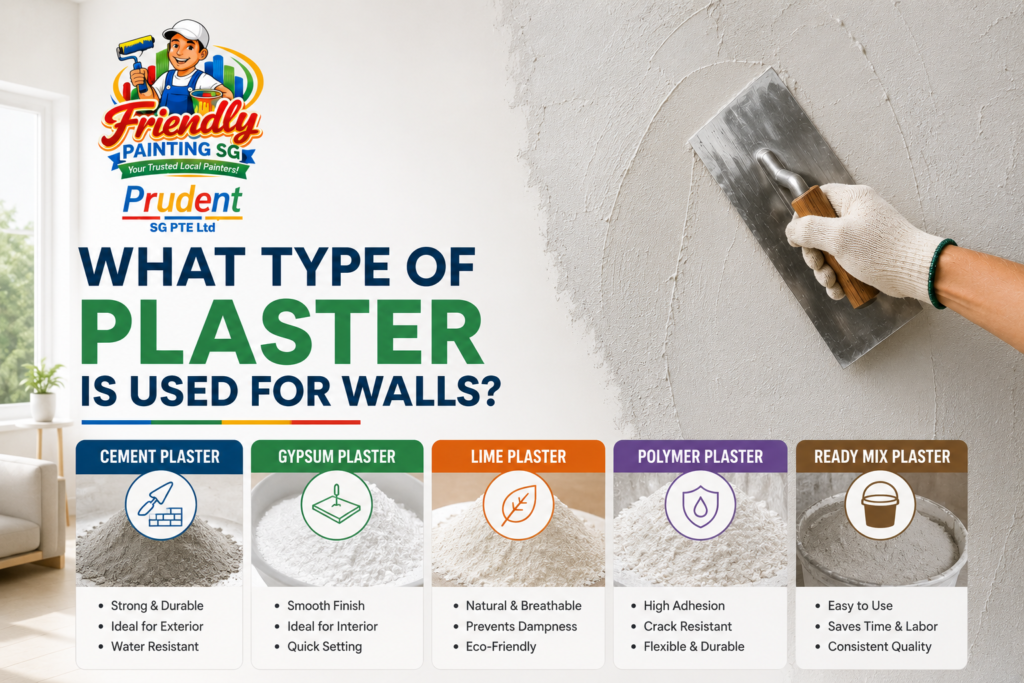
Understanding what type of plaster is used for walls is essential before repairing cracks, levelling uneven surfaces, or preparing a Singapore home for repainting. For most dry interior living spaces, a gypsum-based finish plaster or skim coat is usually the most practical option because it can create a smooth, seamless, paint-ready surface. However, cement-based plaster may be more suitable for rough masonry or moisture-exposed areas, while lime plaster can benefit compatible traditional walls that require greater vapour permeability.
The correct choice therefore depends on the wall substrate, room conditions, depth of repair, moisture exposure, and desired finish. A bedroom wall with minor unevenness does not require the same system as a damaged brick wall. Similarly, plasterboard joints need a different treatment from cracks in solid concrete.
British Gypsum describes gypsum finish plaster as a material that creates a smooth, inert, high-quality surface on internal walls and ceilings. Its product guidance also separates finishing plaster, backing plaster, plasterboard jointing products, and specialist systems according to the surface and required performance.
This guide compares the main interior plaster types, explains which plaster is best for walls in different situations, and shows how Friendly Painting Service SG can assess plaster repairs before an interior painting project.
Quick Answer: Which Plaster Is Best for Interior Walls?
For most Singapore homes, the choice can be simplified as follows:
| Wall condition or use | Usually suitable plaster system | Main reason |
|---|---|---|
| Smooth, dry interior wall | Gypsum finish plaster or skim coat | Produces a fine paint-ready finish |
| Rough brick or block wall | Cement-based or suitable backing plaster | Builds thickness and levels masonry |
| Compatible traditional masonry | Lime plaster | Supports vapour movement and traditional construction |
| Plasterboard partition | Joint compound or gypsum finishing system | Designed for board joints and fastener marks |
| High-traffic interior wall | Harder veneer or durable gypsum finish | Offers greater surface resistance |
| Decorative feature wall | Venetian or speciality decorative plaster | Creates texture and visual depth |
Therefore, gypsum plaster is generally the best all-round option for ordinary dry interior walls, while cement plaster is often more appropriate when a stronger masonry base is required.
Nevertheless, no plaster should be applied before active leakage, unstable surfaces, or serious cracking has been investigated.
What Is Interior Wall Plaster?
Interior plaster is a mineral or gypsum-based material applied to walls and ceilings to create a level, stable, and visually consistent surface.
Depending on the system, plaster can:
- Cover irregular masonry
- Fill shallow surface defects
- Create a smooth base for paint
- Strengthen selected interior surfaces
- Finish plasterboard
- Repair damaged existing plaster
- Produce decorative textures
However, plaster is only one part of the complete wall system. Surface cleaning, removal of loose materials, bonding treatment, repair depth, drying, sanding, priming, and painting all influence the final result.
What Are the Three Main Types of Wall Plaster?
People searching what are the three types of plaster are usually referring to:
- Gypsum plaster
- Cement plaster
- Lime plaster
These are the three broad material families most relevant to ordinary wall construction and repair. However, plasterboard joint compounds, veneer plaster, clay plaster, and decorative Venetian finishes are also used for more specific applications.
The three main types are not interchangeable. Each behaves differently in relation to moisture, wall movement, thickness, drying, and finishing.
1. Gypsum Plaster: Best for Smooth, Dry Interior Walls
Gypsum plaster is generally the strongest starting point when homeowners ask what type of plaster is used for walls inside bedrooms, living rooms, dining areas, corridors, or offices.
It is designed to create a fine, smooth surface that can receive primer, paint, wallpaper, or another decorative treatment. British Gypsum’s current plaster-system documentation describes products such as MultiFinish and BoardFinish as gypsum finish plasters developed to produce smooth, high-quality surfaces on interior walls and ceilings.
Why Gypsum Plaster Works Well Indoors
Gypsum plaster is popular because it offers:
- Smooth surface finishing
- Good workability
- Efficient interior application
- Fine correction of minor unevenness
- Compatibility with many paint systems
- Less coarse texture than traditional cement plaster
Moreover, selected gypsum backing and finishing systems can be used over masonry or suitable plaster bases when the manufacturer’s preparation and thickness requirements are followed.
For example, British Gypsum’s HardWall is a gypsum backing plaster intended for medium- to high-suction masonry surfaces, including bricks and aircrete blocks. This demonstrates why “gypsum plaster” should not be treated as one single product; backing and finishing products perform different jobs.
Where Gypsum Plaster Is Most Suitable
Gypsum-based finishing is commonly appropriate for:
- Dry concrete interior walls
- Existing stable plaster
- Plasterboard
- Bedrooms
- Living rooms
- Offices
- Hallways
- Selected ceiling surfaces
However, product compatibility still needs to be confirmed. A thin finish plaster cannot correct every deep depression or replace a missing masonry base.
When Gypsum May Not Be the Best Choice
Gypsum plaster is generally not the first choice for surfaces affected by:
- Active water penetration
- Persistent dampness
- Exterior weather exposure
- Unresolved plumbing leaks
- Severely unstable plaster
- Major structural movement
Applying gypsum over a damp wall may hide the problem briefly, but the finish can later soften, stain, blister, or separate. Therefore, moisture must be traced and corrected before replastering begins.
2. Cement Plaster: Best for Rough Masonry and Strong Base Repairs
Wall plaster cement generally refers to cement-based plaster or render made from cement, graded sand, water, and sometimes performance-enhancing additives.
Cement plaster is widely used over concrete, brick, and blockwork because it can build a stronger and thicker levelling layer than a light finishing skim. Therefore, it may be appropriate when the wall is substantially uneven or when damaged masonry needs a robust replacement base.
Where Cement Plaster Is Useful
Cement-based systems may suit:
- Brick walls
- Concrete blocks
- Deep damaged patches
- Rough masonry
- Utility areas
- Selected moisture-exposed walls
- Walls requiring thicker correction
- Interior surfaces connected to exterior masonry
Nevertheless, cement plaster is not automatically waterproof. If rain penetration, plumbing leakage, or failed waterproofing is causing dampness, the water source still needs to be repaired.
Advantages of Cement-Based Plaster
Cement plaster can provide:
- Strong masonry compatibility
- Greater build thickness
- A hard base
- Good resistance to everyday knocks
- Suitability for rough or irregular substrates
- Better tolerance of demanding conditions than ordinary gypsum finish plaster
However, it normally requires more time and skill to produce a very smooth painted surface. Consequently, a finer skim coat may be applied over a properly prepared and cured cement base.
Limitations of Cement Plaster
Poorly proportioned, excessively thick, or badly cured cement plaster may crack or debond.
Furthermore, a hard cement-rich repair may behave differently from the softer material surrounding it. This can become important when repairing old walls or junctions between different construction materials.
Therefore, cement plaster should be selected for a technical reason—not simply because it is perceived as stronger.
3. Lime Plaster: Best for Compatible Breathable Walls
Lime plaster is produced using lime-based binders and is commonly associated with traditional masonry, restoration work, and wall systems where vapour movement is important.
Compared with dense cement-based material, suitable lime plaster can allow moisture vapour to move through a compatible wall construction more easily. In addition, it tends to be more accommodating of small movements than rigid cement-rich finishes.
When Lime Plaster May Be Appropriate
Lime plaster can make sense for:
- Traditional brick or masonry
- Heritage-style properties
- Compatible older walls
- Natural decorative interiors
- Walls requiring a vapour-permeable finish
However, it is not automatically the best solution for a typical modern HDB bedroom or condominium living room. Its mixing, coat sequence, curing, and final decoration often require experienced application.
Lime Plaster Is Not Limewash
Lime plaster creates or repairs the wall surface itself.
Limewash, by contrast, is a decorative coating applied over a compatible surface. Therefore, homeowners asking for a textured limewash appearance may need only surface preparation and decorative painting rather than complete lime plastering.
The existing wall condition should be assessed before either treatment is selected.
4. Dry Wall Plaster: Best for Plasterboard Partitions
The phrase dry wall plaster is frequently used to describe the materials applied to gypsum plasterboard or drywall.
However, drywall finishing normally does not involve covering the entire partition with a thick traditional plaster layer. Instead, the system typically uses joint tape, jointing compound, skim plaster, or veneer plaster to create a continuous surface across the boards.
British Gypsum explains that its plasterboard jointing materials are designed to reinforce joints and produce a smooth, continuous, crack-resistant surface ready for priming and decoration.
A Typical Drywall Finishing Process
The work usually includes:
- Checking board installation
- Treating recessed joints
- Applying joint tape
- Covering screw or fastener marks
- Applying further finishing compound
- Sanding or smoothing
- Priming
- Painting
Therefore, a product intended for solid brick plastering should not automatically be applied to drywall joints.
Common Drywall Defects
Plasterboard walls may develop:
- Visible joint lines
- Screw pops
- Cracked tape
- Damaged external corners
- Torn surface paper
- Poorly blended patches
- Movement cracks
Each problem requires appropriate preparation. For example, repeatedly spreading filler over loose joint tape will not provide a dependable repair.
5. Veneer Plaster: Best for a Harder, Refined Interior Finish
Veneer plaster is a thin plaster system applied over a suitable gypsum base or another approved, properly prepared substrate.
It combines some of the speed associated with plasterboard construction with a harder, more continuous plaster surface. USG explains that veneer plaster systems can provide durable, scuff-resistant, and impact-resistant wall finishes, while certain veneer products are designed specifically for high-traffic areas.
Where Veneer Plaster Can Work Well
It may be considered for:
- High-traffic corridors
- Commercial interiors
- Offices
- Schools
- Homes requiring a harder surface
- Premium smooth-wall projects
However, veneer plaster is a complete specified system. The approved base, bonding method, thickness, mixing, and application technique must all be followed.
Therefore, it should not be treated as an ordinary filler that can be placed over any painted wall.
Gypsum, Cement, Lime and Drywall Plaster Compared
| Factor | Gypsum plaster | Cement plaster | Lime plaster | Drywall finishing |
|---|---|---|---|---|
| Primary use | Smooth interior finishing | Levelling masonry | Traditional breathable walls | Plasterboard joints and surfaces |
| Typical finish | Fine and smooth | Coarser unless skimmed | Natural and slightly softer | Smooth and seamless |
| Build thickness | Thin to moderate, product-dependent | Moderate to thick | Applied in compatible coats | Generally thin |
| Damp suitability | Limited where persistent damp exists | Better masonry tolerance, but not waterproof | Vapour-permeable when correctly specified | Product and board dependent |
| Drying or curing | Usually efficient | Normally requires longer curing | Can require controlled curing | Depends on compound or plaster |
| Skill requirement | Moderate to high | High for accurate levelling | Specialist experience helpful | Requires correct joint technique |
| Best for painting | Excellent | Good after suitable finishing | Depends on chosen coating | Excellent after priming |
Which Plaster Is Best for Concrete Interior Walls?
A smooth, dry concrete interior wall may need only a compatible skim or gypsum finishing system.
However, very smooth concrete can provide limited mechanical grip. Therefore, the manufacturer may require a bonding agent, primer, or surface preparation before plaster application.
USG’s plaster bonder is intended to improve adhesion on structurally sound interior surfaces, including concrete, drywall, gypsum plaster, stone, and cement board. Consequently, applying plaster directly over glossy paint or dense concrete without preparation can create unnecessary adhesion risk.
For deeper unevenness, the contractor may use a suitable backing or cementitious repair before applying the finer finish.
The correct sequence might therefore be:
- Stable concrete
- Surface preparation
- Bonding treatment
- Base correction where needed
- Finish plaster
- Primer
- Paint
Which Plaster Is Best for Brick or Block Walls?
Brick and concrete-block walls often require a backing plaster capable of levelling mortar joints and surface variations.
Cement-based plaster is a common solution because it provides a robust base. Nevertheless, suitable gypsum backing plasters may also be used on approved interior masonry backgrounds.
British Gypsum, for example, specifies HardWall backing plaster for masonry surfaces such as brick and aircrete blocks.
Therefore, which plaster is best for walls made from brick depends on:
- Suction of the brick
- Wall moisture
- Required thickness
- Final finish
- Product availability
- Manufacturer specifications
- Installer experience
A contractor should not begin with the finish coat before confirming how the brickwork will be prepared and levelled.
Which Plaster Is Best for Previously Painted Walls?
Plaster should not be spread automatically over existing paint.
First, the contractor needs to determine whether the coating is:
- Securely bonded
- Glossy
- Chalky
- Flaking
- Contaminated
- Moisture damaged
- Compatible with a bonding system
Loose or powdery paint must normally be removed. Meanwhile, a sound but low-absorption surface may require mechanical preparation or an approved plaster bonder.
Otherwise, the new plaster may adhere only to the old paint rather than the stable wall beneath it.
What Is a Good Wall Plaster?
When people ask what is a good wall plaster, they are often looking for a particular product name. However, a good plaster is one that matches the wall, application depth, room condition, and final finish.
A suitable system should offer:
- Reliable adhesion
- Compatibility with the substrate
- Appropriate hardness
- Sufficient working time
- Suitable drying or curing
- A finish that matches the project
- Compatibility with the chosen primer and paint
Moreover, good workmanship is equally important. Even a high-quality plaster can fail when applied over dust, dampness, unstable coating, or an incorrectly prepared base.
Therefore, product selection and preparation should be evaluated together.
Plastering vs Skim Coating
Both Plastering and skim coating are related, but they are not always the same service.
Plastering
Plastering may involve building a base layer, correcting deeper unevenness, or replacing damaged wall material.
It is commonly required when:
- Brick joints remain visible
- Large areas are hollow or loose
- The wall is substantially uneven
- Existing plaster has fallen away
- Deeper damage needs rebuilding
Skim Coating
Skim coating applies a relatively thin finishing layer to improve smoothness.
It may be sufficient when:
- Existing plaster remains stable
- The wall has shallow imperfections
- Previous repairs are visible
- A smoother paint finish is required
- Surface texture is inconsistent
Consequently, applying a thick skim coat is not the correct solution for major wall irregularities. Deeper areas should receive a suitable base repair first.
Interior Plaster and Singapore’s Humid Climate
Singapore’s climate makes moisture diagnosis particularly important. However, high outdoor humidity does not mean every interior wall requires cement plaster.
A dry, air-conditioned bedroom or living room can remain suitable for gypsum finishing. The greater concern is persistent local moisture caused by:
- Plumbing leaks
- External rain penetration
- Condensation
- Air-conditioning drainage
- Failed bathroom waterproofing
- Poor ventilation
Therefore, the wall should be inspected for dampness before plastering.
No ordinary gypsum, cement, or lime plaster can permanently correct an active leak. The moisture source must first be repaired, after which damaged materials can be removed and the wall allowed to dry appropriately.
What About Bathrooms and Wet Areas?
Ordinary finish plaster should not be treated as waterproofing.
Bathrooms, shower areas, and other wet zones may require:
- Appropriate water-resistant substrate
- Waterproofing membrane
- Correct detailing around penetrations
- Suitable tile or coating system
- Controlled drainage
Cement-based material may form part of the wall build-up, but it does not replace the specified waterproofing system.
Therefore, homeowners should not approve a proposal that simply covers a wet wall with “waterproof plaster” without identifying where the water is coming from and how the wall system will be protected.
Wall Cracks: When Is Plaster Repair Enough?
Small stable imperfections may require only local filling and plaster repair. However, the cause of a crack matters more than its appearance.
HDB explains that hairline cracks may form because adjoining materials expand and contract differently. It recommends suitable repair for minor cracks, while wider cracks should be assessed by an appropriate contractor.
Local Repair May Suit:
- Small drill holes
- Stable hairline cracks
- Minor chips
- Shallow dents
- Isolated uneven patches
Further Investigation Is Needed for:
- Wide or growing cracks
- Repeatedly reopening repairs
- Hollow plaster across large areas
- Rust staining
- Bulging walls
- Damp cracks
- Falling material
- Cracks linked to doors, beams, or structural junctions
Therefore, filling every crack with plaster without identifying its cause can produce only a temporary cosmetic result.
Warning Signs That Existing Plaster Is Failing
Damaged plaster may show several visible or audible symptoms:
- Flaking or powdering
- Hollow sounds when tapped
- Bubbling paint
- Cracks
- Swelling
- Damp stains
- Mould growth
- Soft patches
- Separation from the wall
- Falling fragments
However, different symptoms indicate different causes. Bubbling may result from moisture, whereas hollow areas can indicate debonding. Consequently, the contractor should assess the surface before recommending full replastering or local repair.
HDB Considerations Before Wall Plastering
HDB maintains renovation guidelines covering walls and wall finishes. Therefore, flat owners should confirm whether the proposed work is ordinary surface replacement or part of broader alteration, hacking, or reconstruction work.
Special care is also required around household shelters and other controlled building elements. Homeowners should not assume that every HDB surface can be hacked, drilled, built up, or modified in the same way.
Before work starts, confirm:
- Which wall is being repaired
- Whether hacking is required
- Whether the wall is part of a household shelter
- Whether moisture is involved
- Whether other regulated renovation work is included
- Which contractor will complete the work
For ordinary painting preparation, local patching or skim work may be sufficient. However, deeper construction changes should be reviewed against the latest HDB conditions.
How to Choose the Right Interior Plaster
A reliable decision should follow a clear process.
Step 1: Identify the Substrate
First, determine whether the wall is concrete, brick, block, plasterboard, or existing plaster.
Step 2: Check for Moisture
Next, investigate stains, soft areas, mould, blistering, or damp odours.
Step 3: Assess the Repair Depth
A shallow surface defect may need skim coating, whereas a missing or hollow base may require deeper plaster replacement.
Step 4: Define the Finish
Decide whether the final wall will be painted, wallpapered, tiled, or left as a decorative plaster surface.
Step 5: Select a Compatible System
The contractor should specify preparation, bonding, base plaster, finishing material, primer, and paint.
Step 6: Test a Difficult Surface
Where adhesion, colour, or texture is uncertain, a small test area can reduce risk before the entire wall is completed.
Common Interior Plastering Mistakes
Plastering Over Active Moisture
This hides the symptom without fixing the water source.
Applying New Material Over Loose Paint
The new plaster may detach together with the weak coating beneath it.
Using Finish Plaster for Deep Holes
Fine finishing products are not always suitable for thick structural correction.
Assuming Cement Plaster Is Waterproof
Cement-based plaster can still absorb water and cannot replace a proper waterproofing system.
Ignoring Manufacturer Thickness Limits
Applying a product far beyond its recommended depth can increase cracking, sagging, and drying problems.
Painting Before the Surface Is Ready
Moist or unevenly absorbent plaster can cause patchy paint, poor adhesion, or staining.
Repairing Cracks Without Checking Their Cause
Movement-related or moisture-related cracks can return after a cosmetic patch.
Preparing New Plaster for Painting
Once plastering is complete, the surface must be prepared for decoration.
A paint-ready wall should be:
- Stable
- Sufficiently dry
- Smooth
- Dust-free
- Free from loose particles
- Properly refined around repairs
- Compatible with the selected primer
USG’s preparation guidance emphasises proper treatment of gypsum plaster surfaces before painting. Nevertheless, drying and decoration timing should always follow the particular plaster manufacturer’s instructions and actual site conditions.
After preparation, a compatible primer or sealer helps control absorption and supports a more even finishing coat.
What Affects Interior Wall Plastering Costs?
Plastering costs vary because the visible wall area does not reveal the complete workload.
Important factors include:
- Wall size
- Substrate type
- Existing coating
- Damage depth
- Loose-plaster removal
- Crack repair
- Moisture damage
- Required plaster thickness
- Access
- Drying or curing time
- Skim coating
- Sanding
- Primer and painting
A small isolated patch is usually a different project from removing and rebuilding an entire wall surface.
Therefore, customers should compare quotation scopes rather than only the total amount.
What Should a Plastering Quotation Include?
A useful quotation should explain:
- Areas included
- Existing condition
- Surface removal
- Crack treatment
- Plaster type
- Base and finish coats
- Bonding agent where required
- Estimated thickness
- Drying or curing expectations
- Sanding
- Primer
- Painting
- Cleanup
- Exclusions
Moreover, unexpected work should be explained and approved before it is completed.
For example, a contractor may discover a hollow section after loose paint is removed. In that case, the customer should receive a clear explanation of the additional repair rather than an unexplained charge at the end.
Why Choose Friendly Painting Service SG?
Friendly Painting Service SG, operating through Friendly Painting SG, provides painting-related wall preparation and plastering support across Singapore.
Its published services include:
- Wall crack repair
- Plastering
- Surface preparation
- Hole filling
- Sanding
- Primer application where required
- Interior painting
- Ceiling painting
- Final site cleaning
The company describes its wall crack repair and plastering service as a solution for preparing smoother, more durable surfaces before painting.
When contacting Friendly Painting Service SG, provide:
- Property type
- Wall location
- Photographs of the damage
- Approximate affected area
- History of leakage
- Existing wall material where known
- Desired finish
- Required completion date
Consequently, the team can determine whether the wall needs minor filling, skim coating, deeper plaster repair, moisture investigation, or another specialist service.
Final Verdict: What Type of Plaster Is Used for Interior Walls?
So, what type of plaster is used for walls inside Singapore homes?
For most dry bedrooms, living rooms, offices, and corridors, gypsum finish plaster or a compatible skim system is usually the best option because it creates a smooth surface suitable for painting.
However, cement-based plaster may be better when rough brick, block, or damaged masonry needs a stronger and thicker base. Lime plaster is more relevant to compatible traditional or breathable wall systems. Meanwhile, plasterboard requires a drywall jointing or gypsum finishing system designed specifically for board construction.
Therefore, the correct choice depends on five factors:
- Wall material
- Moisture exposure
- Repair depth
- Required finish
- Product-system compatibility
Most importantly, plaster should never be used to hide active leakage, unstable material, or a serious unexplained crack.
Friendly Painting Service SG can assess wall cracks, uneven surfaces, damaged plaster, preparation, and final painting requirements before recommending the appropriate scope.
Frequently Asked Questions
1. What type of plaster is used for walls inside homes?
Gypsum plaster is commonly used on dry interior walls because it can create a smooth, paint-ready surface. However, cement plaster may be required for rough masonry or deeper base repairs.
2. Which plaster is best for walls?
Gypsum finish plaster is often best for smooth, dry interior walls. Nevertheless, the best choice depends on whether the substrate is concrete, brick, block, plasterboard, or damaged existing plaster.
3. What are the three types of plaster?
The three broad traditional categories are gypsum plaster, cement plaster, and lime plaster. In addition, drywall joint compounds, veneer plasters, and decorative systems are used for specialist applications.
4. What is a good wall plaster?
A good wall plaster is compatible with the substrate, moisture condition, required thickness, and final coating. Therefore, a well-selected system is more important than choosing a product solely by brand or perceived strength.
5. Is gypsum plaster better than wall plaster cement?
Gypsum normally provides a smoother interior finish, while cement plaster is better suited to robust masonry levelling and deeper correction. Consequently, neither is universally better.
6. What does dry wall plaster mean?
Dry wall plaster usually refers to joint compound, skim plaster, or veneer plaster used on gypsum plasterboard. It is intended to finish board joints and surfaces rather than rebuild rough brick masonry.
7. Can cement plaster stop a leaking wall?
No. Cement plaster may tolerate different conditions from gypsum, but ordinary cement plaster does not repair failed waterproofing or plumbing. The water source must be corrected first.
8. Can plaster be applied over old paint?
Only after the coating has been inspected and properly prepared. Loose, glossy, chalky, or contaminated paint may prevent adhesion, so removal or a compatible bonding treatment may be required.
9. How long should plaster dry before painting?
Drying time depends on the plaster product, thickness, ventilation, humidity, and wall condition. Therefore, follow the manufacturer’s instructions and confirm that the surface is sufficiently dry before priming.
10. Does Friendly Painting Service SG provide plastering?
Yes. Friendly Painting SG publishes wall crack repair, plastering, surface preparation, sanding, primer, and interior painting services. A site-specific assessment determines whether the wall needs local repair, skim coating, or deeper plaster replacement.