
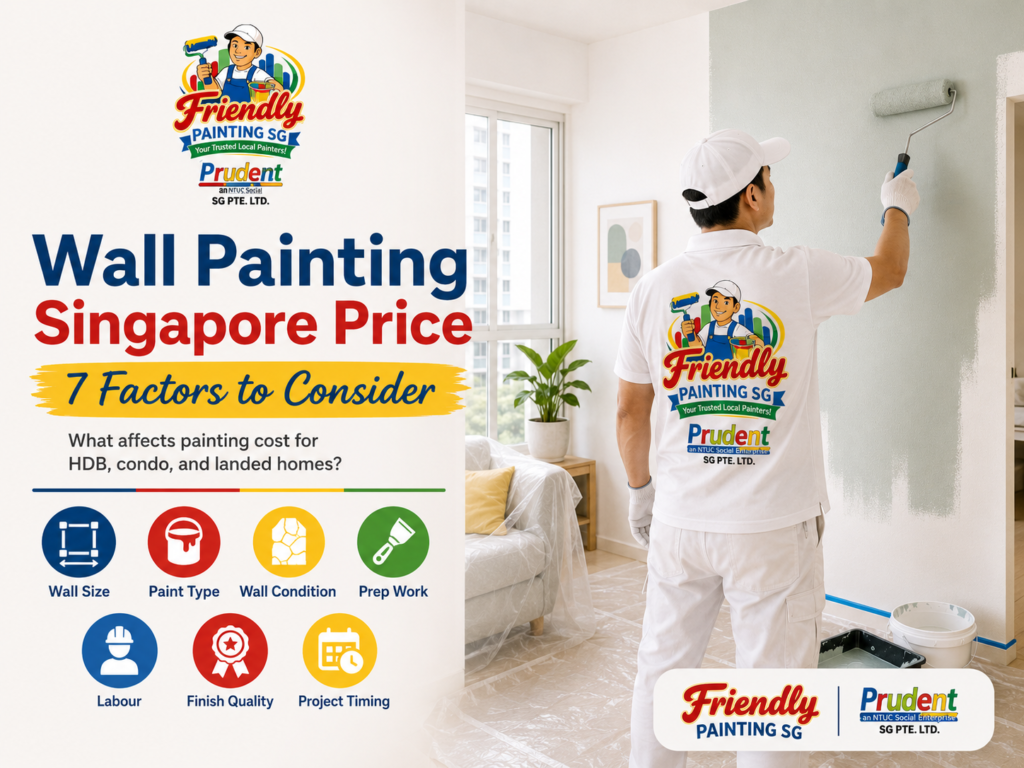
A fresh coat of paint can make an ageing HDB flat, condominium, landed house, office, or rental property feel cleaner and more inviting. However, estimating the wall painting Singapore price is not as simple as multiplying the number of rooms by a standard rate. Two properties of a similar size can receive very different quotations. For example, one home may have clean walls that need only light preparation and two coats of paint. Meanwhile, another may contain peeling surfaces, water stains, dark colours, mould marks, furniture-filled rooms, or ceilings that require repair. Consequently, the second project needs more labour, materials, and time.
Paint quality also affects the quotation. Standard interior emulsions usually serve a different purpose from premium washable, low-odour, mould-resistant, or specialised coatings. In addition, painting walls alone costs differently from a package that includes ceilings, doors, frames, gates, pipes, feature walls, and extensive surface repair.
Therefore, homeowners should not select a contractor by looking only at the lowest headline price. Instead, they should compare the complete scope, preparation process, paint range, number of coats, property protection, cleanup, timeline, and workmanship support.
This guide explains the seven main factors that influence wall-painting costs in Singapore. Moreover, it shows how to evaluate a quotation, avoid incomplete offers, and choose a service that provides dependable long-term value.
Quick Answer: What Affects Wall Painting Prices in Singapore?
The final quotation usually depends on seven main factors:
- Property size and total paintable area
- Wall condition and preparation requirements
- Paint brand, product range, and finish
- Existing colour, new colour, and number of coats
- Surfaces included in the project
- Furniture, accessibility, occupancy, and schedule
- Contractor experience, cleanup, warranty, and support
Friendly Painting SG states that its published prices are starting references and that final quotations may vary according to site condition, paint type, surface preparation, and project size. Therefore, a property-specific assessment is more reliable than a general package figure.
Understanding the Wall Painting Singapore Price
People searching for a painting services Singapore price list often expect one fixed charge for each property type. Although a list can provide a starting point, it cannot fully account for the condition and scope of an individual project.
For instance, two four-room HDB flats may have nearly identical floor areas. Nevertheless, one may be vacant and recently renovated, while the other may be occupied, heavily furnished, and covered in dark paint. The second property may require additional masking, furniture movement, surface repairs, primer, and coats.
As a result, the most accurate quotation usually combines basic property information with photographs, videos, or an on-site inspection.
A reliable quote should clearly identify:
- Rooms and areas included
- Walls, ceilings, doors, and other surfaces
- Paint brand and complete product name
- Surface-preparation work
- Primer requirements
- Number of coats
- Furniture and floor protection
- Project duration
- Cleanup and touch-ups
- Exclusions and possible additional work
However, a quotation that provides only one amount and the phrase “whole-house painting” leaves too much open to interpretation.
Factor 1: Property Size and Total Paintable Area
Property size is one of the clearest factors affecting the overall cost. Generally, a larger home has more wall area, requires more paint, and takes longer to complete.
However, floor area and paintable area are not the same thing.
A compact property with several small rooms may have more corners, doors, partitions, and detailed edges than a larger open-plan property. Consequently, the painters may spend more time cutting around frames, switches, cabinetry, and built-in fixtures.
The total paintable area can include:
- Living-room walls
- Bedroom walls
- Dining areas
- Corridors
- Storerooms
- Kitchens
- Service yards
- Stairwells
- High walls
- Ceilings
- Feature walls
Therefore, room count should be treated as a starting point rather than the only measurement.
How Layout Changes the Workload
An empty rectangular room is usually easier to paint than a room with several built-in cabinets, windows, wall-mounted televisions, decorative panels, and fixed shelving.
Moreover, every corner and obstruction requires additional cutting, masking, or careful roller work. As a result, two rooms of equal floor size may involve different labour requirements.
High ceilings also increase the workload. The team may require suitable ladders, platforms, extension tools, and more time for safe access. Consequently, double-height living rooms and staircases often need a separate site assessment.
HDB, Condo, and Landed-Property Differences
HDB flats are commonly estimated according to their property type, number of rooms, condition, and scope. Nevertheless, a standard package may not include every ceiling, door, gate, frame, or repair.
Condominium projects can involve similar interior work. However, building-management requirements may affect contractor registration, lift protection, approved working hours, parking, and material movement.
Landed houses usually contain larger wall areas, higher ceilings, staircases, exterior surfaces, gates, railings, balconies, and different building materials. Therefore, landed-property quotations are often more customised than standard apartment packages.
Factor 2: Wall Condition and Surface Preparation
Surface preparation can significantly influence the wall painting Singapore price because paint performs best on a clean, dry, stable, and properly prepared surface.
A wall that is already smooth may need only light cleaning and minor patching. However, damaged surfaces may require scraping, filling, sanding, sealing, priming, mould treatment, or plaster repair before the finishing coats can begin.
Singapore’s warm and humid conditions can support the rapid spread of mould and bacteria. Therefore, painters may encounter mould marks, damp patches, or recurring surface problems, especially in poorly ventilated or moisture-affected areas.
Common Wall Conditions That Increase Preparation
Additional preparation may be required when walls contain:
- Peeling or flaking paint
- Hairline cracks
- Deep holes
- Loose plaster
- Water stains
- Mould marks
- Grease or smoke residue
- Uneven previous repairs
- Chalky surfaces
- Adhesive residue
- Dark or glossy existing paint
However, the cause of the damage must also be considered. Fresh paint cannot permanently solve an active water leak, serious moisture penetration, unstable plaster, or structural movement.
Therefore, responsible painters should explain whether the problem is cosmetic or whether another contractor must first resolve the underlying cause.
Why Preparation Should Not Be Skipped
Poor surface preparation may create a lower initial quotation. Nevertheless, it can also lead to visible repair marks, uneven texture, weak adhesion, or early peeling.
For example, painting over loose coating does not strengthen the unstable layer underneath. Similarly, covering a water stain with ordinary finishing paint may allow the mark to reappear.
A proper process may involve:
- Inspecting the surface
- Removing unstable paint
- Cleaning dust and residue
- Filling minor cracks or holes
- Sanding repaired areas
- Applying primer or sealer where required
- Applying the finish coats
As a result, the final surface is more likely to appear even and consistent.
Minor Repairs Versus Major Repairs
Customers should confirm how the contractor defines “minor wall repair.”
Small drill holes and hairline cracks may be included in a standard preparation package. In contrast, extensive plastering, major crack repair, concrete deterioration, waterproofing, or leak correction may require separate assessment.
Therefore, the quotation should distinguish between routine preparation and additional repair work. This distinction prevents disagreements after the project begins.
Factor 3: Paint Brand, Product Range, and Finish
The paint selected for the project affects both the cost and the finished performance.
However, naming the manufacturer alone is not enough. Major brands offer several product ranges for different budgets, surfaces, and maintenance needs.
Interior paint options may include:
- Standard wall emulsion
- Low-odour paint
- Low-VOC paint
- Washable paint
- Stain-resistant paint
- Mould-resistant paint
- Premium matt paint
- Low-sheen paint
- Specialised kitchen or bathroom coating
Official product information from Singapore paint manufacturers shows that interior ranges can differ in washability, odour level, mould resistance, stain resistance, finish, coverage, and environmental certification. Consequently, two quotations using the same manufacturer may still specify products with different features and positioning.
Budget, Mid-Range, and Premium Paint
A budget-friendly paint may be appropriate for a rental unit, storeroom, temporary refresh, or property being prepared for handover. However, the customer should still confirm suitability and expected performance.
A mid-range product may provide a balance between appearance, durability, and cost. Therefore, it is commonly considered for general living rooms, bedrooms, and occupied homes.
Premium paint may offer stronger washability, lower odour, improved stain resistance, mould-related features, or specialised finishes. Nevertheless, a premium label does not eliminate the need for correct preparation and application.
The appropriate option depends on:
- How often the wall is touched
- Whether children or pets use the space
- Exposure to moisture
- Cleaning requirements
- Desired finish
- Household sensitivity to odour
- Expected repainting cycle
- Overall project budget
Matt Versus Low-Sheen Finishes
Matt paint produces limited reflection and can create a soft, contemporary appearance. Moreover, it may reduce the visibility of small surface irregularities.
Low-sheen or sheen finishes reflect more light and can offer improved washability, depending on the product. However, reflective surfaces can make dents, patching, and uneven plaster more visible.
Therefore, surface condition should influence the finish selection. A highly reflective finish may not be the best choice for a visibly uneven wall unless additional preparation is included.
Low-Odour and Low-VOC Options
Low-odour products can be helpful in occupied homes, offices, childcare-related settings, or rooms that must return to use quickly.
However, customers should review the manufacturer’s actual product information instead of relying on broad marketing terms. Some Singapore products are specifically presented as low-odour, low-VOC, washable, mould-resistant, or certified under environmental labelling schemes.
In addition, ventilation and manufacturer-recommended drying conditions should still be followed during and after painting.
Factor 4: Existing Colour, New Colour, and Number of Coats
The colour transformation can affect the amount of labour and paint required.
Changing from a light neutral shade to another similar colour may be relatively straightforward. However, changing from a dark blue, red, green, or black wall to white or another pale colour may require primer and additional coverage.
Similarly, applying a strong new colour over a light wall can require careful coating to achieve a uniform finish.
Why the Number of Coats Matters
The number of coats depends on:
- Existing wall colour
- New colour
- Surface condition
- Paint opacity
- Primer or sealer
- Product instructions
- Application method
- Required finish quality
Many interior paint systems recommend two finishing coats under the stated product conditions. However, the final requirement may change according to colour contrast and wall preparation.
Therefore, a quotation should explain the proposed paint system rather than using an unclear statement such as “paint until covered.”
Dark-to-Light Colour Changes
A major colour change often needs more preparation because the existing shade may remain visible through early coats.
For example, a dark feature wall may require:
- Cleaning
- Light sanding
- Suitable primer
- Multiple finish coats
- Additional drying time
Consequently, repainting one dark wall may cost more than refreshing several pale walls in similar condition.
Multiple Colours and Feature Walls
Using one colour throughout a property simplifies preparation and application. In contrast, several colours require additional organisation, cutting, material separation, and touch-up control.
Feature walls can also involve:
- A different paint product
- Stronger colour
- Decorative texture
- Limewash
- Geometric designs
- Detailed masking
Therefore, customers should disclose all desired colours and effects before accepting the quotation.
Factor 5: Surfaces Included in the Painting Scope
The phrase “wall painting Singapore” may refer strictly to interior walls. However, some customers expect the quotation to include ceilings, doors, frames, gates, pipes, and other surfaces.
These elements require different preparation, tools, and paint systems. Consequently, they should be listed separately.
A complete scope may include:
- Interior walls
- Ceilings
- Doors
- Door frames
- Main gate
- Window frames
- Metal railings
- Exposed pipes
- Skirting
- Storeroom
- Balcony walls
- Exterior walls
- Feature walls
Ceiling Painting
Ceiling painting requires overhead work, floor protection, careful cutting, and suitable access equipment. Moreover, ceilings may contain water stains, peeling areas, or mould marks that need additional treatment.
Therefore, customers should not assume ceiling work is automatically included in a wall-painting package.
Door and Frame Painting
Doors and frames may be made from timber, metal, laminate, or previously coated surfaces. Consequently, they may require sanding, primer, and a different paint from interior walls.
The number of doors also affects labour. Each surface includes edges, frames, hardware protection, and drying considerations.
Gate and Metal Painting
Metal gates and railings may contain rust, failing coating, or weather exposure. Therefore, the team may need to remove unstable material and use a suitable metal primer and finish.
A low-priced wall package may exclude this work entirely. For that reason, customers should request a separate description for metal surfaces.
Exterior Painting
Exterior walls face sunlight, rainfall, moisture, and weathering. As a result, they need exterior-grade materials and may require additional cleaning, access equipment, repair, and weather planning.
HDB also lists painting the external parts of a building, such as common-corridor walls and ceilings, among works that homeowners cannot independently carry out as ordinary internal flat renovation. Therefore, ownership and approval should be checked before including areas outside the private unit.
Factor 6: Furniture, Accessibility, Occupancy, and Schedule
The condition of the property during painting can change the amount of time needed.
An empty home usually gives painters direct access to walls and ceilings. Therefore, preparation and application can move more efficiently.
An occupied home may require the team to:
- Move furniture in stages
- Cover large items
- Remove and replace wall decorations
- Work room by room
- Maintain access for occupants
- Protect electronics
- Perform daily cleanup
- Coordinate around children or pets
Consequently, an occupied property may involve more labour than a vacant unit of the same size.
Furniture Protection
Professional property protection may include floor coverings, plastic sheets, drop cloths, masking tape, and wrapping around fixed items.
However, customers should remove personal valuables, documents, jewellery, medicines, artwork, fragile decorations, and sensitive electronics themselves.
The quotation should also clarify whether the painters will move large furniture and whether it will be returned to its original position afterward.
Access and Building Requirements
Condominiums and commercial buildings may impose working-hour restrictions, contractor registration, lift-protection requirements, parking procedures, or security clearance.
As a result, a project that appears technically simple may require additional logistical planning.
Meanwhile, landed properties may contain exterior areas, double-height spaces, stairwells, and sections that need specialised access.
Urgent or Weekend Projects
A standard project completed during normal working hours may follow the contractor’s regular schedule. However, urgent completion, night work, weekend access, or strict commercial handover dates can require additional coordination.
Therefore, customers should mention the required deadline before requesting the final quotation.
A cheaper offer may not provide the workforce or schedule needed to meet an urgent move-in, tenant handover, or business reopening date.
Factor 7: Contractor Experience, Cleanup, Warranty, and Support
The final factor is the level of service included around the painting itself.
Two contractors may specify similar paint products, yet provide different project management, supervision, protection, cleanup, inspection, and post-service support.
A complete wall painting service Singapore package may include:
- Consultation
- Site inspection
- Written quotation
- Colour guidance
- Surface preparation
- Property protection
- Painter supervision
- Daily organisation
- Final inspection
- Touch-ups
- Cleanup
- Workmanship support
However, the cheapest quotation may cover only labour and basic paint application.
Why Written Quotations Matter
CASE advises consumers to conduct research, insist on written agreements, and use progressive payment arrangements for renovation-related work. In addition, CaseTrust-accredited renovation businesses are required to use transparent pricing, written variation approval, service-warranty terms, and milestone-based payment practices.
Although a straightforward painting project may be smaller than a full renovation, the same principles remain useful.
A written quotation should record:
- Agreed surfaces
- Preparation
- Product range
- Number of coats
- Start and completion expectations
- Payment terms
- Cleanup
- Warranty conditions
- Additional-work approval
Consequently, both parties have a clearer reference if questions arise.
Supervision and Quality Control
Experienced painters should inspect preparation before applying the finishing coats. Furthermore, the supervisor should confirm colours, check coverage, review edges, and organise touch-ups.
Without clear supervision, different workers may produce inconsistent results across rooms.
Therefore, customers should ask who will manage the project and who they should contact during the work.
Final Cleanup
A painting project is not complete when the final roller stroke is applied.
The team should also remove masking materials, collect waste, inspect visible splashes, organise equipment, and complete agreed touch-ups.
However, cleanup expectations differ between contractors. Therefore, the quotation should state what is included instead of leaving the term “cleaning” undefined.
Workmanship Warranty
A warranty can provide reassurance, but customers should read its terms carefully.
It should explain:
- Warranty duration
- Covered workmanship problems
- Excluded conditions
- Reporting method
- Inspection procedure
- Available remedy
Nevertheless, a workmanship warranty normally cannot guarantee against new leakage, structural movement, impact damage, or moisture problems caused by conditions outside the painter’s control.
Wall Painting Singapore Price Factors at a Glance
| Factor | Why it affects the quotation |
|---|---|
| Property size | Larger paintable areas need more materials and labour |
| Wall condition | Cracks, peeling, stains, and mould require preparation |
| Paint product | Standard and premium ranges have different features |
| Colour change | Strong colour changes may need primer and more coats |
| Scope | Ceilings, doors, gates, and frames add separate work |
| Occupancy and access | Furniture, building rules, and high areas increase labour |
| Service level | Supervision, protection, cleanup, and warranty add value |
How Property Type Affects Wall Painting Costs
HDB Wall Painting
HDB painting commonly includes bedrooms, living areas, corridors, and other internal walls.
According to HDB’s current building-work guidelines, painting internal walls, ceilings, or doors does not normally require a renovation permit. However, restrictions apply to specific household-shelter components, and broader renovation work may have separate requirements.
Therefore, homeowners should confirm whether the project is limited to normal repainting or forms part of a larger renovation.
The cost may change according to:
- Flat type
- Occupancy
- Ceiling inclusion
- Number of colours
- Wall condition
- Doors and frames
- Existing furniture
- Required completion date
Condominium Wall Painting
Condo painting involves similar preparation and application. Nevertheless, building-management requirements can affect access and scheduling.
Before work begins, owners may need to confirm:
- Contractor registration
- Working hours
- Lift use
- Protection of common areas
- Parking
- Renovation deposits
- Material-delivery arrangements
Consequently, these administrative requirements should be resolved before confirming a tight timeline.
Landed-House Painting
Landed-property painting is usually assessed individually because the size, structure, and exterior requirements vary widely.
A landed-house quotation may include:
- Interior walls
- Double-height ceilings
- Staircases
- Exterior walls
- Gates
- Fences
- Railings
- Balconies
- Timber surfaces
- Metal features
As a result, a site inspection is often necessary to assess access, materials, surface condition, and safety requirements.
Office and Commercial Painting
Commercial work may need to minimise interruption to employees, customers, equipment, and normal operations.
Therefore, contractors may schedule the project:
- In phases
- After business hours
- During weekends
- Before tenant handover
- During a temporary closure
In addition, offices and shops may require faster-drying, low-odour, or washable products. The selected paint should be based on the environment and usage rather than price alone.
Should You Choose the Cheapest Painting Services in Singapore?
Searching for the cheapest painting services Singapore can help customers establish a budget. However, the lowest quotation should be evaluated carefully.
A cheaper offer may be completely suitable when:
- The walls are in good condition.
- The property is vacant.
- The scope is limited.
- Standard paint is acceptable.
- Only one colour is required.
- No major repair is needed.
- The schedule is flexible.
Nevertheless, a very low price may also exclude important work.
Possible exclusions include:
- Primer
- Surface repair
- Ceiling painting
- Door painting
- Furniture movement
- Floor protection
- Additional coats
- Premium paint
- Final cleaning
- Warranty support
Therefore, the better question is not simply, “Which contractor is cheapest?” Instead, ask, “Which quotation provides the best value for the same scope?”
How to Compare a Painting Services Singapore Price List
A price list becomes more useful when every package is compared on the same basis.
Use the following process:
1. Confirm the Property Type
State whether the project involves an HDB flat, condo, landed home, office, shop, or other property.
2. Define Every Surface
List walls, ceilings, doors, frames, gates, pipes, balconies, and exterior areas separately.
3. Describe the Existing Condition
Share clear photographs of cracks, peeling paint, stains, mould, or damaged plaster.
4. Confirm the Paint Product
Ask for the manufacturer, full product name, finish, and colour range.
5. Ask About Preparation
Confirm whether scraping, filling, sanding, primer, and mould treatment are included.
6. Clarify the Number of Coats
The quotation should explain the proposed system, particularly when the project involves strong colour changes.
7. Review Protection and Cleanup
Ask how furniture, flooring, fixtures, and built-in items will be protected.
8. Confirm Extra-Charge Procedures
Additional work should be explained and approved before it is completed.
9. Review Payment Terms
For larger projects, milestone-based payments can reduce risk and connect payments to progress. CASE specifically encourages consumers to negotiate lower deposits and progressive payments for renovation work.
10. Check Warranty Terms
Do not rely only on the word “warranty.” Ask what it covers and how a claim is handled.
Common Hidden or Overlooked Painting Costs
Not every additional charge is unfair. Sometimes deeper damage becomes visible only after unstable coating is removed.
However, the contractor should explain potential exclusions before work begins where possible.
Commonly overlooked areas include:
- Major crack repair
- Extensive plastering
- Water-damage treatment
- Mould treatment
- Stain-blocking primer
- High-access equipment
- Additional colour coats
- Door and frame preparation
- Metal rust treatment
- Exterior washing
- Urgent scheduling
- Work outside standard hours
Therefore, customers should request written approval before chargeable variations proceed.
How to Control Your Wall-Painting Budget
Reducing costs does not have to mean choosing unsuitable materials or skipping necessary preparation.
Keep the Scope Clear
Decide whether you need walls only or a complete package. Adding doors, ceilings, and gates after work begins can disrupt the schedule and budget.
Limit Unnecessary Colour Changes
Using fewer colours can reduce material separation, cutting time, and touch-up complexity.
Prepare the Property
Removing small belongings, pictures, and fragile decorations before the painters arrive can make the project more efficient.
Choose Paint According to Use
A premium washable coating may provide value in a busy living room. However, a storeroom may not require the same specification.
Address Leaks First
Repair active moisture or leakage problems before repainting. Otherwise, the new finish may fail and require additional work later.
Request a Site-Specific Quotation
Photographs may support an initial estimate. Nevertheless, damaged, large, or complex properties benefit from an on-site assessment.
Compare Like for Like
One quotation may appear higher because it includes better preparation, more surfaces, or a higher-specification paint.
Therefore, compare the full scope rather than the final figure alone.
Warning Signs in a Painting Quotation
Be careful when a quotation contains several of the following issues:
- No complete paint product name
- No description of preparation
- No list of rooms or surfaces
- No number of coats
- No written exclusions
- No project schedule
- No cleanup information
- No contact person
- Large advance payment without milestones
- Verbal promises that are absent from the quotation
Although one missing detail may be corrected through a simple question, several unclear areas can create disputes later.
Why Choose Friendly Painting SG?
Friendly Painting SG provides residential and commercial painting support for HDB flats, condominiums, landed homes, offices, and other properties across Singapore. Its published service information includes interior, exterior, ceiling, door, gate, feature-wall, and commercial painting options.
The company also explains that final pricing depends on paint selection, surface preparation, site condition, and project size. Therefore, customers can request a project-specific quotation rather than depending only on a general package amount.
When contacting Friendly Painting SG, provide:
- Property type
- Location
- Number of rooms
- Walls and surfaces included
- Photographs of current conditions
- Preferred colours
- Paint requirements
- Occupancy status
- Desired completion date
This information allows the team to determine whether photographs are sufficient or whether a site inspection is more appropriate.
Final Thoughts
The wall painting Singapore price depends on much more than the number of bedrooms.
Property size affects the quantity of paint and labour. However, wall condition can be equally important because cracks, peeling surfaces, stains, and mould require additional preparation. Moreover, the paint range, colour change, number of coats, project scope, furniture, access, and completion schedule all influence the final quotation.
The contractor’s service level also matters. Property protection, supervision, final inspection, cleanup, and workmanship support may not be visible in a headline price, yet they can significantly affect the overall experience.
Therefore, customers comparing wall painting services Singapore should request detailed written quotations and examine every inclusion. Similarly, anyone reviewing a painting services Singapore price list should treat it as an initial guide rather than a guaranteed final cost.
The cheapest quotation may suit a simple, vacant property with clean walls. Nevertheless, damaged or occupied homes usually require a more complete process.
Friendly Painting SG offers wall-painting support for different residential and commercial properties. A site-specific assessment can help determine the appropriate preparation, paint system, scope, schedule, and overall value for the project.
Frequently Asked Questions
1. What affects the wall painting Singapore price?
The main factors are property size, wall condition, paint range, colour change, number of coats, surfaces included, furniture, accessibility, timeline, and contractor service level. Therefore, two similar homes may receive different quotations.
2. Is there a standard painting-services price list in Singapore?
Many contractors publish starting packages. However, final quotations may vary according to surface condition, preparation, product selection, and scope. A site-specific quote is therefore more accurate than a general list.
3. Does an HDB painting package include ceilings?
Not always. Some packages include walls only, while others include selected ceilings. Therefore, customers should ask for every surface to be listed in writing.
4. Do painters repair cracks before painting?
Minor holes and hairline cracks may be included in routine preparation. However, deeper cracks, extensive plaster damage, concrete problems, or recurring movement may require separate assessment.
5. Does premium paint increase the painting cost?
Generally, premium products can increase material costs because they may offer specialised features such as washability, low odour, mould resistance, or stain resistance. Nevertheless, the right product should be selected according to the room’s actual requirements.
6. Why does changing from a dark colour cost more?
Dark-to-light changes may require primer and additional coats to achieve even coverage. Consequently, they can require more paint, labour, and drying time than refreshing a similar colour.
7. Is the cheapest painting service always a bad choice?
No. A budget service may be suitable for a simple property with stable walls and a limited scope. However, customers should confirm preparation, paint, coats, protection, cleanup, and exclusions before accepting the offer.
8. Do I need an HDB permit to paint internal walls?
HDB’s current guidelines state that painting internal walls, ceilings, or doors does not normally require a renovation permit. However, broader renovation activities and certain household-shelter elements have separate restrictions.
9. How can I receive a more accurate painting quotation?
Provide the property type, room count, photographs, surface condition, scope, preferred colours, occupancy status, and desired schedule. In addition, arrange a site inspection when the project includes damage, high ceilings, exterior work, or complex access.
10. Where can I request wall-painting services in Singapore?
Friendly Painting SG provides wall-painting services for HDB flats, condominiums, landed properties, offices, and commercial spaces. Customers can share their project details and request a quotation based on the actual scope and site condition.