
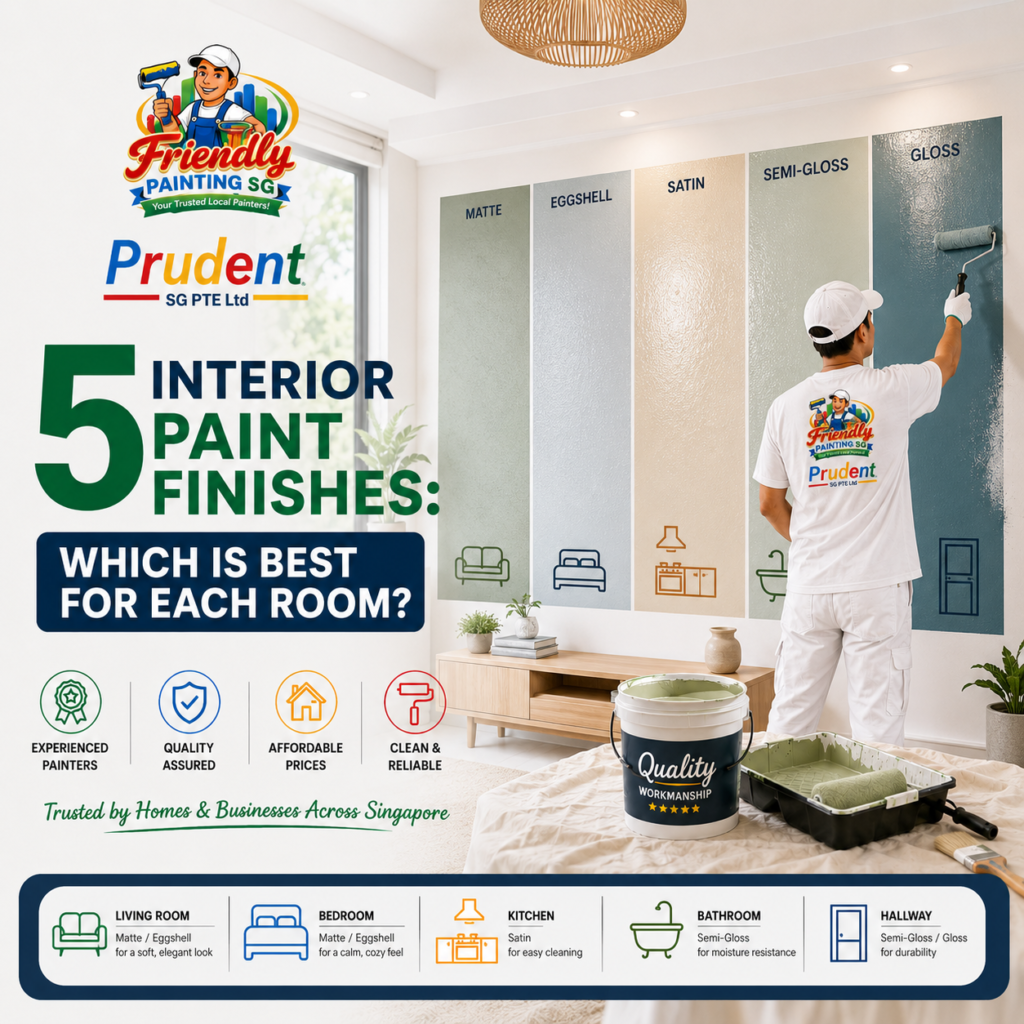
The five main interior paint finishes are matte/flat, eggshell, satin, semi-gloss, and high-gloss, arranged from least to most reflective. But choosing the right finish is not simply about shine. A matte wall may hide imperfections beautifully, while satin or semi-gloss can be easier to maintain in busy or moisture-prone areas. For Singapore homes, room use, humidity, cleaning frequency, wall condition, and natural light should all influence the decision.
So, which finish should you actually use in your bedroom, living room, kitchen, or bathroom? The table below gives you the answer in seconds.
The 5 Interior Paint Finishes at a Glance
| Paint Finish | Shine Level | Best For | Main Advantage | Watch Out For |
|---|---|---|---|---|
| Matte / Flat | Very low | Ceilings, bedrooms, low-traffic walls | Hides wall flaws well | Usually less forgiving of repeated cleaning |
| Eggshell | Low | Living rooms, dining rooms, bedrooms | Excellent balance of appearance and practicality | Touch-ups can sometimes remain visible |
| Satin | Medium | Hallways, family areas, children’s rooms | Easier to clean and more durable | Shows wall-preparation flaws more clearly |
| Semi-Gloss | High | Doors, trim, cabinets, selected kitchens and bathrooms | Durable and washable | Highlights dents and uneven surfaces |
| High-Gloss | Very high | Doors, cabinets, furniture, accents | Maximum shine and strong durability | Requires excellent surface preparation |
That is the quick comparison. However, the best finish changes from room to room.
Paint manufacturers also vary slightly in how they name sheen levels. Benjamin Moore, for example, lists flat, matte, eggshell, satin/pearl, semi-gloss, and high-gloss among its common finish categories, while Sherwin-Williams groups finishes according to reflectivity and intended application.
Why Does Paint Finish Matter?
Paint finish—or paint sheen—describes how much light reflects from a painted surface.
As a general rule:
Lower sheen = softer appearance and better concealment of minor wall imperfections.
Higher sheen = more visible reflection, stronger emphasis on the surface, and often greater resistance to cleaning and wear.
This creates an important trade-off.
Suppose one wall has minor plaster waves and old patch repairs. A flat or matte finish can make those inconsistencies less noticeable because very little light bounces back from the wall.
Now apply a high-gloss finish to the same wall. Light catches every raised or recessed area, so imperfections can appear much more obvious.
Sherwin-Williams similarly recommends flat and matte finishes when minimizing imperfections matters, while satin, semi-gloss, and gloss options are commonly used where greater durability or easier cleaning is required.
For Singapore interiors, also consider:
- How often the room is used
- Whether children frequently touch the walls
- Whether the room experiences moisture
- How much natural light enters
- Existing plaster condition
- Cleaning frequency
- Whether the surface is a wall, ceiling, door, trim, or cabinet
Now, let us compare the five finishes individually.
1. Matte or Flat Paint: Best for Soft Walls and Hiding Imperfections
What Does Flat or Matte Paint Mean?
Flat and matte paints sit at the lowest-reflectivity end of the finish scale.
Flat paint typically has almost no visible shine.
Matte paint may have a very subtle sheen depending on the manufacturer, but it still creates a soft, low-reflection appearance.
That makes these finishes particularly useful when you want the colour—not the surface reflection—to be the main visual feature.
Sherwin-Williams recommends flat finishes for applications such as adult bedrooms, formal living rooms, ceilings, and uneven or textured walls.
Where Does Matte or Flat Paint Work Best?
Good starting points include:
- Ceilings
- Adult bedrooms
- Low-traffic living areas
- Formal spaces
- Walls with minor surface imperfections
- Areas where you want a calm, modern finish
Why Is Matte Good at Hiding Wall Flaws?
Because it reflects less light.
Small defects such as minor waves, old patching, or slight texture differences do not cast obvious highlights.
However, matte paint does not repair damaged walls.
If you have peeling paint, deep cracks, failed plaster, water damage, or obvious holes, those problems should be addressed before the finish coat is applied.
Friendly Painting SG’s current service information specifically includes sanding, patching, and surface preparation before painting.
What Are the Disadvantages of Matte Paint?
The biggest concern is usually maintenance.
Traditional flat finishes may show scuffs more easily and can be harder to clean aggressively without altering the surface appearance. Sherwin-Williams also describes flat paint as more prone to visible scuffs and stains than higher-sheen options.
Modern premium matte formulations can perform much better, so always check the specifications of the actual paint product, not merely the word “matte.”
Choose Matte/Flat If:
- You want minimal shine
- Your walls have minor imperfections
- You are painting a ceiling
- The room is relatively low traffic
- You prefer a sophisticated, understated finish
Avoid Choosing It Automatically If:
- The walls require frequent wiping
- Children regularly touch the surface
- The room experiences heavy daily traffic
2. Eggshell Paint: Best All-Round Choice for Living Spaces
What Is Eggshell Paint?
Eggshell has a subtle sheen similar to the soft surface of an eggshell.
It sits between matte and satin, which is exactly why it is popular.
You gain more durability and easier maintenance than traditional flat paint without creating the noticeably reflective appearance of semi-gloss.
Benjamin Moore lists eggshell among suitable options for living rooms, dining rooms, bedrooms, and higher-traffic walls.
Where Is Eggshell Paint Best Used?
Eggshell works well in:
- Living rooms
- Dining rooms
- Bedrooms
- Home offices
- Family areas
- Moderately busy hallways
For many Singapore homes, eggshell is one of the safest starting points for general interior walls.
It provides enough sheen to feel refined without making every wall highly reflective.
Matte vs Eggshell: Which Should You Choose?
Choose matte if:
- Wall flaws are your bigger concern
- You strongly dislike visible sheen
- The room is low traffic
Choose eggshell if:
- Walls occasionally need wiping
- The room receives normal daily use
- You want a balance of appearance and practicality
For example, a rarely used guest bedroom may look excellent in matte.
A family living room where people regularly touch the walls may benefit more from eggshell.
What Are the Disadvantages of Eggshell Paint?
Because eggshell reflects more light than matte, wall preparation becomes slightly more noticeable.
Touch-ups can also be tricky.
If a small patch is repainted months later, the new section may sometimes reflect light differently from the surrounding wall due to application technique, paint ageing, texture, or the direction of the roller.
Choose Eggshell If:
You want a versatile finish that works for many ordinary interior walls.
3. Satin Paint: Best for Busy Rooms That Need Easier Cleaning
What Is Satin Paint?
Satin has more sheen than eggshell but considerably less than semi-gloss.
It produces a smooth, lightly reflective appearance and is often selected where durability and regular maintenance matter more.
Sherwin-Williams recommends satin-type finishes for areas that may experience nicks, scuffs, or heavier traffic, including hallways, children’s bedrooms, family rooms, and woodwork.
What Is Satin Paint Used For?
Typical applications include:
- Hallways
- Family rooms
- Children’s rooms
- Busy walls
- Selected kitchens
- Selected bathroom applications
- Woodwork
- Doors and trim, depending on product
Eggshell vs Satin: What Is the Difference?
The simplest comparison is:
Eggshell: softer appearance, lower shine.
Satin: slightly more reflective, generally more practical for busier surfaces.
If you have a living room where wall appearance is your main concern, eggshell may be enough.
If you have a hallway where people frequently brush against the wall, satin may be easier to maintain.
What Are the Disadvantages of Satin Paint?
Its main weakness is that surface defects become more visible.
Satin can reveal:
- Poor sanding
- Uneven filler
- Roller marks
- Plaster waves
- Previous repairs
The finish itself is not causing those problems. It is simply reflecting enough light to reveal them.
Preparation becomes increasingly important as sheen rises.
Choose Satin If:
- The room is used frequently
- Walls need regular cleaning
- You still want less shine than semi-gloss
- Practical maintenance matters
4. Semi-Gloss Paint: Best for Trim, Doors and Hard-Working Surfaces
What Is Semi-Gloss Paint?
Semi-gloss produces a clearly visible shine.
It is commonly selected for surfaces that need to handle touching, wiping, splashes, or repeated cleaning.
Sherwin-Williams identifies kitchens, bathrooms, utility areas, doors, and trim among common semi-gloss applications.
What Is Semi-Gloss Best Used For?
Semi-gloss is particularly useful on:
- Interior doors
- Door frames
- Window trim
- Skirting
- Mouldings
- Cabinets
- Selected kitchen surfaces
- Selected bathroom surfaces
It is also useful for creating visual contrast.
For example:
Wall: eggshell
Door and trim: semi-gloss
Both can be painted the same colour, yet the difference in sheen makes the trim more visually defined.
Satin vs Semi-Gloss: Which Is Better?
Neither is universally better.
Choose satin for walls when you want improved maintenance without strong reflection.
Choose semi-gloss for surfaces such as trim and doors where durability and easy cleaning are more important.
What Are the Disadvantages of Semi-Gloss Paint?
Semi-gloss can expose every weakness in the surface.
Poorly repaired walls may reveal:
- Filler edges
- Scratches
- Uneven plaster
- Brush marks
- Roller texture
Therefore, careful surface preparation matters considerably more.
Choose Semi-Gloss If:
You need a durable finish for doors, trim, cabinets, or a suitable high-use surface.
5. High-Gloss Paint: Best for Smooth Doors, Cabinets and Statement Details
What Is High-Gloss Paint?
High-gloss is the most reflective of the five main finishes.
It produces a strong polished effect and is typically reserved for areas where shine is intentional.
Sherwin-Williams recommends gloss finishes for surfaces such as wood trim, cabinets, doors, and furniture.
What Is High-Gloss Paint Used For?
Common applications include:
- Doors
- Cabinets
- Furniture
- Trim
- Architectural details
- Selected accent surfaces
Can You Use High-Gloss Paint on Walls?
Yes—but only when the effect is intentional.
A perfectly prepared feature wall can look dramatic in high-gloss paint.
However, high gloss reflects so much light that even small preparation flaws can become visible.
Before applying a very glossy finish, a wall may need:
- Filling
- Sanding
- Smoothing
- Priming
- Careful finish application
What Are the Disadvantages of High-Gloss Paint?
The biggest disadvantage is simple:
It shows everything.
A glossy finish can emphasize imperfections that were barely visible before painting.
Choose High-Gloss If:
You want a bold polished finish and the underlying surface is exceptionally smooth.
Which Paint Finish Is Best for Each Room?
This is the question that matters most when you are actually painting a home.
Living Room: Eggshell Is Usually the Safest Starting Point
For many living rooms, eggshell offers an excellent balance.
It provides:
- Low visible sheen
- Better practicality than traditional flat paint
- An attractive finish under natural light
- Good suitability for everyday living
Matte can also work beautifully when the walls are slightly imperfect or you want a softer aesthetic.
Good starting point: Eggshell
Alternative: Matte
Bedroom: Matte or Eggshell
Bedrooms generally experience less wall contact than hallways and kitchens.
Therefore:
Adult bedroom: matte or eggshell
Children’s bedroom: eggshell or satin
For children’s rooms, additional washability can be valuable.
Sherwin-Williams similarly lists matte, eggshell/satin-style finishes among suitable bedroom choices, with more durable finishes useful for children’s rooms.
Dining Room: Matte or Eggshell
Dining rooms usually benefit from a refined, low-shine finish.
Eggshell is particularly versatile because it combines a softer look with everyday practicality.
Hallway: Satin Is Often the Practical Winner
Think about what happens in a hallway:
- Hands touch the walls
- Bags brush the surface
- Furniture may pass through
- Scuffs occur more often
Therefore, increased durability matters.
Good starting point: Satin
Alternative: Eggshell if traffic is moderate
Kitchen: Choose Washability, Then the Sheen
Kitchens can expose walls to:
- Food splashes
- Grease
- Moisture
- Frequent cleaning
A washable satin-type finish may work well on suitable walls, while semi-gloss is commonly used for cabinetry, doors, and trim.
However, the specific paint formulation is more important than blindly selecting the glossiest finish.
Sherwin-Williams’ sheen guide includes satin/eggshell-type and moisture-suitable finishes among options for kitchen and bath walls, while semi-gloss remains a common choice for hard-working trim and related surfaces.
Bathroom: Do Not Choose by Sheen Alone
This is especially important for Singapore homes.
You may hear:
“Bathroom means semi-gloss.”
That is too simplistic.
Modern coatings are available in different sheen levels and may be specifically formulated for moist environments.
Sherwin-Williams explicitly advises selecting the right product for the job first, then choosing among the sheen options available for that product.
So for a bathroom, ask:
- Is the product formulated for interior moisture exposure?
- Is the surface properly prepared?
- Is ventilation adequate?
- How frequently must the wall be cleaned?
- Which sheen options does the selected product offer?
Then choose the finish.
Ceiling: Flat or Matte
For most ceilings, flat remains the classic choice.
Why?
- Minimal reflection
- Less emphasis on ceiling imperfections
- Calm visual appearance
- Keeps attention on the walls and furnishings
Sherwin-Williams’ room guide also identifies flat as a primary ceiling finish.
Doors and Trim: Semi-Gloss or High-Gloss
Doors, frames, skirting, and trim are touched frequently.
Semi-gloss offers a practical balance of durability and shine.
High-gloss can create a more dramatic, polished look when the surface preparation is excellent.
Best Interior Paint Finish by Room: Quick Decision Table
| Room / Surface | Recommended Starting Point | Why |
| Living Room | Eggshell | Balanced appearance and maintenance |
| Adult Bedroom | Matte / Eggshell | Soft, comfortable look |
| Children’s Room | Eggshell / Satin | Better for frequent contact |
| Dining Room | Eggshell | Refined low sheen |
| Hallway | Satin | Better for busy walls |
| Kitchen Walls | Washable Satin-Type Finish | Easier maintenance |
| Bathroom Walls | Moisture-Suitable Product | Formulation matters more than sheen alone |
| Ceiling | Flat / Matte | Hides minor imperfections |
| Doors | Semi-Gloss | Durable and easy to wipe |
| Trim | Semi-Gloss / Gloss | Highlights architectural detail |
| Cabinets | Semi-Gloss / Gloss | Durable polished finish |
Which Paint Finish Hides Imperfections Best?
Flat or matte paint generally hides minor wall imperfections best.
The explanation is visual rather than magical.
Low-reflection paint produces fewer highlights and shadows across bumps and dents, making them less noticeable.
However, no finish should be used as a substitute for proper wall repair.
If your wall has:
- Deep cracks
- Peeling sections
- Failed plaster
- Water damage
- Large holes
- Serious unevenness
repair it before painting.
Friendly Painting SG currently includes surface preparation within its painting workflow, including sanding and patching before paint application.
Which Paint Finish Is Easiest to Clean?
In traditional paint systems, higher-sheen finishes generally offer greater resistance to repeated cleaning.
A simple progression is:
Flat → Eggshell → Satin → Semi-Gloss → Gloss
from less reflective to more reflective.
However, modern coating technology has made this less absolute.
Sherwin-Williams notes that some premium coatings can offer strong washability and stain resistance at several sheen levels.
So instead of asking only:
“Which sheen is washable?”
ask:
“How washable is this specific paint product in the sheen I want?”
That produces a much better buying decision.
Which Finish Works Best in Singapore’s Humid Homes?
There is no single paint sheen that solves humidity by itself.
This is an important distinction.
For Singapore interiors, consider the complete system:
- Surface condition
- Moisture source
- Ventilation
- Paint formulation
- Wall preparation
- Room usage
- Sheen
- Cleaning requirements
For example, putting semi-gloss over a wall with an unresolved moisture problem does not solve the underlying moisture issue.
Similarly, matte paint is not automatically unsuitable just because Singapore is humid. The actual coating formulation and room conditions matter.
Friendly Painting SG provides painting across HDB flats, condominiums, landed properties, and commercial interiors in Singapore, and its site describes surface preparation as part of applicable painting work.
Therefore, the smarter approach is:
Choose the correct paint system for the room first, then choose the sheen.
Does Natural Light Change Which Finish You Should Choose?
Yes.
A highly reflective finish can look much shinier in a bright room with strong windows than it does in a darker room.
Natural and artificial light can also reveal:
- Roller texture
- Wall waviness
- Filler patches
- Uneven sanding
- Colour differences
Imagine a long living-room wall beside large windows.
During the day, light may travel almost parallel to the wall. That side lighting can expose surface imperfections much more strongly on satin or semi-gloss paint than on matte.
Therefore, inspect the wall under its real lighting conditions before choosing the finish.
This is particularly relevant for modern Singapore condominiums with large glazing and open-plan living rooms. Friendly Painting SG’s existing condo-colour guide similarly highlights the importance of actual room lighting when making paint decisions.
Matte vs Eggshell vs Satin vs Semi-Gloss vs High-Gloss
If you remember nothing else, remember this:
Matte / Flat
Best for: Hiding minor imperfections and minimizing shine.
Eggshell
Best for: Balanced everyday interior walls.
Satin
Best for: Busy spaces requiring easier maintenance.
Semi-Gloss
Best for: Doors, trim, cabinets, and suitable frequently cleaned surfaces.
High-Gloss
Best for: Smooth statement surfaces and maximum shine.
The further you move toward gloss, the more important surface preparation becomes.
7 Mistakes to Avoid When Choosing Interior Paint Finish
1. Choosing the Same Finish for the Whole Home
A ceiling and a kitchen cabinet do completely different jobs.
They do not need the same finish.
2. Assuming Gloss Hides Bad Walls
It usually does the opposite.
Higher reflection makes irregularities more noticeable.
3. Choosing Matte Without Considering Cleaning
Matte may look beautiful, but ask how often the wall will be touched or wiped.
4. Assuming Every Bathroom Must Be Semi-Gloss
Choose a coating formulated for the environment first.
Then select the most suitable available sheen.
5. Ignoring Natural Light
Strong side lighting can dramatically change how a finish looks.
6. Comparing Sheen Names Across Brands as If They Were Identical
Paint manufacturers do not always define eggshell, satin, pearl, and related finishes in exactly the same way. Benjamin Moore and Sherwin-Williams, for example, offer broader sheen ranges than the simplified five-finish model.
If the difference matters visually, inspect an actual sample.
7. Skipping Surface Preparation
A premium paint applied over an uneven, cracked surface can still look poor.
Before painting:
- Repair cracks
- Fill holes
- Remove loose paint
- Sand rough areas
- Clean the surface
- Prime where required
The final coat can only look as good as the surface underneath allows.
How to Choose the Right Interior Paint Finish in 5 Steps
Step 1: Identify the Surface
Are you painting:
- Wall
- Ceiling
- Door
- Trim
- Cabinet
This immediately narrows your choices.
Step 2: Ask How Busy the Area Is
A quiet adult bedroom and a narrow hallway need different levels of durability.
Step 3: Think About Cleaning
How often will the surface need wiping?
Step 4: Inspect the Wall Condition
If the wall is uneven, either improve the preparation or choose a more forgiving finish.
Step 5: Choose the Paint Product First
For demanding rooms such as bathrooms or kitchens, choose the correct paint formulation before deciding on sheen.
Then select the finish that provides the look you want.
Final Thoughts: Which Paint Finish Should You Choose?
So, what are the 5 types of paint finishes for interiors?
They are:
- Matte or flat
- Eggshell
- Satin
- Semi-gloss
- High-gloss
But simply knowing their names will not help you choose the right paint.
For most everyday living-room walls, eggshell is an excellent starting point because it balances appearance and practicality.
Choose matte or flat when you want minimal reflection or need to make minor wall imperfections less noticeable.
Move toward satin when walls face more traffic and regular cleaning.
Use semi-gloss for doors, trim, cabinets, and other suitable surfaces where durability matters.
Reserve high-gloss for very smooth surfaces where strong reflection is part of the design.
For Singapore homes, also consider humidity, ventilation, natural light, wall condition, maintenance needs, and the actual paint formulation—not sheen alone.
If you are planning to repaint an HDB flat, condominium, landed home, or commercial interior and are unsure which finish suits each surface, Friendly Painting SG can assess the wall condition and painting requirements before recommending an appropriate approach. The company provides residential and commercial painting services across Singapore.
Frequently Asked Questions
1. What are the 5 types of paint finishes for interiors?
The five commonly discussed interior paint finishes are matte/flat, eggshell, satin, semi-gloss, and high-gloss. They progress from very low reflection to a highly reflective surface.
2. What does flat matte paint mean?
Flat or matte paint creates very little visible reflection after drying. As a result, it can produce a soft appearance and make minor wall imperfections less noticeable.
3. What are the disadvantages of matte paint?
Traditional matte finishes may show marks more easily and can be less forgiving of aggressive cleaning. However, modern washable matte paints may perform differently, so always check the specific product.
4. What is eggshell in painting?
Eggshell is a low-sheen finish positioned between matte and satin. It is popular for living rooms, dining rooms, and bedrooms because it offers a good balance between visual softness and everyday durability.
5. Why can eggshell paint be difficult to touch up?
A newly painted patch can sometimes reflect light differently from the surrounding older coating due to differences in application, texture, paint age, or roller direction.
6. Is eggshell or satin better?
Eggshell is usually better when you want lower sheen and an elegant wall appearance. Satin is generally more suitable when the surface sees heavier use and easier cleaning is a priority.
7. What are the disadvantages of satin paint?
Satin reflects more light, so poor sanding, dents, filler marks, and uneven wall preparation may become more visible.
8. Is satin or semi-gloss better for kitchens?
For kitchen walls, a suitable washable satin-type coating may offer a good balance. Semi-gloss is commonly used for doors, trim, cabinets, and other hard-working surfaces. Always follow the selected product’s intended application.
9. What is high-gloss paint used for?
High-gloss paint is commonly used on smooth doors, cabinets, trim, furniture, and architectural accents where strong shine and durability are desired.
10. Which paint finish is best for Singapore homes?
There is no universal winner. Eggshell is a useful general option for living areas, matte works well for many bedrooms and ceilings, satin can suit busier walls, and semi-gloss is practical for doors and trim. In moisture-prone areas, choose a suitable coating formulation first and then select its finish.