
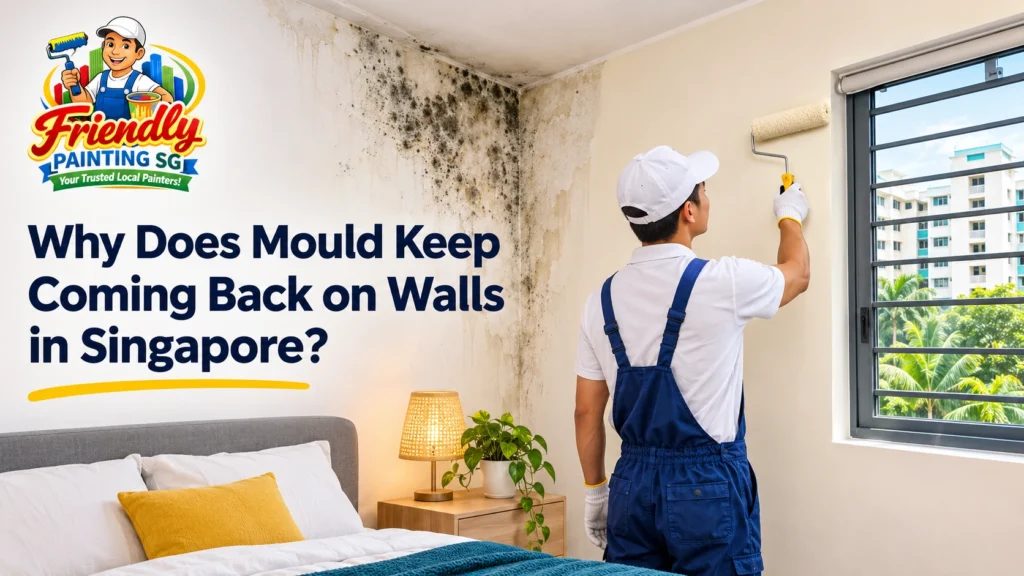
Have you ever cleaned mould from your walls, only to discover the same black or green patches appearing again a few weeks later? If so, you’re not alone. Recurring wall mould is a frustrating problem for many homeowners in Singapore, particularly those living in HDB flats, condominiums, and older residential properties.
But why does mould keep coming back on walls, even after thorough cleaning or repainting?
The main reason is usually unresolved moisture. Singapore’s humid tropical climate, inadequate ventilation, condensation, hidden water leaks, and improper wall preparation can create conditions where mould continues to grow. Although cleaning removes visible patches, the problem often returns when the underlying source of moisture remains untreated.
Fortunately, recurring mould does not always mean your walls need extensive repairs. Understanding its causes can help you choose the right treatment, prevent unnecessary repainting, and protect your home’s interior.
In this guide, we’ll explore why wall mould keeps returning in Singapore, how to identify its source, which removal methods are effective, and how proper maintenance and painting can reduce future growth.
Why Does Mould Keep Coming Back on Walls Even After Cleaning?
Cleaning visible mould may make a wall look fresh again. However, the improvement can be temporary if the conditions that encouraged mould growth have not changed.
Mould is a type of fungus that reproduces through microscopic spores. These spores are naturally present in indoor and outdoor environments. When they settle on a suitable surface with sufficient moisture, they can begin growing.
Therefore, the goal of effective mould prevention is not to eliminate every airborne spore. Instead, it is to control the conditions that allow mould to develop.
How Moisture Causes Mould to Return
Moisture is the most important factor behind recurring wall mould.
In Singapore, indoor moisture can accumulate through everyday activities, including cooking, showering, drying clothes indoors, and operating air conditioning.
Additionally, water may enter walls through damaged waterproofing, leaking pipes, or external cracks.
When a wall remains damp, mould can repeatedly develop on painted surfaces, wallpaper, plaster, or accumulated dust.
For example, imagine a bedroom wall affected by condensation every night. You clean the mould thoroughly on Monday, but the wall continues collecting moisture throughout the week.
Even if the initial cleaning was successful, new mould growth may develop because the damp conditions remain unchanged.
Why Cleaning Visible Mould Is Not Enough
One common mistake is assuming that removing visible black spots means the mould problem has been solved.
However, cleaning does not automatically correct:
- Excessive indoor humidity.
- Water seepage through external walls.
- Poor ventilation behind furniture.
- Condensation on cold surfaces.
- Moisture trapped beneath damaged paint.
- Hidden plumbing leaks.
As a result, mould can return to the same location.
The right solution depends on whether the problem involves surface condensation, water leakage, or moisture-damaged wall materials.
Hidden Moisture Behind Paint and Plaster
Paint can conceal early signs of dampness.
Sometimes, moisture becomes trapped within plaster or other porous wall materials. This can lead to bubbling paint, staining, peeling, or a persistent musty smell.
Applying another layer of paint over the affected surface may temporarily hide these symptoms.
However, if moisture continues entering the wall, the coating may eventually deteriorate again.
A professional moisture assessment may be necessary when dampness appears persistent or the source cannot be identified visually.
Mould Spores and Recurring Growth
Mould spores can settle on many indoor surfaces, including walls, ceilings, furnishings, and curtains.
Nevertheless, their presence alone does not mean mould growth will occur.
Growth requires suitable environmental conditions, especially moisture.
Consequently, regular cleaning, moisture control, and appropriate ventilation are more important than attempting to eliminate every spore from the home.
What Causes Mould to Keep Returning on Walls in Singapore?
Several factors contribute to recurring mould in Singapore homes.
In many cases, more than one cause is involved. For example, a bedroom might have high humidity, limited airflow, and a cold external wall.
Understanding these interacting conditions is essential for choosing an effective solution.
High Humidity in Singapore’s Tropical Climate
Singapore experiences warm and humid weather throughout the year.
Because the surrounding air frequently contains significant moisture, maintaining comfortable indoor humidity can be challenging.
When indoor relative humidity remains elevated for extended periods, surfaces may stay damp longer, particularly in poorly ventilated areas.
This creates favourable conditions for fungal growth.
Common locations include:
- Bedrooms with limited air circulation.
- Bathrooms without effective exhaust ventilation.
- Kitchens exposed to steam.
- Storage rooms and enclosed cabinets.
- Walls behind large wardrobes.
- Corners with little natural airflow.
A hygrometer can help homeowners monitor indoor humidity.
As a practical prevention target, many building and indoor-air recommendations favour maintaining relative humidity below 60%, ideally around 30–50% where feasible.
However, Singapore’s climate may require air conditioning, dehumidification, or other moisture-control measures to achieve consistently lower indoor humidity.
Singapore’s National Environment Agency (NEA) provides guidance on indoor ventilation and air quality, including the importance of managing humidity and reducing conditions that encourage mould growth.
Poor Ventilation and Limited Air Circulation
Poor ventilation allows moisture to accumulate.
For instance, keeping bedroom windows closed throughout the day without adequate mechanical ventilation may reduce the exchange of indoor and outdoor air.
However, simply opening windows is not always the best solution.
During particularly humid weather, bringing large amounts of untreated outdoor air indoors can increase moisture levels.
Therefore, effective ventilation should be combined with humidity management.
Useful improvements include:
- Operating suitable exhaust fans.
- Improving airflow around furniture.
- Using air conditioning appropriately.
- Running a dehumidifier when necessary.
- Avoiding prolonged moisture accumulation.
The most suitable approach depends on the room’s ventilation system, outdoor conditions, and existing humidity.
Water Leaks and Damp Walls
Water leakage is another major cause of persistent wall mould.
Unlike ordinary surface condensation, leakage can continuously supply moisture from inside or outside the building.
If the leak remains active, repeated cleaning and repainting are unlikely to deliver lasting results.
Hidden Plumbing Leaks
Concealed plumbing can make moisture problems difficult to identify.
A leaking pipe inside a wall may cause:
- Localised damp patches.
- Discoloured paint.
- Bubbling or peeling coatings.
- Unusual wall moisture.
- Recurring mould in one location.
In some cases, the affected area grows gradually.
However, not every damp patch indicates a plumbing leak. A proper inspection should distinguish water leakage from condensation and other moisture sources.
Water Seepage Through External Walls
Heavy rainfall can expose weaknesses in external walls, joints, or waterproofing systems.
If rainwater enters through damaged building components, internal finishes may become damp.
This problem can be particularly noticeable on walls facing frequent wind-driven rain.
Typical warning signs include staining after rainfall, deteriorating paint, and moisture concentrated around specific wall sections.
For persistent seepage, repairing the water-entry point is more important than simply replacing the interior paint.
Air Conditioning and Wall Condensation
Air conditioning can influence indoor mould growth in two different ways.
When properly operated, it removes moisture from indoor air and can help reduce humidity.
However, condensation may occur when humid air contacts sufficiently cold surfaces.
For example, an air-conditioned bedroom may have a wall adjoining a warmer, more humid space.
Depending on wall temperature and surrounding moisture conditions, condensation can develop.
In Singapore, condensation associated with neighbouring air-conditioned units has also been recognised as a concern in some HDB flats.
Therefore, homeowners should avoid assuming that every mould problem near an air-conditioned room is caused by a leak.
Furniture Blocking Airflow Against Walls
Large furniture can create areas with restricted ventilation.
When wardrobes, bookshelves, or storage cabinets sit directly against walls, air movement behind them becomes limited.
As a result, moisture may remain trapped for longer.
This is particularly problematic when furniture is positioned against colder external walls.
To reduce the risk:
- Leave a reasonable gap between furniture and walls.
- Avoid overcrowding enclosed rooms.
- Inspect concealed wall surfaces periodically.
- Monitor humidity inside wardrobes.
- Address any condensation problems.
These simple measures can help reduce recurring mould behind furniture.
Painting Over Mould Without Proper Treatment
Painting directly over mould is a common but ineffective shortcut.
Although fresh paint may conceal discolouration, it does not necessarily remove contamination or resolve dampness.
Furthermore, applying coatings to wet or poorly prepared surfaces can cause adhesion problems.
Before repainting, the wall should be assessed, affected materials treated or removed as appropriate, and the moisture source corrected.
Only then should suitable primers and finishing coatings be applied.
Why Is Recurring Wall Mould Common in Singapore HDB Flats and Condos?
Wall mould can affect different residential building types.
However, the underlying causes may vary according to building design, ventilation, maintenance, and how occupants use each space.
If recurring mould has damaged your flat’s interior walls, experienced HDB painting services can help restore the affected finishes after the underlying moisture issue has been addressed.
Common Mould Problems in HDB Bedrooms
HDB bedrooms can experience mould when humidity, surface temperature, and airflow create favourable conditions.
Potential problem areas include:
- External-facing bedroom walls.
- Corners behind wardrobes.
- Walls adjoining air-conditioned spaces.
- Areas near windows.
- Poorly ventilated storage spaces.
In some situations, condensation may be associated with temperature differences between adjacent rooms or residential units.
Therefore, identifying the actual moisture source is important before requesting repairs or repainting.
Mould Growth on Condo Walls and Ceilings
Condominiums can experience similar moisture problems.
Even properties with modern air-conditioning systems may develop mould if ventilation is inadequate or condensation occurs on specific surfaces.
Other contributing factors may include plumbing leaks, defective waterproofing, or moisture entering through building elements.
For condo residents, the management corporation or building management team may need to investigate problems involving shared building components.
Nevertheless, responsibility depends on the source of the defect and the property’s applicable management arrangements.
Why Mould Appears Behind Wardrobes and Furniture
Mould behind wardrobes is especially frustrating because the affected wall may remain hidden for months.
By the time occupants notice discolouration or a musty smell, the affected area may already be extensive.
Poor Air Circulation in Enclosed Spaces
Air circulation behind tightly positioned furniture is often limited.
Consequently, moisture can accumulate without evaporating efficiently.
Regular inspection and adequate spacing can reduce this problem.
Condensation on Cooler Wall Surfaces
When humid air reaches a sufficiently cold wall, water vapour may condense.
If the wall is hidden behind furniture, drying may occur slowly.
Over time, recurring condensation can support mould growth.
This is why improving airflow and controlling humidity should be considered together.
How Singapore’s Rainy Weather Affects Indoor Moisture
During rainy periods, the surrounding atmosphere can remain highly humid.
Rainwater may also expose existing weaknesses in external building surfaces.
However, rainy weather does not automatically cause mould.
Problems generally develop when moisture accumulates indoors or enters building materials and remains unresolved.
For example, a properly maintained room with effective humidity control may remain mould-free even during prolonged wet weather.
How Can You Identify the Real Cause of Recurring Wall Mould?
Identifying the moisture source is often the most important step toward preventing mould recurrence.
Although different moisture problems can produce similar-looking stains, several patterns may help narrow down the possibilities.
Signs of Condensation-Related Mould
Condensation-related mould often develops in areas with cold surfaces and limited airflow.
Possible signs include:
- Mould near external wall corners.
- Dampness during air-conditioning use.
- Growth behind wardrobes.
- Surface moisture without obvious leakage.
- Recurring spots in enclosed spaces.
However, these signs are not conclusive.
A moisture investigation may still be necessary to rule out hidden water intrusion.
Signs of Water Leakage or Seepage
Water leakage may produce more concentrated or persistent dampness.
Watch for:
- Water stains that expand after rain.
- Damp patches near plumbing.
- Peeling paint in a localised area.
- Soft or deteriorating plaster.
- Moisture that remains despite humidity control.
If these symptoms continue, a qualified contractor should investigate before further decorative work begins.
Black Spots, Musty Smells, and Peeling Paint
Visible mould can appear in different colours, including black, green, grey, and white.
However, colour alone cannot reliably identify the mould species or determine its health significance.
A musty smell may indicate microbial growth or hidden dampness.
Meanwhile, peeling paint can result from moisture, poor adhesion, ageing coatings, or other surface problems.
Therefore, homeowners should evaluate the full pattern of symptoms rather than relying on one visual clue.
How to Check Wall Moisture
Start with a simple inspection.
- Identify the affected wall.
- Check whether the problem follows rainfall or air-conditioning use.
- Look for nearby plumbing fixtures.
- Inspect adjacent walls and ceilings.
- Measure indoor relative humidity.
- Record whether the affected area changes over time.
A moisture meter can help assess dampness, although readings require proper interpretation.
Different wall materials and hidden components can influence measurements.
When to Request Professional Moisture Testing
Professional assessment may be appropriate when:
- Mould repeatedly returns after treatment.
- Dampness has no obvious source.
- Paint continues bubbling or peeling.
- A concealed leak is suspected.
- Several rooms are affected.
- Wall materials show signs of deterioration.
An experienced inspector may use moisture measurements and other diagnostic methods to identify likely causes.
However, equipment readings should be interpreted alongside building conditions and inspection findings.
How to Tell Whether Mould Is Spreading
Take photographs of the affected area at regular intervals.
Use similar lighting and angles so changes are easier to compare.
Additionally, inspect nearby corners, ceiling junctions, and concealed spaces.
An expanding patch, new affected locations, or increasing musty odour may indicate an ongoing moisture problem.
Avoid disturbing extensive mould growth unnecessarily because doing so can spread particles into the surrounding air.
How to Stop Mould from Coming Back on Walls Permanently
The most reliable way to prevent recurring mould is to eliminate or control the moisture conditions that support its growth.
Although no treatment can guarantee that mould will never return, addressing the underlying cause greatly improves long-term prevention.
Identify and Fix the Moisture Source
Begin by determining whether the problem involves:
- Condensation.
- Water leakage.
- Rainwater seepage.
- High indoor humidity.
- Inadequate ventilation.
Each problem requires a different solution.
For example, repairing a leaking pipe will not resolve condensation caused by excessive indoor humidity.
Similarly, using a dehumidifier may help control room moisture but cannot repair defective waterproofing.
Correct diagnosis prevents homeowners from investing in ineffective treatments.
Improve Ventilation and Indoor Air Circulation
Adequate ventilation helps manage moisture and improve indoor air quality.
However, ventilation strategies must account for Singapore’s humid outdoor conditions.
Useful approaches include operating bathroom exhaust fans, improving air movement around furniture, and ensuring mechanical ventilation systems function properly.
When outdoor humidity is high, air conditioning or dehumidification may be necessary to reduce indoor moisture.
Control Indoor Humidity with a Dehumidifier
A dehumidifier can be useful in rooms where humidity remains consistently elevated.
It removes moisture from the air, helping reduce conditions favourable to mould growth.
For best results:
- Choose a unit suitable for the room.
- Monitor humidity with a hygrometer.
- Empty and clean the water tank regularly.
- Maintain the device according to manufacturer instructions.
- Investigate persistent dampness rather than relying entirely on the appliance.
Remember that a dehumidifier cannot correct active water leakage or serious building defects.
Clean and Treat Mould-Affected Surfaces Safely
Small areas of surface mould may sometimes be cleaned by homeowners.
However, the appropriate method depends on the material, affected area, and occupant circumstances.
Hard, non-porous surfaces are generally easier to clean than porous materials.
Before cleaning, identify and control the moisture problem.
Avoid dry brushing, aggressive scraping, or disturbing extensive growth without suitable precautions.
When DIY Mould Cleaning Is Appropriate
DIY cleaning may be reasonable for a small, accessible area on a suitable surface when there is no indication of major water damage.
Use appropriate protective equipment, follow product instructions, and avoid mixing cleaning chemicals.
People with respiratory conditions, significant allergies, or other health vulnerabilities should be particularly cautious.
For widespread contamination or persistent water damage, professional assistance is generally more appropriate.
When Damaged Plaster or Paint Needs Replacement
Moisture-damaged building materials may require more than surface cleaning.
For example, plaster that has deteriorated, detached, or remained wet for a prolonged period may need repair or replacement.
The affected surface should be assessed before repainting.
Importantly, coating over damaged material can conceal the problem without improving its condition.
Apply Suitable Anti-Mould Primer and Paint
After correcting moisture problems and preparing the surface, appropriate anti-mould coatings may provide additional protection.
These products contain formulations intended to resist fungal growth on the paint film under specified conditions.
However, their effectiveness depends on correct application and environmental conditions.
Therefore, homeowners should consider anti-mould paint as part of an overall prevention strategy, not a substitute for moisture control.
Maintain a Regular Wall Inspection Routine
Preventive maintenance can help identify moisture problems early.
Consider checking:
- External-facing bedroom walls.
- Areas behind wardrobes.
- Bathroom ceilings.
- Walls near plumbing fixtures.
- Window corners.
- Previous mould-affected locations.
Regular inspections are particularly useful after heavy rainfall, water leakage, or changes in air-conditioning habits.
Early intervention can reduce the extent of future damage.
Can Anti-Mould Paint Prevent Mould from Returning?
Anti-mould paint can help reduce fungal growth on painted surfaces, but it cannot resolve every cause of recurring mould.
Its performance depends heavily on the condition of the wall and the surrounding environment.
How Anti-Mould Paint Works
Anti-mould paints are formulated to improve resistance to fungal growth on the coating.
Some products contain preservatives or other ingredients designed to inhibit mould development on the paint film.
However, product performance varies.
Homeowners should review manufacturer specifications, suitable applications, and preparation requirements before selecting a coating.
Anti-Mould Paint vs Regular Interior Paint
Regular interior paint mainly provides colour, surface protection, and decorative finishing.
Anti-mould paint adds a specific resistance feature intended for environments where fungal growth may be a concern.
Nevertheless, neither coating can reliably prevent mould when water continuously enters the wall.
For this reason, solving the moisture problem remains the first priority.
Why Surface Preparation Matters Before Repainting
Poor surface preparation is a frequent reason for disappointing repainting results.
Even a high-quality coating may fail if applied over contaminated, damp, unstable, or peeling surfaces.
Cleaning and Drying the Wall
Before repainting, contractors should determine whether the affected wall can be cleaned and retained or whether damaged materials require removal.
The surface must then be sufficiently dry for the chosen coating system.
Drying time varies according to wall material, moisture severity, humidity, and ventilation.
Applying Primer and Protective Coatings
A suitable primer can improve adhesion and support a consistent finish.
However, not every wall requires the same primer.
The correct product depends on the substrate, existing coating, surface condition, and manufacturer’s recommendations.
After preparation, the finishing paint should be applied according to the specified number of coats and drying intervals.
When Anti-Mould Painting Is Not Enough
Anti-mould paint alone may be insufficient when:
- Plumbing continues leaking.
- Rainwater enters through external cracks.
- Condensation repeatedly wets the wall.
- Internal humidity remains uncontrolled.
- Damaged wall materials have not been repaired.
In these situations, additional building repairs or environmental changes are necessary.
When Should You Hire a Professional for Recurring Wall Mould?
Not every mould problem requires professional remediation.
However, repeated growth, extensive contamination, or unexplained dampness should not be ignored.
A professional assessment can help distinguish cleaning problems from building defects.
Signs That Mould Requires Professional Attention
Consider seeking professional assistance when:
- Mould covers a large area.
- Growth returns repeatedly.
- The wall remains visibly damp.
- A persistent musty smell is present.
- Plaster or paint is deteriorating.
- Mould is suspected inside concealed spaces.
- Water damage involves several rooms.
Additionally, specialised assistance may be necessary when mould affects ventilation systems or follows substantial water damage.
When Water Leakage or Waterproofing Repairs Are Needed
Water leakage should be addressed before repainting.
Depending on the location, this may require plumbing repairs, waterproofing work, or investigation of shared building components.
For HDB flats, relevant HDB guidance and the circumstances of the defect should be considered.
Condominium residents may need to involve their management office when common property or shared systems are potentially affected.
How Professional Wall Preparation and Repainting Help
Once the moisture issue has been corrected, professional preparation can improve the quality and durability of the finished surface.
A suitable painting process may include:
- Inspecting the existing coating.
- Identifying damaged or unstable materials.
- Removing unsuitable paint layers.
- Treating affected surfaces appropriately.
- Allowing the substrate to dry.
- Repairing cracks or plaster defects.
- Applying suitable primer.
- Finishing with an appropriate paint system.
However, the exact process should reflect the wall’s condition.
Extensive mould contamination may require specialist remediation before decorative painting begins.
Once moisture problems have been resolved, professional interior painting services in Singapore can help restore damaged surfaces through proper preparation, priming, and repainting.
Choosing a Suitable Painting Service in Singapore
If recurring mould has damaged your interior walls, choosing an experienced painting service in Singapore can help ensure proper surface preparation and coating selection.
Before hiring, ask:
- Will the wall be inspected before painting?
- How will moisture problems be identified?
- Is mould removal included in the scope?
- What happens if the plaster is damaged?
- Which primer and finishing paint will be used?
- Are repairs and drying time included?
- What limitations apply to the proposed solution?
A trustworthy contractor should explain what painting can achieve and when plumbing, waterproofing, or specialist mould remediation is required.
For homeowners considering HDB painting services or interior painting services in Singapore, addressing the moisture source before repainting is essential.
Otherwise, even a professionally painted wall may develop mould again.
When your walls are ready for restoration, choosing reliable professional painting services in Singapore can help ensure appropriate surface preparation and suitable paint application.
Final Thoughts: Keeping Your Walls Mould-Free in Singapore
Recurring wall mould can be frustrating, especially after spending time and money on cleaning or repainting.
However, understanding the relationship between moisture, condensation, ventilation, and wall condition makes the problem easier to manage.
In Singapore, high humidity can contribute to mould growth, but the underlying cause is not always the weather.
Sometimes, the real issue is a concealed plumbing leak, poor airflow behind furniture, condensation from air-conditioning, or water entering through an external wall.
Therefore, successful prevention begins with identifying the source.
Address Moisture Problems Before Repainting
If your wall repeatedly develops mould, avoid applying another layer of paint without investigating the cause.
First, determine where the moisture originates.
Next, repair the problem and allow affected materials to dry.
Finally, prepare and repaint the surface using suitable products.
This approach gives the finished wall a much better chance of remaining in good condition.
Build Long-Term Habits to Reduce Mould Recurrence
Maintaining a mould-resistant indoor environment requires ongoing attention.
Monitor humidity, inspect concealed spaces, maintain ventilation equipment, and repair leaks promptly.
Additionally, avoid keeping large furniture tightly against damp or poorly ventilated walls.
The key takeaway is simple: recurring mould is usually a moisture-control problem, not merely a cleaning problem.
When the source of moisture is properly addressed, homeowners can significantly reduce the likelihood of mould returning and maintain healthier, better-looking interior spaces.
Frequently Asked Questions About Recurring Wall Mould
1. Why does mould keep coming back on walls after cleaning?
Mould usually returns because the conditions supporting its growth remain unchanged. High humidity, condensation, inadequate ventilation, or hidden leaks can keep a wall damp after cleaning. Removing visible mould without correcting the moisture source may provide only temporary results.
2. Can mould return after repainting a wall?
Yes. Mould can return after repainting if the surface remains damp or contaminated. Painting over existing mould, damaged plaster, or unresolved water leakage may result in further problems. Proper moisture control and surface preparation are essential before applying new paint.
3. Does air conditioning cause mould on walls in Singapore?
Air conditioning does not automatically cause mould. In fact, properly functioning air conditioners can help reduce indoor humidity. However, condensation may develop when humid air contacts sufficiently cold walls. Poor drainage or maintenance problems can also contribute to moisture accumulation.
4. Is recurring wall mould common in HDB flats?
Recurring wall mould is a recognised problem in some HDB flats, particularly where moisture, condensation, or poor ventilation occurs. External walls, bedroom corners, and areas behind furniture may be affected. However, the exact cause varies between properties and should be investigated individually.
5. Can a dehumidifier stop mould from coming back?
A dehumidifier can reduce indoor humidity and help prevent mould growth associated with excessive airborne moisture. However, it cannot repair leaking pipes, damaged waterproofing, or ongoing water seepage. It is most effective when combined with appropriate ventilation and moisture-source control.
6. Does anti-mould paint permanently prevent mould?
No. Anti-mould paint can improve resistance to fungal growth on the coating, but it does not guarantee permanent protection. Persistent condensation, high humidity, or water leakage can still create conditions for mould. Correcting these problems before painting is essential.
7. How do I know if wall mould is caused by a water leak?
Possible signs include persistent damp patches, staining that worsens after rainfall, bubbling paint, and moisture concentrated near pipes or wet areas. However, condensation can produce similar symptoms. A professional inspection may be needed to confirm the source.
8. Should I remove mould before repainting?
Yes. Mould-affected surfaces should be properly assessed and treated before repainting. Depending on the extent of contamination and material damage, cleaning or replacement may be necessary. The wall should also be sufficiently dry, and the underlying moisture issue must be corrected.
9. When should I call a professional for wall mould?
Professional help is advisable when mould covers a large area, repeatedly returns, affects damaged building materials, or appears alongside unexplained dampness. A qualified specialist can investigate moisture sources and recommend suitable treatment or repairs.
10. How can I prevent mould during Singapore’s rainy season?
Monitor indoor humidity, maintain effective ventilation, use dehumidification when necessary, inspect walls for water intrusion, and repair leaks promptly. Keep furniture slightly away from vulnerable walls and check moisture-prone areas regularly. Preventing prolonged dampness is the most important step.