
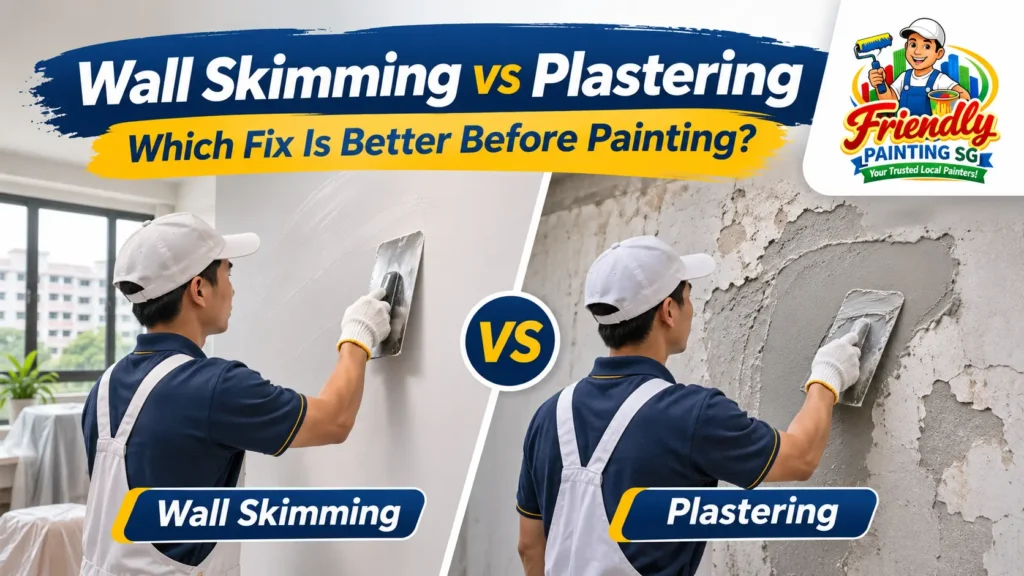
Wall skimming vs plastering is an important comparison for Singapore homeowners who want smooth, durable, and attractive walls before painting. Whether you are renovating an HDB flat, refreshing a condominium, or repairing damaged walls in a landed property, choosing the right surface preparation method can significantly affect the final painting results.
Although wall skimming and plastering are closely related, they serve different purposes. Skim coating generally involves applying a thin finishing layer to smooth minor surface imperfections, while plastering can repair deeper damage, restore uneven surfaces, and provide a suitable base for further finishing.
The simple answer is that wall skimming is usually better for sound walls with minor imperfections, while plastering is more appropriate when the underlying surface is damaged, rough, or significantly uneven. Some walls benefit from both methods.
However, choosing between them is not always straightforward. Factors such as existing plaster condition, cracks, moisture exposure, wall material, and the desired paint finish must be considered.
In Singapore, where humidity can affect drying conditions and wall finishes, proper preparation becomes particularly important.
This guide explains the differences between wall skimming and plastering, their advantages, application processes, cost factors, and suitability for different Singapore homes. It also helps you determine which method your walls need before investing in a fresh coat of paint.
Wall Skimming vs Plastering: What Is the Main Difference?
The primary difference between wall skimming and plastering lies in their purpose, application thickness, and the condition of the wall being treated.
Wall skimming focuses on creating a smooth finishing surface. Plastering is often used to build up, level, or repair the underlying wall surface.
However, the terminology can overlap because a skim coat is itself a type of thin plaster or finishing treatment.
What Is Wall Skimming?
Wall skimming, also called skim coating, is the process of applying a thin layer of suitable finishing compound over an existing wall.
Its purpose is to smooth minor surface irregularities and create a more uniform foundation for painting.
Skim coating is commonly considered when a wall has:
- Minor scratches or shallow dents
- Small surface imperfections
- Uneven patches from previous repairs
- Rough finishing marks
- Minor differences in surface texture
- Visible imperfections under strong lighting
A skim coat does not automatically repair deeper damage or improve the structural condition of a wall.
How a Thin Skim Coat Smooths Wall Surfaces
A suitable skim coat compound is spread evenly over a prepared substrate using a trowel or finishing tool.
The application helps fill shallow irregularities and create a consistent surface.
Depending on the product, multiple thin layers may be required.
After the material dries or cures, the wall is prepared for primer and paint.
When Skim Coating Is Suitable Before Painting
Skimming is generally suitable when the underlying wall is stable, reasonably level, and free from active moisture problems.
For example, an HDB living room wall with small patching marks may benefit from skim coating before repainting.
However, a wall with loose plaster or significant unevenness requires additional repairs first.
What Is Wall Plastering?
Wall plastering involves applying suitable plastering material to build up or restore a wall surface.
It can help correct uneven substrates, replace damaged plaster, or prepare masonry surfaces for decorative finishing.
The material and application method depend on the wall type, required thickness, and intended use.
How Plastering Repairs and Levels Uneven Walls
Plastering can fill deeper depressions and improve the flatness of suitable wall substrates.
Where existing plaster has deteriorated, damaged sections may need removal before replacement material is applied.
After the repaired surface becomes stable and sufficiently dry, additional finishing may be necessary.
When Full Plastering Is Necessary
Plastering may be appropriate when:
- Existing plaster is loose or damaged.
- Wall surfaces have significant depressions.
- Previous repairs have left uneven areas.
- Bare masonry requires a suitable finishing layer.
- The wall needs more substantial restoration.
The exact scope should be determined through inspection rather than appearance alone.
Wall Skimming vs Plastering: Key Differences at a Glance
| Comparison Factor | Wall Skimming | Wall Plastering |
|---|---|---|
| Main purpose | Smooth minor imperfections | Repair or level wall substrates |
| Application | Thin finishing layer | Usually thicker base or repair layer |
| Best for | Sound, relatively even walls | Rough, damaged, or uneven walls |
| Deep defects | Usually unsuitable alone | Can address suitable deeper defects |
| Final finish | Fine, smooth surface | May require additional finishing |
| Materials | Skim coat compounds | Cement-based, gypsum-based, or compatible plaster |
| Labour requirements | Often less extensive | May involve greater preparation and application |
| Before painting | Drying, preparation, and primer | Drying or curing, finishing, and primer |
Which Method Should You Choose Before Painting?
The correct choice depends on what needs fixing.
If the wall is sound but looks slightly uneven, skim coating may provide the desired finish.
If the underlying plaster is damaged, plaster repair should come first.
For walls with deeper defects and minor surface imperfections, combining plastering with a final skim coat may produce better results.
How to Tell Whether Your Walls Need Skimming or Plastering
Before selecting a repair method, inspect the existing wall condition.
This helps avoid unnecessary work and ensures that the treatment addresses the actual problem.
Minor Surface Imperfections and Uneven Paint Finishes
Small dents, patching marks, and uneven texture usually affect the surface rather than the underlying wall structure.
If the plaster remains sound, local filling or skim coating may be sufficient.
However, a complete skim coat may be unnecessary when only a few minor defects are present.
Deep Cracks, Holes, and Damaged Plaster
Deep cracks and holes require more careful assessment.
A thin skim coat cannot reliably restore missing plaster or correct significant substrate defects.
Appropriate filling, plaster repair, or specialist assessment may be necessary.
Cracks that widen, recur, or appear with wall deformation should be investigated before cosmetic treatment.
Rough or Uneven Wall Surfaces
The difference between roughness and unevenness matters.
A wall can feel rough while remaining reasonably flat.
Such a wall may benefit from skim coating.
However, a wall with noticeable depressions or changes in level may require more substantial preparation.
Peeling Paint and Loose Wall Finishes
Skim coating directly over unstable paint can cause adhesion problems.
The loose coating should be removed, and the substrate assessed before further treatment.
Applying new materials over an unstable surface may result in peeling or cracking.
Hollow-Sounding or Deteriorating Plaster
A hollow sound when a wall is lightly tapped may suggest poor adhesion or separation within the plaster system.
However, sound alone is not a definitive diagnosis.
A contractor should assess whether the existing material remains suitable for further finishing.
Loose plaster may require removal and replacement.
Damp Walls and Water-Damaged Surfaces
Moisture is particularly important in Singapore’s humid environment.
A wall affected by water seepage should not be skimmed or replastered until the underlying issue has been addressed.
Otherwise, the new finish may deteriorate.
Quick Decision Guide: Skim Coat, Plaster, or Simple Patching?
| Wall Condition | Most Suitable Starting Approach |
|---|---|
| Small isolated dent | Local filling |
| Sound wall with uneven texture | Skim coating |
| Deep depression | Suitable plaster repair or levelling |
| Loose or deteriorating plaster | Remove and replace damaged material |
| Previously repaired wall with visible patch marks | Skim coating after assessment |
| Damp wall | Resolve moisture problem first |
| Widening structural crack | Qualified assessment before repair |
How Does Wall Skimming Work Before Painting?
Proper skim coating involves preparation, careful application, and adequate drying.
Skipping any stage may affect the appearance or performance of the final paint.
Step 1: Inspect the Existing Wall Condition
The first step is to identify surface defects and assess whether the substrate is stable.
Look for peeling paint, loose plaster, cracks, water staining, and unevenness.
The inspection determines whether skim coating alone is appropriate.
Step 2: Clean and Prepare the Wall Surface
Remove loose dust, grease, and unsuitable coatings.
Depending on the substrate and skim coat system, additional preparation or a compatible bonding treatment may be required.
A clean, stable surface improves the likelihood of proper adhesion.
Step 3: Apply a Suitable Skim Coat Compound
Select a product that matches the wall material and intended environment.
Choosing Between Cement-Based and Gypsum-Based Skim Coats
Cement-based skim coats may be appropriate for compatible cementitious substrates and certain moisture-prone conditions.
Gypsum-based finishing compounds are commonly used on suitable dry interior surfaces.
However, compatibility must be confirmed through the manufacturer’s technical instructions.
Neither material should be selected solely because it is commonly used.
Applying Thin, Even Layers
Skim coating should follow the specified thickness limits.
Applying excessive material in one layer may contribute to cracking, poor adhesion, or uneven drying.
A professional may use additional coats where the selected system allows.
Step 4: Allow the Skim Coat to Dry and Cure
Drying and curing requirements vary by product.
Temperature, ventilation, humidity, and application thickness can affect the process.
In Singapore, consistently humid indoor conditions may slow drying.
Follow the product manufacturer’s requirements instead of assuming that every skim coat becomes paint-ready after the same number of hours.
Step 5: Smooth the Finished Surface Where Required
Some finishing compounds require sanding after drying, while others are finished using specific trowelling techniques.
The objective is to achieve a consistent surface without damaging the new layer.
Remove sanding dust before applying primer.
Step 6: Apply Primer Before Painting
Freshly skimmed surfaces may absorb paint unevenly.
A suitable primer or sealer helps prepare the surface for the finishing coats.
The selected system should be compatible with the skim coat and wall paint.
Common Skim Coating Mistakes That Affect Paint Quality
Common mistakes include applying the compound over loose paint, exceeding the recommended thickness, using unsuitable materials, and painting before the surface is ready.
Inadequate cleaning can also interfere with adhesion.
Therefore, preparation is just as important as the final application.
How Does Wall Plastering Work Before Painting?
Plastering generally involves more substantial surface restoration than ordinary skimming.
The process depends on the wall’s construction and condition.
Step 1: Assess Cracks, Unevenness, and Existing Plaster
Before plastering, determine whether the existing surface is suitable for repair.
Check for deteriorating materials, deep depressions, cracks, and moisture damage.
Suspicious structural defects should be assessed separately.
Step 2: Remove Loose or Damaged Wall Materials
Unstable plaster should not be covered with a new layer.
Where necessary, damaged material is carefully removed to expose a suitable substrate.
The removal method should avoid unnecessary damage to the wall.
Step 3: Prepare the Substrate for Proper Adhesion
The exposed surface may require cleaning, controlled moisture preparation, or an approved bonding system.
The exact requirements depend on the plaster and substrate.
Step 4: Apply the Appropriate Plastering Material
Cement Plastering for Suitable Masonry Surfaces
Cement-based plaster is commonly used on compatible masonry or cementitious surfaces.
It can provide a robust base layer when applied correctly.
However, the mix, application thickness, and curing method must suit the intended use.
Gypsum Plastering for Compatible Interior Walls
Gypsum-based plaster can produce smooth interior surfaces when used on suitable substrates.
It is generally associated with dry interior applications rather than areas exposed to persistent moisture.
Step 5: Level the Wall and Repair Surface Defects
The plaster is applied and levelled using suitable tools.
Depending on the intended finish, further smoothing or skim coating may be necessary.
When walls have deep cracks, uneven surfaces, or deteriorating plaster, applying a thin skim coat may not provide a lasting solution. The underlying damage should be assessed and repaired before the final surface treatment. Professional wall crack repair and plastering services can help restore suitable damaged wall surfaces, improve surface uniformity, and prepare them for painting.
Step 6: Allow Proper Drying and Curing
Fresh plaster must reach the required condition before painting.
Thicker applications generally need more time than thin surface treatments, although material chemistry also matters.
Rushing this stage can lead to coating failures.
Step 7: Prepare the Plastered Wall for Painting
After the plaster is ready, complete the necessary finishing, cleaning, and priming.
A consistent substrate supports more even paint coverage.
Wall Skimming vs Plastering: Which Gives a Better Paint Finish?
Neither method automatically produces a superior result in every situation.
The best paint finish comes from using the treatment that matches the wall’s actual condition.
Surface Smoothness and Final Appearance
A skim coat is specifically intended to produce a fine finishing surface.
Therefore, it can be valuable when smoothness is the main objective.
Plastering, meanwhile, may be necessary to establish a sufficiently level and stable base.
How Each Method Handles Uneven Walls
Skimming can correct shallow imperfections within the product’s specified thickness.
It cannot reliably compensate for significant wall unevenness.
Plastering or a suitable levelling system may be needed first.
Paint Adhesion and Surface Preparation
Paint adhesion depends on substrate stability, cleanliness, moisture condition, and compatibility.
A smooth wall is not necessarily a well-prepared wall.
For example, skim coating applied over loose paint may appear attractive initially but fail later.
A smooth wall does not automatically guarantee a durable paint finish. Proper surface preparation, compatible primer, and suitable paint application are equally important. After completing the necessary skimming or plastering work, professional interior painting services in Singapore can help achieve a consistent finish on properly prepared interior walls.
Durability and Resistance to Future Surface Defects
Durability depends on the complete wall system, not simply whether skimming or plastering was used.
Proper preparation, material selection, curing, and moisture control all contribute.
How Lighting Makes Wall Imperfections More Visible
Strong side lighting can reveal subtle surface waves, scratches, and patching marks.
This is especially noticeable on large feature walls or surfaces with glossy finishes.
For homeowners planning decorative lighting, more detailed surface preparation may be worthwhile.
Can You Combine Plastering and Skim Coating?
Yes. The two methods can complement each other.
For example, a damaged wall may first need local plaster restoration to correct deeper defects.
After the repaired material has cured, a suitable skim coat can create a more uniform finishing surface.
The wall can then be primed and painted.
Wall Skimming vs Plastering for HDB Flats in Singapore
HDB properties have specific renovation requirements, so homeowners should consider both technical suitability and applicable regulations.
Common Wall Conditions in Older HDB Flats
Older flats may have layers of previous paint, repair patches, plaster cracking, or damaged finishes.
However, property age alone does not determine whether skimming or plastering is necessary.
The existing surface condition remains the deciding factor.
Do New BTO Walls Need Skim Coating Before Painting?
Not every new BTO wall requires skim coating.
If the supplied wall surface is sufficiently smooth, stable, and suitable for painting, additional skimming may be unnecessary.
However, visible imperfections or specific finish requirements may justify further preparation.
When Resale HDB Walls May Require Replastering
Resale flats sometimes contain older repairs, damaged plaster, or substantial surface unevenness.
Where the underlying material has deteriorated, replastering may be necessary before painting.
A full-wall treatment should be recommended only when the condition warrants it.
Choosing the Right Treatment for Concrete and Block Walls
Concrete and block walls can have different surface properties.
The selected material should be compatible with the substrate.
Joints between different materials may also require special attention because movement can contribute to cracking.
HDB Renovation Guidelines for Wall Plastering
HDB has requirements governing applicable wall finishing works.
These requirements should be reviewed before renovation begins.
Before starting wall skimming or plastering work in an HDB flat, homeowners should understand the applicable renovation requirements. According to HDB’s official renovation guidelines, wall-finishing works are covered by specific renovation guidance intended to protect building integrity. Homeowners should review the relevant requirements and confirm whether their proposed work requires approval before renovation begins.
Approved Materials and Wall Finish Requirements
HDB specifies pre-packed material for plastering works and limits the total thickness of applicable wall finishes, including plaster, to 25 mm.
The exact work must comply with the current applicable renovation guidelines. Housing & Development Board+1
When to Check HDB Renovation Permit Requirements
Not every surface finishing activity requires a renovation permit.
However, permit requirements depend on the nature of the work.
Wall demolition, structural alterations, and certain other building works are subject to additional restrictions.
Homeowners should verify the requirements before authorising renovation.
Why Wall Condition Matters More Than Property Age
A relatively new wall may require substantial repairs if it has suffered water damage.
Meanwhile, an older wall may need only minor filling and repainting if its plaster remains sound.
Therefore, inspection provides a more reliable basis for treatment than the building’s age.
Wall Skimming vs Plastering for Condos and Landed Homes
Condominiums and landed properties may have different wall construction systems, maintenance histories, and renovation requirements.
Skimming Previously Painted Condominium Walls
Skim coating may be suitable for condominium walls with stable paint and minor surface defects.
However, existing coatings must be assessed for compatibility.
Loose or unsuitable paint should be removed before treatment.
Repairing Damaged Plaster in Older Landed Properties
Older landed homes may have accumulated multiple layers of repairs and finishes.
Where plaster is damaged or poorly bonded, restoration may be necessary before smoothing.
The condition of the underlying wall should guide the work.
Surface Preparation After Interior Renovation
Renovation activities can leave patching marks, screw holes, and uneven textures.
Small defects may be filled locally.
Broader surface irregularities may justify skim coating.
Selecting Suitable Materials for Different Wall Substrates
Concrete, masonry, plasterboard, and existing plaster require different preparation methods.
Always confirm product suitability rather than using one compound for every surface.
When to Check Management Rules or Renovation Requirements
Condominium residents should check applicable MCST renovation rules.
Landed homeowners should also verify whether their proposed work involves structural changes or other regulated activities.
How Much Does Wall Skimming vs Plastering Cost in Singapore?
The cost of wall preparation depends on the scope and complexity of the work.
There is no single price that accurately represents every skimming or plastering project.
Factors That Affect Wall Skimming Costs
Skimming costs may depend on wall area, access, surface condition, material selection, and the number of required layers.
A relatively smooth wall generally needs less correction than one with widespread imperfections.
Factors That Affect Wall Plastering Costs
Plastering may involve additional removal, substrate preparation, repair thickness, and material requirements.
As a result, substantial plaster restoration can require more labour than a thin finishing treatment.
Why Wall Condition Influences Labour and Materials
A wall with loose plaster needs more preparation than a stable wall.
Similarly, deeper defects require different materials and repair techniques.
Therefore, the actual condition strongly affects the quotation.
Small-Area Repairs vs Full-Wall Treatment
Small dents or isolated damaged areas may need only local repairs.
Treating the entire wall when unnecessary can increase costs without providing proportionate benefits.
How Surface Preparation Affects Painting Costs
Painting quotations sometimes exclude extensive plastering or skim coating.
Ask whether the proposed price includes filling, surface preparation, primer, and finishing coats.
Which Option Offers Better Value for Your Wall Condition?
Skim coating can offer good value when minor imperfections are the main concern.
Plastering offers better value when a damaged substrate needs proper restoration.
Choosing the cheaper method is not beneficial if it does not solve the underlying problem.
What to Check Before Accepting a Contractor’s Quotation
Review the preparation work, materials, wall area, number of coats, drying requirements, and painting scope.
Ensure that exclusions are clearly explained.
How Long Does Wall Skimming or Plastering Take Before Painting?
The time needed depends on material chemistry, application thickness, temperature, ventilation, and humidity.
A fixed drying period should not be assumed.
Typical Work Stages for Wall Skimming
Skimming involves preparation, application, drying, any necessary smoothing, and priming.
Additional layers may extend the overall schedule.
Typical Work Stages for Wall Plastering
Plastering may require removal of damaged material, substrate preparation, application, levelling, curing, finishing, and priming.
Extensive repairs usually involve more work stages.
How Material Thickness Affects Drying Time
Thicker material generally retains more moisture and may take longer to reach the required condition.
However, different products have different curing mechanisms.
Follow the manufacturer’s specifications.
Why Singapore’s Humidity Can Slow Drying
High indoor humidity can reduce moisture evaporation.
Limited ventilation may further extend drying time.
In some situations, suitable ventilation or dehumidification can help maintain appropriate conditions.
How to Know When the Wall Is Ready for Primer and Paint
The wall should be adequately dry, stable, clean, and prepared according to the coating manufacturer’s instructions.
Where appropriate, professionals may use moisture testing alongside visual inspection.
What Happens If You Paint Before the Surface Is Ready?
Premature painting may contribute to blistering, peeling, patchiness, or poor adhesion.
Allowing sufficient drying or curing time protects the quality of the finish.
Can Wall Skimming or Plastering Fix Cracks and Damaged Walls?
Both methods can form part of wall restoration, but neither is suitable for every defect.
When Skim Coating Can Hide Minor Surface Imperfections
A skim coat can conceal shallow marks, scratches, and minor unevenness.
However, it does not eliminate underlying movement.
Why Deep Cracks Need Proper Repair Before Skimming
Deep cracks should be assessed and repaired appropriately.
Applying a thin finishing compound over an untreated crack may allow the defect to reappear.
When Damaged Plaster Must Be Removed and Replaced
Loose, detached, or severely deteriorated plaster may require replacement.
A new finishing coat cannot create a durable surface over unstable material.
Why Cracks May Reappear After Wall Skimming
Cracks may return because of continued movement, moisture, unsuitable materials, or incomplete repairs.
Repeated cosmetic treatment without identifying the cause may provide only temporary results.
When Water Seepage Must Be Fixed Before Surface Repairs
Active seepage must be addressed first.
Otherwise, new plaster or skim coating may become damaged again.
When Structural Cracks Require Specialist Assessment
Widening cracks, significant displacement, and wall deformation require qualified assessment.
Plastering and painting are not substitutes for structural repairs.
Common Mistakes to Avoid Before Skimming, Plastering, or Painting
Many finishing problems begin before the paint is applied.
Understanding common mistakes can help homeowners evaluate the proposed repair method.
Applying a Skim Coat Over Loose or Peeling Paint
Unstable paint can detach from the wall and take the new skim coat with it.
Remove unsuitable material and prepare the substrate properly.
Using Thin Skim Coats to Correct Major Wall Unevenness
Skim coats have application thickness limits.
Using them to correct excessive unevenness may lead to cracking or poor performance.
A suitable levelling or plastering system is more appropriate.
Ignoring Dampness and Hidden Water Damage
Moisture can affect plaster adhesion and coating performance.
Investigate unexplained damp patches before beginning repair work.
Choosing Unsuitable Materials for the Wall Surface
Different substrates require compatible materials.
For example, a gypsum-based interior product may not be appropriate for a persistently damp surface.
Skipping Primer or Incorrect Surface Preparation
Incorrect priming can cause uneven absorption or adhesion problems.
Use the preparation and coating system recommended for the selected material.
Applying Paint Before Materials Have Dried Properly
Even a smooth surface can fail if painting begins before the substrate is ready.
Rushing the process can create unnecessary rework.
Hiring a Contractor Without Confirming the Repair Scope
A vague quotation may leave homeowners uncertain about what will be completed.
Confirm whether the work includes removal, filling, plastering, skimming, priming, and painting.
When Should You Hire a Wall Skimming or Plastering Specialist in Singapore?
Professional assistance is worth considering when surface preparation involves extensive repairs, difficult substrates, or uncertain damage.
Signs That Professional Wall Preparation Is Necessary
Consider professional assessment when:
- Large wall areas are uneven.
- Existing plaster is loose.
- Repairs repeatedly fail.
- Dampness affects the wall.
- Deep cracks are present.
- The desired finish requires extensive preparation.
What a Contractor Should Inspect Before Recommending Repairs
A competent assessment should examine substrate stability, moisture conditions, crack patterns, surface flatness, and existing finishes.
The contractor should explain why the proposed treatment is necessary.
Questions to Ask About Materials, Workmanship, and Drying
Ask which materials will be used, whether the substrate needs repair, and how drying requirements will be handled.
Also confirm the preparation and painting scope.
Why Proper Surface Preparation Matters for Long-Term Paint Performance
A quality paint finish depends on the condition beneath it.
Applying an expensive coating over unstable plaster is unlikely to produce lasting results.
Choosing Suitable Wall Repair and Plastering Services
Homeowners should select a contractor whose proposed work matches the actual defect.
Minor cosmetic repairs, extensive plaster restoration, and structural concerns require different levels of expertise.
Is Wall Skimming or Plastering Better Before Painting?
The best choice depends on the wall’s condition rather than the popularity of a particular method.
Both treatments can improve paint readiness when used correctly.
Choose Wall Skimming for Sound Walls with Minor Imperfections
Skimming is generally appropriate when the wall is stable, reasonably level, and needs a smoother surface.
It can improve the appearance of suitable walls without unnecessary extensive repairs.
Choose Plastering for Deeper Damage and Uneven Substrates
Plastering is more appropriate when the wall requires substantial levelling or restoration.
Damaged or detached plaster should be addressed before decorative finishing.
Consider Both Methods When the Wall Requires Levelling and Finishing
A wall with deeper defects may benefit from plaster repairs followed by a final skim coat.
This combination can provide both a suitable substrate and a smooth finish.
Inspect the Wall Before Investing in a New Paint Finish
For Singapore homeowners comparing wall skimming vs plastering, the most reliable approach is to assess the existing wall before selecting a treatment.
If the wall is sound but slightly rough, consider skimming. If it is damaged or significantly uneven, repair or plaster it first. If both conditions exist, a combined approach may be appropriate.
Ultimately, proper preparation, compatible materials, moisture control, and sufficient drying are more important than choosing either method by name alone.
Frequently Asked Questions About Wall Skimming vs Plastering
1. What is the difference between wall skimming and plastering?
Wall skimming involves applying a thin finishing compound to smooth minor imperfections. Plastering is generally used to build up, repair, or level a wall substrate. Although the techniques are related, they address different levels of surface preparation.
2. Is wall skimming better than plastering before painting?
Wall skimming is usually better for sound, relatively level walls that need a smoother finish. Plastering is more appropriate for deeper defects or damaged substrates. The better option depends on the actual wall condition.
3. Do I need to skim coat my HDB walls before painting?
Not necessarily. HDB walls that are stable, smooth, and properly prepared may be painted without additional skim coating. However, uneven textures, patching marks, or surface imperfections may justify a suitable skim coat.
4. Can wall skimming fix cracks and uneven walls?
Skim coating can address shallow imperfections and minor surface irregularities. However, deep cracks, structural movement, or significant unevenness require appropriate repair before skimming. It should not be used to conceal potentially serious defects.
5. Can I paint directly over a newly plastered wall?
New plaster must dry or cure sufficiently before painting. The surface may also need further finishing, cleaning, and a compatible primer. Always follow the plaster and paint manufacturers’ instructions.
6. How long should I wait before painting a skim-coated wall?
The required waiting time depends on the skim coat product, thickness, humidity, and ventilation. Singapore’s humid conditions may extend drying. Follow the manufacturer’s specified requirements rather than relying on a universal timeframe.
7. Is skim coating cheaper than plastering in Singapore?
Skim coating is often less extensive when only minor surface imperfections need correction. However, total costs depend on wall area, preparation, material choice, and labour. A localised plaster repair may cost less overall than unnecessary full-wall skimming.
8. Can you apply a skim coat over an existing painted wall?
Some skim coat products are suitable for properly prepared painted surfaces. However, the existing paint must be stable, clean, and compatible with the selected system. Loose, peeling, or unsuitable coatings should be addressed before application.
9. Which is better for old HDB walls: skimming or replastering?
If the existing plaster is sound but uneven, skimming may be sufficient. If the plaster has deteriorated, detached, or suffered significant damage, replastering may be necessary. An inspection should determine the appropriate treatment.
10. When should I hire a professional for wall skimming or plastering?
Professional assistance is advisable for extensive unevenness, deteriorating plaster, recurring cracks, damp walls, or large-area preparation. A qualified contractor can assess the substrate and recommend suitable materials. Suspected structural defects require specialist assessment rather than cosmetic finishing.