
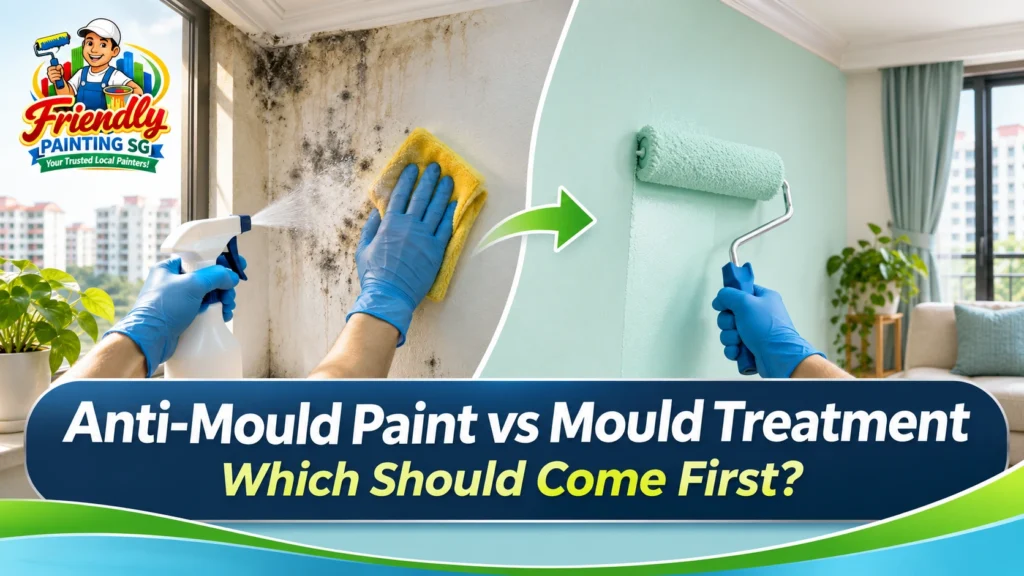
Mould growth is a common concern for homeowners and property managers in Singapore, especially in bathrooms, kitchens, bedrooms, and poorly ventilated spaces. When dark patches appear on walls or ceilings, many people face the same question: anti mould paint vs mould treatment—which solution should come first?
Although both solutions help manage mould problems, they serve different purposes. Mould treatment addresses existing contamination, while anti-mould paint helps reduce the likelihood of future surface growth under suitable conditions.
Singapore’s tropical climate makes moisture management particularly important. High humidity, frequent rainfall, condensation, and occasional water leakage can create favourable conditions for mould development.
According to Singapore’s Meteorological Service, the country’s average annual relative humidity is approximately 82%. Consequently, controlling indoor moisture is essential for maintaining healthier walls and protecting painted surfaces.
Quick Answer: Mould treatment should generally come before anti-mould painting when mould is already present. First, identify and repair the moisture source. Next, remove existing mould safely and allow the affected surface to dry. Finally, apply a suitable primer and anti-mould paint to help protect the finished surface.
Understanding the differences between these approaches can help Singapore homeowners avoid unnecessary repainting expenses and recurring wall damage.
What Is Anti-Mould Paint and How Does It Work?
Anti-mould paint is a specially formulated coating designed to resist or discourage mould growth on painted surfaces.
Unlike conventional decorative paints, many anti-mould coatings contain additives that inhibit fungal growth on the paint film.
However, these coatings do not eliminate existing mould contamination or repair underlying moisture problems.
For homeowners in Singapore, choosing the right coating is essential for long-term wall protection. Understanding the available Nippon painting services and paint options in Singapore can help you select a suitable finish for moisture-prone areas.
What Is Anti-Mould Paint?
Anti-mould paint is commonly used on interior walls and ceilings where condensation or occasional moisture exposure creates conditions favourable to fungal growth.
Depending on the formulation, it may offer:
- Resistance to surface mould development.
- Improved durability in moisture-prone rooms.
- A washable painted finish.
- Decorative protection for properly prepared surfaces.
- Reduced maintenance associated with surface staining.
Nevertheless, product performance varies. Some paints are specifically formulated for bathrooms, while others are suitable for general interior applications.
Always check the manufacturer’s technical specifications before selecting a product.
Key Benefits of Anti-Mould Paint
The primary advantage of mould-resistant paint is preventive protection.
When applied to clean, dry, properly prepared walls, it can help discourage fungal growth on the coating.
Additional benefits include:
1. Improved Surface Protection
The protective formulation can make painted surfaces less favourable to mould development.
2. Suitable for Humid Environments
Certain products are designed for rooms that experience elevated humidity.
3. Attractive Interior Finish
Homeowners can improve wall appearance while adding mould-resistant protection.
4. Easier Routine Maintenance
Some formulations provide washable finishes that simplify cleaning.
However, even premium anti-mould wall paint cannot permanently prevent mould if water continues entering the building materials.
Where Is Anti-Mould Paint Commonly Used?
Bathrooms and Toilets
Bathrooms frequently experience steam, condensation, and splashing.
Therefore, moisture-resistant coatings are particularly useful on appropriate wall and ceiling surfaces outside continuously wet areas.
Kitchens and Laundry Areas
Cooking, washing, and drying clothes generate water vapour.
Suitable mould-resistant paint can complement effective ventilation and moisture management.
Bedrooms and Living Rooms
Mould may develop behind wardrobes, near air-conditioning units, or on poorly ventilated external walls.
In these situations, anti-mould painting can provide additional protection after the underlying issue has been resolved.
What Is Mould Treatment and Why Is It Important?
Mould treatment refers to the process of identifying, removing, and managing existing fungal contamination.
Professional mould treatment may involve moisture investigation, surface cleaning, material removal, drying, and preventive recommendations.
Unlike painting, the primary objective is to address an existing problem.
Understanding Professional Mould Treatment
Mould develops when fungal spores encounter suitable moisture, temperatures, and organic material.
Wall paint, wallpaper, dust, plasterboard, and accumulated dirt can provide suitable surfaces for growth.
Consequently, simply covering visible stains does not resolve the underlying problem.
An appropriate mould removal process should address both contamination and the conditions supporting it.
Common Methods Used for Mould Treatment
Identifying and Controlling Moisture Sources
The first step is determining why mould appeared.
Possible causes include:
- Plumbing leaks.
- Roof or exterior wall seepage.
- Condensation.
- Poor ventilation.
- Persistent dampness.
- Water intrusion around windows.
Without fixing the source, mould may return after treatment.
Removing Mould-Contaminated Materials
Different materials require different treatment methods.
Non-porous surfaces can often be cleaned effectively.
However, heavily contaminated porous materials, such as certain plasterboards, insulation, or ceiling panels, may require removal and replacement.
Cleaning and Treating Affected Surfaces
For limited surface contamination, suitable cleaning methods can remove visible fungal growth.
Technicians may use appropriate detergents, specialised cleaning products, and containment procedures depending on the affected material.
Importantly, using chemicals alone is not a substitute for physically removing contamination.
Drying and Preparing Walls for Repainting
After cleaning, the surface must dry thoroughly.
Repainting a damp wall can cause:
- Paint bubbling.
- Peeling.
- Discolouration.
- Poor adhesion.
- Recurring mould growth.
Therefore, moisture assessment should form part of the preparation process.
When Is Professional Mould Treatment Necessary?
Professional assistance is particularly valuable when:
- Mould repeatedly returns.
- Large sections of walls or ceilings are affected.
- Water damage has occurred.
- Contamination extends into porous materials.
- Hidden mould is suspected.
- The affected area involves air-conditioning components.
- Residents have respiratory conditions or other vulnerabilities.
The US Environmental Protection Agency notes that small affected areas below approximately 10 square feet, or 0.93 square metres, may often be cleaned by homeowners, depending on circumstances. Larger or complicated situations may warrant professional assistance.
Anti-Mould Paint vs Mould Treatment: Key Differences Explained
Understanding the differences between these approaches helps homeowners choose the correct solution for their property.
Purpose and Function
Mould treatment removes existing contamination and addresses related moisture concerns.
Anti-mould paint provides a protective decorative coating intended to discourage future surface growth.
Therefore, these solutions often work best as complementary steps rather than competing alternatives.
Effectiveness Against Existing Mould
Mould treatment is intended to remove existing contamination.
In contrast, anti-mould paint should not be used to conceal active mould.
Even when the finished wall initially looks clean, fungal contamination may remain beneath the coating.
Long-Term Mould Prevention
Neither approach guarantees permanent mould prevention.
Long-term success depends primarily on controlling moisture.
For example, a properly treated bathroom may develop new mould if condensation remains excessive and ventilation is inadequate.
Application Methods and Surface Preparation
Mould remediation may require specialised cleaning, protective equipment, material removal, and drying.
Painting typically involves cleaning, surface repairs, priming, and applying the required number of coats.
Cost and Maintenance Considerations
Painting is usually simpler when the surface is already clean, dry, and sound.
However, treating extensive contamination or repairing water damage can increase the overall project cost.
Anti-Mould Paint vs Mould Treatment Comparison Table
| Comparison Factor | Anti-Mould Paint | Mould Treatment |
|---|---|---|
| Primary purpose | Help prevent surface mould growth | Remove existing mould |
| Existing mould removal | Not suitable for removal | Designed to address contamination |
| Moisture problem resolution | Does not repair moisture sources | Should include moisture investigation and correction |
| Application | Painting and coating | Cleaning, remediation, and possible material removal |
| Best surface condition | Clean, dry, mould-free | Existing mould contamination |
| Long-term effectiveness | Depends on moisture control | Depends on successful remediation and moisture control |
| Main benefit | Preventive surface protection | Removal of existing contamination |
| Suitable for Singapore homes | Yes, where appropriate | Yes, when mould is already present |
| Maintenance | Cleaning and periodic inspection | Follow-up moisture monitoring |
| Recommended sequence | After necessary treatment | Before repainting |
Key takeaway: Mould treatment addresses an existing problem, while anti-mould paint helps protect the finished surface.
Anti-Mould Paint vs Mould Treatment: Which Should Come First?
When mould is already visible, treatment should generally come before painting.
However, the complete process begins with identifying and controlling moisture.
Why Mould Treatment Should Generally Come Before Painting
Removing existing mould before repainting is important for effective surface restoration. According to the US Environmental Protection Agency’s mould cleanup guidance, moisture control is essential for preventing mould growth, and paint applied over contaminated surfaces may peel.Painting over existing contamination can conceal visible staining without eliminating the problem.
Moreover, damp or contaminated surfaces often prevent coatings from bonding correctly.
A systematic approach improves both the appearance and durability of the final finish.
Step 1: Identify the Root Cause of Mould Growth
Inspect the affected area carefully.
Look for:
- Water stains.
- Condensation.
- Peeling paint.
- Damp patches.
- Plumbing leaks.
- Poor ventilation.
The location and pattern of mould can provide useful clues.
For instance, mould near a window may suggest condensation, while repeated staining below a bathroom may indicate water leakage.
However, visual observations alone cannot always establish the exact cause.
Step 2: Repair Water Leaks and Control Excess Moisture
Fix plumbing, waterproofing, or drainage problems before beginning decorative work.
Additionally, improve ventilation and control excessive indoor humidity.
In Singapore’s humid climate, air-conditioning and dehumidification may help maintain suitable indoor conditions.
Step 3: Remove Existing Mould Safely
Use an appropriate cleaning or remediation method based on the affected surface and severity.
For small areas on suitable hard surfaces, careful cleaning may be sufficient.
However, extensive contamination requires additional precautions.
Wear suitable protective equipment and avoid dry brushing methods that spread contaminated dust.
Never mix bleach with ammonia, acidic cleaners, or other cleaning chemicals.
Step 4: Allow the Surface to Dry Completely
Drying is essential before painting.
The required time depends on:
- Wall material.
- Temperature.
- Ventilation.
- Moisture level.
- Severity of previous water damage.
A wall that feels dry on the surface may still contain moisture internally.
Therefore, a moisture meter can be useful when dampness is suspected.
Step 5: Apply a Suitable Primer When Required
Once the wall is clean, dry, and sound, apply a compatible primer if recommended.
Primers can improve adhesion, seal repaired surfaces, and prepare the substrate for finishing coats.
However, primer cannot replace proper mould removal.
Step 6: Finish with Anti-Mould Paint
Apply the selected coating according to the manufacturer’s instructions.
Follow the recommended:
- Surface preparation requirements.
- Application method.
- Number of coats.
- Recoating intervals.
- Drying and curing conditions.
Finally, maintain adequate ventilation to reduce future moisture accumulation.
Can You Apply Anti-Mould Paint Without Mould Treatment?
Yes, but only when there is no existing mould that requires removal.
When Anti-Mould Paint May Be Suitable Without Prior Remediation
Clean, Dry Walls Without Existing Mould
For newly prepared or previously painted walls that are clean, dry, and free from contamination, anti-mould paint can serve as a preventive coating.
For example, a homeowner repainting a well-maintained bathroom may choose a suitable mould-resistant finish.
When Mould Treatment Is Essential Before Painting
Walls with Visible, Recurring, or Widespread Mould
If mould already exists, the contamination and moisture source must be addressed first.
Painting directly over it is inappropriate, even when the coating contains anti-fungal additives.
What Happens If You Paint Over Mould Without Treating It?
Several problems may develop.
Recurring mould: Existing contamination may remain, and growth can resume when moisture persists.
Peeling paint: Contamination and dampness can reduce adhesion.
Discolouration: Dark stains may reappear through damaged coatings.
Continued deterioration: Wet plasterboard, wallpaper, or other vulnerable materials may remain damaged.
As a result, the homeowner may eventually need to repeat both the treatment and repainting process.
Common Causes of Wall Mould and How to Prevent Recurrence
Singapore’s climate creates conditions where moisture-related wall problems require consistent attention.
However, not every mould problem has the same cause.
Identifying the source helps determine the most effective preventive measures.
High Indoor Humidity and Condensation
Humidity is a major factor in mould development.
Condensation occurs when moist air meets a sufficiently cool surface.
This can happen around air-conditioned rooms, cold pipes, windows, and poorly insulated surfaces.
Maintaining indoor relative humidity around 30–60%, where practical, is a commonly recommended moisture-control approach.
In Singapore, keeping indoor humidity consistently below 60% may require air-conditioning or dehumidification.
Poor Ventilation in Bathrooms and Kitchens
Bathrooms and kitchens generate substantial moisture.
Without adequate ventilation, water vapour can accumulate on walls and ceilings.
Therefore, properly maintained exhaust fans can help reduce moisture buildup.
Water Leaks and Plumbing Problems
Water leakage may originate from:
- Concealed pipes.
- Bathroom fixtures.
- Roof drainage.
- Window seals.
- Air-conditioning drainage systems.
Unlike ordinary condensation, leaks may keep building materials wet for extended periods.
Consequently, waterproofing or plumbing repairs may be necessary before treatment.
Roof Seepage and External Wall Moisture
Persistent rainfall can expose weaknesses in roofs, joints, and building exteriors.
Water entering through damaged areas may produce staining, bubbling, and mould.
In such cases, interior painting alone cannot solve the problem.
Damp Building Materials and Inadequate Drying
Walls may remain damp following renovation, flooding, or leakage.
If coatings are applied before suitable drying, trapped moisture can contribute to deterioration.
Practical Ways to Reduce Indoor Mould Growth
Consider these preventive measures:
- Repair water leaks promptly.
- Use bathroom exhaust fans.
- Maintain air-conditioning systems.
- Monitor indoor humidity.
- Use dehumidifiers when necessary.
- Avoid placing large furniture tightly against persistently damp walls.
- Dry condensation on windows and other surfaces.
- Investigate recurring musty odours.
- Check hidden corners regularly.
Additionally, ventilate rooms when outdoor conditions are suitable. During very humid weather, opening windows continuously may not always improve moisture control, especially in air-conditioned spaces.
How Much Do Anti-Mould Painting and Mould Treatment Cost in Singapore?
The cost depends on the condition of the property, the area affected, and the work required.
Because mould problems vary considerably, homeowners should request a detailed assessment instead of relying on a single advertised price.
Factors Affecting Mould Treatment Costs
Size of the Affected Area
Treating a small bathroom ceiling is generally less complex than remediating multiple rooms.
Severity of Contamination
Surface mould may require relatively straightforward cleaning.
However, extensive contamination involving damaged materials may require specialised remediation.
Type of Building Material
Concrete, tiles, painted plaster, wallpaper, and plasterboard may require different approaches.
Porous materials can be especially challenging when contamination extends beneath the surface.
Moisture Source and Necessary Repairs
If the problem involves leaking pipes, waterproofing failure, or concealed water damage, repair costs may exceed the cleaning expense.
Factors Affecting Anti-Mould Painting Costs
Painting expenses depend on several elements.
Paint selection: Different formulations have different prices and performance characteristics.
Wall condition: Cracks, flaking coatings, and damaged plaster increase preparation requirements.
Total area: Larger spaces require more materials and labour.
Primer requirements: Additional preparation and compatible primer systems may affect cost.
Accessibility: High ceilings or difficult-to-reach areas can require additional equipment.
Is Mould Treatment Followed by Anti-Mould Paint Worth the Investment?
When existing mould is present, completing the necessary remediation before repainting is generally the more dependable approach.
Initial Cost vs Long-Term Maintenance
Skipping treatment may reduce initial expenditure.
However, if mould returns, homeowners may face additional cleaning, repairs, and painting expenses.
Why Fixing Moisture Problems Can Reduce Repeat Expenses
Consider two situations.
Scenario A: A homeowner paints over a damp bedroom wall without repairing a concealed leak.
The wall may deteriorate again because the moisture remains.
Scenario B: Another homeowner identifies the leak, repairs it, removes affected materials where necessary, dries the wall, and applies a suitable coating.
The second approach addresses the actual cause and provides a better foundation for lasting results.
Although costs vary, correcting the underlying problem can reduce unnecessary repeat work.
Common Mistakes to Avoid When Treating and Painting Mouldy Walls
Even well-intentioned maintenance can produce disappointing results when essential preparation steps are overlooked.
Applying Anti-Mould Paint Directly Over Existing Mould
This is one of the most common mistakes.
Anti-mould coatings are preventive products, not substitutes for cleaning and remediation.
Always remove existing contamination before repainting.
Ignoring Water Leaks and Excess Humidity
Mould can return when the underlying moisture problem remains unresolved.
Therefore, inspect plumbing, drainage, waterproofing, and ventilation before focusing on paint selection.
Using Ordinary Paint in Moisture-Prone Areas
Standard decorative paint may not provide the performance required for bathrooms or other damp environments.
Choose a coating appropriate for the surface and exposure conditions.
However, specialised paint still requires proper moisture control.
Painting Before Walls Have Dried Properly
Damp surfaces can cause poor adhesion and premature coating failure.
Follow product requirements and verify that the substrate is sufficiently dry.
Using Unsuitable Cleaning Chemicals or Methods
Incorrect cleaning methods can damage surfaces or expose occupants to unnecessary hazards.
Avoid mixing cleaning products.
Furthermore, people with asthma, significant mould allergies, or compromised immune systems should avoid direct involvement in mould cleanup.
Overlooking Recurring Mould Behind Furniture and Cabinets
Hidden areas may have limited airflow.
Consequently, mould can continue developing behind wardrobes, cabinets, or wall coverings without being immediately visible.
Inspect these locations when unexplained odours or repeated staining occur.
When Should You Hire a Professional for Mould Treatment and Painting?
Some minor mould problems can be managed through appropriate household cleaning.
However, professional assistance becomes more important when contamination is extensive, recurring, or connected to structural moisture problems.
Once mould contamination and underlying moisture problems have been addressed, professional repainting can help restore the appearance of your walls. Friendly Painting SG provides painting services for HDB flats, condominiums, and other properties across Singapore.
Signs That Your Mould Problem Needs Professional Attention
Mould Keeps Returning After Cleaning
Recurring growth indicates that the moisture source may not have been adequately addressed.
Large Areas of Walls or Ceilings Are Affected
Widespread contamination can require containment and specialised cleaning procedures.
Mould Appears After Water Damage
Flooding, concealed leaks, and prolonged water intrusion can affect materials beyond the visible surface.
Hidden Moisture or Structural Damage Is Suspected
Musty odours, persistent staining, or soft building materials may indicate concealed problems.
In these situations, a qualified inspection can help determine the necessary repairs.
What to Expect from a Professional Mould Treatment and Painting Service
Initial Inspection and Moisture Assessment
A suitable assessment should identify:
- The affected locations.
- Possible moisture sources.
- Surface and material conditions.
- Visible contamination.
- Necessary repair work.
Recommended Mould Remediation Process
The service provider should explain how contamination will be removed and whether affected materials require replacement.
For larger projects, ask about containment, cleaning procedures, and protection of surrounding areas.
Surface Preparation and Suitable Paint Selection
After remediation, the contractor should determine whether repairs, primer, or a specialised coating are appropriate.
Final Inspection and Prevention Recommendations
Before considering the job complete, check that:
- Visible mould has been removed.
- The moisture problem has been addressed.
- Affected materials are adequately dry.
- Surface preparation is satisfactory.
- The coating has been applied correctly.
Additionally, request practical maintenance recommendations.
For Singapore homeowners, an experienced painting contractor and a qualified mould remediation specialist may need to work together when the underlying problem is complicated.
Should You Choose Anti-Mould Paint or Mould Treatment First?
The answer depends on the condition of your walls.
If mould is already present, treatment must generally come first.
However, preventing recurrence also requires identifying and controlling the underlying source of moisture.
For homeowners planning to refresh their interiors, proper wall preparation is just as important as selecting the right paint. Professional landed house painting services in Singapore can help homeowners achieve a consistent finish after necessary mould treatment and repairs.
The Recommended Approach for Existing Mould
For affected walls, follow this sequence:
- Inspect the affected area.
- Identify the moisture source.
- Repair leaks or other defects.
- Remove existing mould safely.
- Replace heavily contaminated materials when necessary.
- Ensure that surfaces are clean and dry.
- Apply an appropriate primer where required.
- Finish with suitable anti-mould paint.
- Maintain ventilation and monitor indoor humidity.
This approach addresses both the immediate contamination and the conditions that may support future growth.
When Anti-Mould Paint Alone May Be Enough
Anti-mould painting may be appropriate when:
- The wall is mould-free.
- No unresolved moisture problem exists.
- The surface is clean and dry.
- The homeowner wants preventive protection.
- The coating is suitable for the intended room.
For example, repainting a clean bathroom ceiling with a suitable mould-resistant product can be a reasonable maintenance choice.
Long-Term Recommendations for Mould-Free Walls
The most reliable strategy combines proper moisture management, appropriate maintenance, and suitable surface protection.
Importantly, expensive paint cannot compensate for unresolved leaks or continually damp building materials.
Likewise, successful mould treatment does not prevent new growth if excessive moisture returns.
For homeowners in Singapore, the practical priority is clear:
Fix the moisture source first, remove existing mould second, and apply anti-mould paint only after the surface is properly prepared.
If your walls show recurring dark patches, peeling paint, or unexplained dampness, consider arranging a professional inspection before beginning another painting project.
A thorough assessment can help determine whether you need mould remediation, waterproofing repairs, improved ventilation, or a suitable repainting system.
Frequently Asked Questions About Anti-Mould Paint vs Mould Treatment
1. Should I Treat Mould Before Applying Anti-Mould Paint?
Yes. If mould is already present, remove the contamination and correct the moisture problem before painting. Anti-mould paint is primarily intended to discourage future surface growth, not eliminate existing contamination. Once the wall is clean and adequately dry, apply a compatible primer if required, followed by the selected coating.
2. Can Anti-Mould Paint Kill Existing Mould on Walls?
Anti-mould paint should not be relied upon to kill or remove existing mould. Although some formulations contain ingredients designed to inhibit fungal growth on the paint film, these properties do not replace remediation. Existing contamination should be removed before painting, and damaged porous materials may require replacement.
3. What Happens If I Paint Directly Over Mould?
Painting over mould can conceal visible staining while leaving contamination and moisture problems unresolved. Consequently, stains may reappear, coatings may peel, and mould can continue developing where sufficient moisture remains. The CDC advises addressing the water problem and removing mould before painting or caulking.
4. How Long Should I Wait After Mould Treatment Before Painting?
There is no universal waiting period. Drying depends on the wall material, moisture severity, ventilation, temperature, and treatment method. A lightly cleaned surface may dry relatively quickly, while water-damaged plaster or masonry can take considerably longer. Always confirm that the substrate meets the paint manufacturer’s moisture requirements before proceeding.
5. Does Anti-Mould Paint Permanently Prevent Mould Growth?
No. Anti-mould paint can help resist surface growth, but it cannot guarantee permanent protection. Persistent condensation, water leakage, or high humidity can still create conditions favourable to mould. Therefore, effective moisture management and routine inspection remain essential.
6. Is Anti-Mould Paint Suitable for Bathrooms and Kitchens?
Yes, provided the selected product is designed for those environments and the surface is properly prepared. Bathrooms and kitchens experience frequent moisture exposure, making suitable mould-resistant coatings useful. However, exhaust fans, ventilation, leak repairs, and regular cleaning remain important.
7. Can Mould Return After Professional Mould Treatment?
Yes. Mould may return if moisture problems remain unresolved or new water intrusion occurs. Even successful remediation cannot prevent future contamination when conditions again become favourable. Therefore, maintaining suitable humidity, repairing leaks, and monitoring vulnerable areas are necessary for long-term prevention.
8. What Is the Difference Between Anti-Mould Paint and Mould-Resistant Primer?
Anti-mould paint is generally used as a finishing coat that provides decorative coverage and surface resistance to fungal growth. A mould-resistant primer is designed to prepare a suitable substrate and may offer additional protective properties. However, neither product should be applied over untreated active mould. Always confirm compatibility between the primer and finishing paint.
9. Is Professional Mould Treatment Necessary for Small Mould Patches?
Not always. Small areas of surface mould on suitable hard materials may be manageable through careful household cleaning. However, professional assistance is advisable when mould keeps returning, hidden contamination is suspected, water damage is extensive, or vulnerable occupants may be exposed. The size of the visible patch is only one consideration.
10. Is It Cheaper to Use Anti-Mould Paint or Professional Mould Treatment?
Anti-mould painting may have a lower initial cost when walls are already clean and dry. However, the two services perform different functions. If existing mould or water damage requires treatment, painting alone may lead to repeated expenses. Compare quotations based on surface preparation, remediation requirements, repairs, materials, and the total scope of work.