
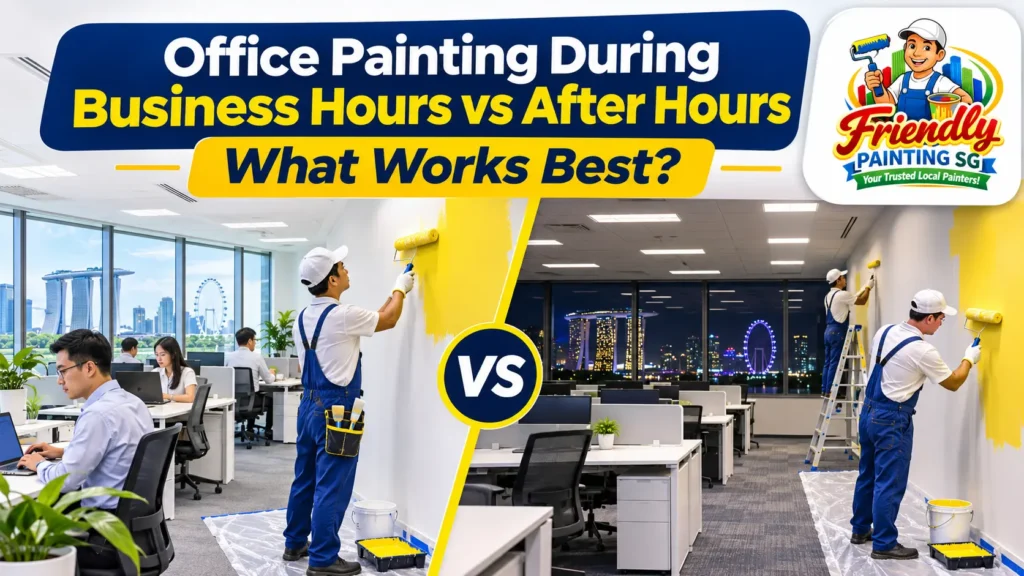
Office painting after hours Singapore is an increasingly practical option for businesses that want to refresh their workplaces without interrupting daily operations. Whether you manage a corporate office, coworking space, professional consultancy, or customer-facing workplace, choosing when to repaint can affect employee productivity, project costs, indoor air quality, and overall business continuity.
Many Singapore businesses operate on demanding schedules. Meetings, customer appointments, daily administrative tasks, and shared workspace arrangements can make daytime renovation difficult. Consequently, evening, overnight, and weekend painting are often considered alternatives.
But is painting after business hours always the better choice?
After-hours office painting is generally more convenient for busy workplaces because fewer employees and customers are present. However, daytime painting may be more cost-effective for vacant offices, flexible workplaces, or projects that can be completed in isolated sections.
The right approach depends on office occupancy, building management requirements, ventilation, surface preparation, labour costs, and the time needed before employees can safely return.
This guide compares daytime and after-hours office painting in Singapore, explains the advantages and limitations of each schedule, and provides practical advice for planning commercial painting projects with minimal disruption.
Office Painting During Business Hours vs After Hours: Which Is Better?
Office painting can be scheduled during normal operating hours, outside business hours, or through a combination of both.
Each option offers different advantages depending on the workplace.
What Is Office Painting During Business Hours?
Daytime office painting involves completing painting activities while the business is normally open.
For example, contractors may repaint an unused meeting room, vacant department, or isolated corridor during regular working hours.
This approach works best when affected areas can be separated from occupied spaces.
However, managing employee access, noise, dust, and ventilation requires careful coordination.
What Is After-Hours Office Painting?
After-hours office painting involves scheduling renovation activities outside a company’s normal operating period.
Depending on the business and building regulations, work may take place during evenings, overnight periods, weekends, or approved public holidays.
The main objective is to minimise interference with employees, meetings, and customers.
Nevertheless, an empty workplace does not automatically guarantee that painting can proceed without restrictions.
Building access, security arrangements, ventilation, and contractor safety must still be managed.
Key Differences Between Daytime and After-Hours Office Painting
The main difference is how painting activities interact with business operations.
Daytime painting may offer simpler contractor supervision and normal building access.
After-hours painting may provide greater freedom to work in spaces that are usually occupied.
However, extended operating arrangements can create additional costs.
Quick Comparison: Cost, Disruption, Safety, and Convenience
| Comparison Factor | Business Hours Painting | After-Hours Painting |
|---|---|---|
| Employee disruption | Potentially higher | Usually lower |
| Client meetings | May require rescheduling | Less direct interference |
| Contractor access | Often easier | Special arrangements may be needed |
| Labour costs | May be lower | Possible overtime premiums |
| Workspace availability | Limited by occupancy | Often greater |
| Ventilation | Normal systems may be available | Extended ventilation may be necessary |
| Building security | Regular arrangements | Additional coordination |
| Project flexibility | Suitable for isolated areas | Suitable for busy shared spaces |
| Business downtime | May affect occupied areas | Can reduce operational interruptions |
When Is After-Hours Office Painting the Better Choice?
After-hours painting is often preferable when office spaces are occupied throughout the day.
For example, a company operating several customer service departments may find it difficult to close workstations during business hours.
In contrast, a smaller business with vacant rooms may complete painting during the day without significant disruption.
Therefore, the best schedule is the one that balances operational requirements, safety, and project cost.
Why Do Singapore Businesses Choose After-Hours Office Painting?
The main reason is business continuity.
Many organisations cannot afford unnecessary interruptions to daily operations, especially when employees share meeting rooms, collaborative spaces, and essential equipment.
Minimising Disruption to Daily Business Operations
Painting involves preparation, furniture movement, surface repairs, application, and cleaning.
These activities can temporarily limit access to workspaces.
Scheduling them outside normal operating hours may allow employees to continue their work without major interruptions.
For example, a marketing agency can plan painting after employees leave, provided the area is properly ventilated and suitable for reoccupation.
Avoiding Interruptions to Employees and Client Meetings
Even relatively quiet painting activities can create distractions.
Surface preparation may involve sanding, scraping, or moving furniture.
Additionally, contractors may need access to walls near desks or meeting tables.
After-hours scheduling reduces the likelihood of these activities interfering with meetings and focused work.
Keeping Office Workstations and Walkways Accessible
Busy offices depend on clear movement routes.
Painting corridors and shared areas during working hours may create temporary access restrictions.
When projects are scheduled outside normal occupancy periods, contractors may have more flexibility.
Nevertheless, emergency exits and essential building facilities must remain accessible.
Reducing the Impact on Customer-Facing Operations
Reception areas, consultation rooms, and customer service counters often need to remain presentable and operational.
A partially painted reception area may inconvenience visitors or interfere with customer interactions.
Therefore, evening or weekend painting can be particularly useful for these workplaces.
Scheduling Painting Around Flexible and Hybrid Work Arrangements
Hybrid work arrangements offer additional scheduling opportunities.
For example, an office with lower occupancy on Fridays may combine daytime painting in vacant rooms with weekend work in shared areas.
This approach can reduce disruption without requiring the entire project to be completed overnight.
How After-Hours Painting Supports Business Continuity
Effective scheduling allows painting activities to take place around normal business needs.
However, business continuity depends on more than the working hours selected.
Proper planning must also account for cleaning, ventilation, paint drying, access restrictions, and final inspections.
What Are the Advantages and Disadvantages of Painting During Business Hours?
Daytime painting remains practical for many commercial properties.
It should not be dismissed simply because after-hours work offers convenience.
Benefits of Daytime Office Painting
Easier Coordination with Office Managers and Staff
During normal business hours, office managers and facility teams are generally available to answer questions.
This can simplify decisions about colours, access, unexpected wall defects, and project changes.
Better Natural Lighting for Surface Inspection
Daylight may help contractors assess wall colour, surface imperfections, and paint coverage.
However, professional lighting can also support evening inspections.
The advantage depends on the office layout and available illumination.
Potentially Lower Labour and Access Costs
Normal working hours may avoid certain overtime premiums.
Building access and security arrangements may also be simpler.
As a result, daytime painting can offer cost advantages when business disruption is limited.
Disadvantages of Painting During Working Hours
Noise, Dust, and Workplace Distractions
Surface preparation can produce noise and dust.
Even when painting itself is relatively quiet, the complete project may affect concentration.
Restricted Access to Desks and Meeting Rooms
Workstations close to the affected walls may need temporary relocation.
Meeting rooms may also become unavailable.
Paint Odours and Ventilation Concerns
Painting products can release airborne substances during application and drying.
Their emissions depend on the formulation and application method.
Therefore, suitable ventilation and exposure controls are important, particularly when employees occupy nearby areas.
Reduced Productivity During Painting Work
Business disruption varies considerably.
Some employees may continue working normally in isolated sections.
Others may need to relocate because their workspace is directly affected.
When Daytime Painting Can Still Be Practical
Daytime painting may be suitable when the project involves vacant rooms, low-occupancy areas, or a business operating remotely during renovation.
It can also work well when contractors can isolate the work zone safely.
What Are the Advantages and Disadvantages of After-Hours Office Painting?
After-hours painting reduces certain operational challenges but introduces others.
Businesses should consider both sides before confirming the schedule.
Benefits of Painting Offices After Working Hours
Less Interference with Employees and Customers
Fewer occupants generally mean fewer interruptions.
Contractors can often complete work without constantly moving around employees or postponing tasks for meetings.
More Flexibility for Painting Larger Office Areas
Empty workspaces may provide better access to walls, corridors, and shared areas.
This can make it easier to organise painting zones.
However, the actual progress still depends on preparation, drying requirements, and workforce availability.
Easier Furniture Protection and Workspace Preparation
Contractors may have more flexibility to cover furniture and move non-essential items.
This can be particularly useful in open-plan offices.
Reduced Conflict with Regular Office Activities
Painting during unoccupied periods may allow businesses to avoid closing meeting rooms during important working hours.
Challenges of After-Hours Office Painting
Possible Evening, Overnight, and Weekend Labour Premiums
After-hours work may involve additional labour charges.
Weekend and public holiday arrangements can also affect quotations.
These premiums depend on the contractor and agreed scope.
Building Access and Security Restrictions
Commercial buildings may have controlled access outside normal hours.
Contractors might need advance registration, access cards, security clearance, or supervision.
Limited Night-Time Ventilation and Air-Conditioning
Some commercial buildings reduce air-conditioning and mechanical ventilation outside normal operating hours.
This can be a significant consideration.
An empty office with inadequate ventilation may not be suitable for painting until appropriate arrangements are made.
Drying Time Before Employees Return
Completing the final paint coat does not mean the area is immediately ready for occupation.
Drying, ventilation, cleaning, and safety checks must be considered.
When After-Hours Painting May Not Be Suitable
After-hours painting may be less practical when the building prohibits certain activities, ventilation cannot be maintained, or overnight access costs are excessive.
It may also be unsuitable when extensive plastering or repairs require longer drying periods.
How Much Does Office Painting After Hours Cost in Singapore?
Office painting costs depend on the condition of the property and the scope of work.
After-hours scheduling is one factor, but it is not necessarily the largest expense.
What Affects Office Painting Costs?
Important considerations include:
- Total wall and ceiling area
- Office layout and accessibility
- Existing paint condition
- Surface cracks and plaster repairs
- Paint type and finish
- Furniture protection
- Required labour
- Project schedule
- Building management requirements
A quotation should clearly distinguish preparation work from final paint application.
Daytime Painting vs After-Hours Labour Costs
After-hours work may cost more because of overtime, transport arrangements, or additional supervision.
However, a higher contractor quotation does not automatically mean the project is more expensive overall.
Business interruption also has potential costs.
How Office Size and Layout Affect the Quotation
A small office with straightforward access may be relatively simple to repaint.
A large workplace containing meeting rooms, partitions, storage areas, and occupied departments may require more detailed preparation.
Complicated layouts can increase the number of painting stages.
Wall Condition, Surface Repairs, and Paint Selection
Damaged plaster, peeling paint, and cracks may require additional preparation.
Premium coatings can also affect material costs.
Importantly, the correct paint should be selected for the surface and operating environment rather than price alone.
Additional Costs for Security, Access, and Building Management
Some buildings charge for extended air-conditioning, security arrangements, or after-hours facilities.
These costs may be separate from the painting contractor’s quotation.
How Business Downtime Can Affect the Real Project Cost
Consider a hypothetical comparison.
A daytime project may have a lower contractor fee but require employees to relocate temporarily.
An after-hours project may involve higher labour costs but allow work to continue during normal business periods.
The true comparison should include operational impact rather than contractor pricing alone.
Which Schedule Offers Better Overall Value?
The better-value schedule is the one that achieves a safe, satisfactory finish while minimising the combined cost of painting, building services, and business disruption.
For a low-occupancy office, daytime work may offer better value.
For a busy customer-facing workplace, after-hours painting may be more practical.
Can Office Painting Be Completed Without Disrupting Business Operations?
Completely eliminating disruption is not always possible.
However, careful planning can substantially reduce its impact.
Planning Painting Work Around Office Occupancy
Review which departments require continuous access.
Identify meeting rooms, reception areas, and workstations that can be temporarily vacated.
Then establish a sequence that fits daily operations.
Dividing the Office into Manageable Painting Zones
Phased office painting allows contractors to complete one area before moving to another.
For example, a project may begin with unused meeting rooms before progressing to shared workstations.
This can reduce the need to close the entire office.
Painting Meeting Rooms and Common Areas Separately
Meeting rooms may be scheduled during periods without bookings.
Common areas may require weekend or evening work.
Treating them separately can simplify access management.
Using Low-Odour, Low-VOC Paint Where Appropriate
Low-VOC coatings may help reduce certain airborne emissions compared with higher-emission alternatives.
However, low odour does not automatically mean a product has no health risks.
Product selection should consider technical specifications, safety information, and the intended indoor environment.
Protecting Office Equipment, Furniture, and Documents
Sensitive equipment and confidential documents should be protected or moved before work begins.
Computers, printers, cables, and shared electronics require particular care.
Painting materials should not obstruct electrical equipment or ventilation openings.
Maintaining Safe Access to Exits and Essential Facilities
Emergency escape routes must remain clear.
Temporary work zones should be appropriately marked and controlled.
Employees should also retain safe access to necessary facilities.
How a Phased Painting Schedule Helps Reduce Downtime
A phased approach supports business continuity by limiting the affected area.
However, work zones should not be reopened until they are ready for safe occupation.
Office Painting After Hours in Singapore: Building Rules and Permissions
Before arranging evening or weekend work, businesses must check the requirements of their building.
Singapore does not have one universal office painting schedule that applies to every commercial property.
Why Building Management Approval May Be Required
Building management teams control access, common facilities, and certain renovation activities.
Depending on the property, contractors may need permission before bringing equipment or carrying out work.
Checking Office Lease and Renovation Requirements
Commercial tenancy agreements may contain requirements for renovation notifications, contractor insurance, reinstatement, or permitted working hours.
Review these conditions before confirming the project.
Contractor Registration, Insurance, and Security Access
Some buildings require contractor registration and documentation.
Depending on the nature of the work, this may include insurance records, risk assessments, worker details, and access applications.
Noise Restrictions for Evening and Weekend Renovation Work
Noisy work may be restricted to particular periods.
For example, JTC fitting-out guidance requires noisy or disruptive renovation activities to be scheduled after office hours with the necessary approval in applicable properties.
However, this should not be interpreted as a universal rule for every office building in Singapore.
Distinguishing Quiet Painting from Noisy Surface Preparation
Rolling paint onto a prepared wall is generally quieter than mechanical sanding, hacking, or drilling.
Therefore, different stages of the same project may require different scheduling arrangements.
Why Permitted Working Hours Differ Between Buildings
Rules depend on the property owner, managing agent, tenancy conditions, and nature of the work.
Always obtain the applicable instructions for the actual premises.
Lift Booking, Material Deliveries, and Waste Removal
Larger painting projects may require the movement of equipment and materials through service lifts.
Advance booking can prevent delays.
Waste disposal should also follow building rules.
Additional Considerations for Offices in Shared Commercial Buildings
Painting activities should not unnecessarily affect neighbouring tenants.
Odours, noise, movement through common corridors, and shared ventilation systems may all require coordination.
What to Confirm Before Scheduling Overnight Painting
Before proceeding, confirm:
- Approved working hours
- Contractor access requirements
- Permitted noisy activities
- Lift and loading arrangements
- Ventilation availability
- Security procedures
- Waste disposal requirements
- Emergency contact arrangements
These details should be settled before the project starts.
Is It Safe for Employees to Return After Overnight Office Painting?
Employee reoccupation is one of the most important considerations when scheduling overnight painting.
An office should not be considered safe for immediate reoccupation solely because the paint feels dry or no longer has a strong smell.
Understanding Paint Odours and Indoor Air Quality
Some paints, primers, and associated products release volatile compounds during application and drying.
The amount and type of emissions depend on the formulation and environmental conditions.
Airborne dust from surface preparation may also affect indoor air quality.
Low-VOC vs Conventional Office Paints
Low-VOC products generally contain lower levels of certain volatile organic compounds.
However, VOC content alone does not describe every potential emission or hazard.
Businesses should review product documentation and choose coatings suitable for occupied commercial interiors.
Singapore has also introduced restrictions on formaldehyde in interior paints from January 2026, making appropriate product selection particularly relevant.
Why Low-Odour Paint Is Not Automatically Risk-Free
A product may have relatively little detectable smell while still requiring ventilation and handling precautions.
Consequently, smell should not be the only factor used to decide whether employees can return.
Ventilation Requirements During and After Painting
Singapore’s National Environment Agency emphasises the importance of appropriate indoor ventilation for managing indoor air quality.
Painting plans should therefore consider how air will be supplied, extracted, and prevented from carrying contaminants into occupied spaces.
Proper ventilation is essential during and after office painting, particularly in Singapore’s air-conditioned commercial buildings. Paint products can release airborne substances during application and drying, making airflow management an important part of the project. According to NEA’s indoor air quality and ventilation guidelines, building owners and facility managers should maintain effective ventilation systems to support healthy indoor environments. Therefore, businesses should coordinate ventilation arrangements and follow paint-specific safety instructions before allowing employees to return.
Managing Airflow in Air-Conditioned Offices
Many Singapore offices use centralised air-conditioning systems.
These systems may not operate normally overnight.
Before beginning work, confirm whether suitable ventilation can be maintained.
Coordinating Ventilation with Building Management
Facility teams may need to arrange extended mechanical ventilation or approved local extraction.
Airflow should not spread painting fumes into neighbouring occupied areas.
How Drying Time Differs from Paint Curing Time
Paint drying and curing are different processes.
Drying generally refers to the coating becoming dry to the touch or suitable for recoating.
Curing involves the coating developing its intended properties over time.
Neither condition alone establishes that the room is ready for occupancy.
When Should Employees Re-enter a Newly Painted Office?
There is no universally safe reoccupation time for every office painting project.
The decision should consider product safety instructions, ventilation, remaining emissions, the extent of painting, cleaning, and the needs of building occupants.
Where necessary, competent indoor air quality advice may be appropriate.
Extra Precautions for Employees with Respiratory Sensitivities
Employees with asthma or other respiratory sensitivities may require additional precautions.
When appropriate, employers should arrange alternative work locations or adjusted schedules during the affected period.
How Long Does After-Hours Office Painting Take?
Project duration depends on the size and complexity of the painting work.
A single overnight shift may be sufficient for some limited tasks, but larger projects often require several stages.
Factors That Determine the Painting Timeline
The timeline depends on preparation, wall condition, number of coats, drying requirements, accessibility, and workforce capacity.
Building access restrictions may also affect progress.
Small Office Repainting vs Large Commercial Office Projects
A small office with sound walls may require relatively straightforward preparation.
Large offices may need phased work involving multiple departments.
As a result, the total schedule can vary substantially.
Surface Preparation, Priming, and Multiple Paint Coats
Painting is not limited to applying the final colour.
Crack repairs, patching, sanding, priming, and cleaning can take significant time.
Each stage must be coordinated properly.
How Singapore’s Humidity Affects Paint Drying
High humidity may slow moisture evaporation from certain water-based coatings.
Airflow, temperature, and substrate condition also influence drying.
Contractors should follow the selected paint manufacturer’s instructions.
Can Office Painting Be Completed Over a Weekend?
Yes, some office repainting projects can be scheduled over a weekend.
However, feasibility depends on the work scope, building access, ventilation, drying requirements, and available labour.
A weekend schedule should not be promised without assessing the site.
What Happens If Painting Takes Longer Than Planned?
The contractor and office manager should agree on contingency arrangements.
These might include extending the approved schedule or keeping affected rooms temporarily unavailable.
Planning Sufficient Time for Inspection and Reoccupation
Final inspection should cover paint coverage, surface defects, cleaning, access, and ventilation conditions.
The office should be reopened only when the relevant requirements have been satisfied.
Office Painting During Business Hours vs After Hours for Different Workplaces
Different workplaces have different operating patterns.
Therefore, the best painting schedule depends on business needs.
Corporate Offices with Regular Working Hours
Corporate offices operating mainly on weekdays may benefit from evening or weekend painting.
This is especially useful for open-plan workspaces with high daytime occupancy.
Shared Offices and Coworking Spaces
Coworking spaces often have extended operating hours and multiple tenants.
A phased approach may be more practical than assuming the entire office is empty at night.
Clinics, Consultation Rooms, and Professional Offices
Healthcare-related premises may require more stringent infection control, product selection, cleaning, and reoccupation procedures.
Painting schedules must account for the nature of the premises and any applicable requirements.
Customer Service Centres and Client-Facing Workplaces
Offices that regularly receive visitors may prefer painting outside customer service hours.
This can help maintain access and minimise disruption.
Offices Operating on Night Shifts or 24-Hour Schedules
For around-the-clock workplaces, after-hours painting may not exist in the conventional sense.
A controlled, phased schedule may be more practical.
Small Offices with Flexible or Hybrid Work Arrangements
Smaller businesses may have opportunities to schedule daytime painting when employees work remotely.
This can reduce the need for overnight labour.
Choosing a Painting Schedule Based on Business Operations
Instead of choosing the schedule first, assess occupancy patterns, available work zones, and access requirements.
Then select the arrangement that best accommodates the project.
Different commercial workplaces require different painting schedules. While corporate offices may benefit from evening or weekend repainting, customer service centres and shared workplaces may need phased work to maintain daily operations. Businesses considering commercial painting services in Singapore should choose a schedule based on occupancy levels, building regulations, surface conditions, and the need to minimise operational downtime.
How to Plan an After-Hours Office Painting Project in Singapore
Successful office repainting starts before contractors arrive.
A clear plan should address the work scope, building requirements, safety, and handover.
Step 1: Assess the Office Area and Existing Wall Conditions
Inspect walls and ceilings for cracks, stains, loose paint, and surface damage.
Identify which repairs are necessary before painting.
Step 2: Identify Business Hours and Low-Occupancy Periods
Review employee schedules, client appointments, and important operational activities.
Choose periods when the affected areas are least essential.
Step 3: Confirm Building Management Requirements
Obtain relevant permissions and confirm security, access, ventilation, and loading arrangements.
Do not assume that weekend work is automatically permitted.
Step 4: Select Suitable Office Paints and Finishes
Choose coatings appropriate for the surface and indoor environment.
Consider durability, maintenance, colour consistency, emissions, and manufacturer requirements.
Step 5: Agree on the Painting Schedule and Work Zones
Divide the project into manageable stages.
Each stage should specify which rooms or areas will be unavailable.
Setting Access and Handover Times
Agree on contractor arrival, work completion, inspection, and handover procedures.
Allow adequate time for drying and ventilation.
Coordinating Work with Cleaning and Security Teams
Security staff should understand approved contractor access.
Cleaning teams should know when painted areas can be entered safely.
Step 6: Protect Furniture, Equipment, and Flooring
Move sensitive items where necessary.
Use appropriate protective materials around desks, flooring, electronics, and fixed equipment.
Step 7: Complete Painting, Ventilation, and Quality Checks
Painting should follow the approved scope and relevant product instructions.
Afterwards, check the workmanship and site condition.
Step 8: Confirm the Workspace Is Ready for Reoccupation
Before employees return, verify that:
- Painting activities have finished.
- Necessary drying and ventilation requirements have been met.
- Tools and waste have been removed.
- Work areas have been cleaned.
- Walkways and exits are clear.
- Equipment and furniture are safely restored.
- Any outstanding restrictions have been communicated.
Common Mistakes to Avoid When Scheduling Office Painting
Even a well-planned project can experience avoidable problems.
The following mistakes are particularly important.
Assuming After-Hours Painting Always Costs Less Overall
Overnight work may reduce business disruption but increase labour or building charges.
Compare the complete project cost.
Starting Work Without Building Management Approval
Failure to obtain required permission can delay the project or create compliance problems.
Confirm the building’s requirements before mobilising contractors.
Choosing Paint Based Only on Colour and Price
Paint suitability involves durability, emissions, substrate compatibility, and maintenance.
A low-cost product may not provide the most appropriate finish for a busy office.
Underestimating Surface Preparation and Drying Time
Cracks, loose paint, and damaged plaster can increase preparation time.
Likewise, inadequate drying time can affect coating performance.
Ignoring Office Ventilation and Air-Conditioning Schedules
Overnight painting without suitable ventilation planning can create unnecessary indoor air quality concerns.
Failing to Notify Employees and Other Building Occupants
Employees should know which areas will be unavailable and when they may return.
Neighbouring tenants may also need notification where building rules require it.
Scheduling Painting Too Close to Important Business Events
Avoid planning major painting activities immediately before client presentations, office openings, or other important events.
Allow contingency time.
Reopening the Office Before the Area Is Ready
An apparently dry wall does not guarantee suitable reoccupation conditions.
Complete the necessary checks before allowing normal use.
How to Choose an Office Painting Contractor in Singapore
Selecting the right contractor involves more than comparing quotations.
Businesses should assess whether the contractor can manage the specific challenges of occupied commercial environments.
Experience with Occupied Commercial Properties
Ask about previous projects involving active offices, shared workspaces, or phased painting.
Relevant experience can support better planning.
Painting an occupied office requires careful planning to minimise disruption to employees, meetings, and daily business activities. Businesses should consider contractors who understand workspace protection, phased scheduling, and appropriate ventilation arrangements. Choosing suitable office painting services in Singapore can help businesses coordinate repainting around their operational requirements while maintaining proper surface preparation and finishing standards.
Availability for Evening, Overnight, and Weekend Work
Confirm that the contractor can work within the approved building schedule.
Also clarify whether extended-hours labour affects the quotation.
Understanding of Building Access and Safety Requirements
A suitable contractor should be prepared to coordinate required documentation, worksite controls, and building procedures.
Paint Selection, Surface Preparation, and Workmanship
Ask how existing defects will be addressed.
Proper preparation is essential for a consistent finish and durable coating performance.
Clear Quotation and Defined Project Scope
A quotation should identify the painting areas, preparation work, materials, number of coats, scheduling arrangements, and exclusions.
Questions to Ask Before Hiring an Office Painting Contractor
Consider asking:
- Can the work be completed during approved after-hours periods?
- What preparation is included?
- Which paints and primers will be used?
- How will furniture and equipment be protected?
- What ventilation arrangements are required?
- Are there overtime or weekend charges?
- How will work areas be isolated?
- What happens if the schedule changes?
- How will completed work be inspected?
- What conditions must be met before employees return?
Why a Site Assessment Matters Before Confirming the Schedule
A site assessment helps identify wall defects, access limitations, ventilation arrangements, and project risks.
It also supports a more realistic work schedule and quotation.
Final Verdict: Is Office Painting After Hours Better Than During Business Hours?
After-hours painting can be an effective way to minimise workplace disruption in Singapore.
However, it is not automatically the best option for every office.
Choose After-Hours Painting for High-Occupancy Offices
Busy offices with regular customer visits, shared workstations, and continuous weekday activities may benefit from evening or weekend scheduling.
The reduced interference can justify additional arrangements.
Consider Daytime Painting for Vacant or Low-Occupancy Spaces
When rooms are unoccupied or employees can work remotely, daytime painting may be simpler and more economical.
Use a Hybrid Schedule for Larger or Complex Office Projects
A combined approach can allocate quiet preparation and isolated-room work to daytime periods while reserving disruptive tasks for approved after-hours slots.
This may offer greater flexibility.
Prioritise Business Continuity, Safety, and Painting Quality
Ultimately, office painting after hours in Singapore is most beneficial when it reduces operational disruption without compromising safe working conditions, ventilation, building requirements, or paint quality.
Business owners and facility managers should choose the schedule based on the actual workplace rather than convenience alone.
A properly planned painting project can improve the appearance of an office while keeping business operations as consistent as reasonably possible.
Frequently Asked Questions About Office Painting After Hours in Singapore
1. Can office painting be done after working hours in Singapore?
Yes. Many Singapore offices can arrange painting during evenings, overnight periods, or weekends, subject to applicable building management rules and access requirements. Businesses should confirm permitted working hours, ventilation arrangements, and contractor access before scheduling work.
2. Is after-hours office painting more expensive than daytime painting?
After-hours painting may involve overtime premiums, extended building services, or additional security arrangements. However, it may reduce business disruption. The better-value option depends on the combined contractor costs and operational impact rather than labour rates alone.
3. Can employees work while office painting is taking place?
Employees may be able to work in properly separated, unaffected areas when suitable safety and ventilation controls are in place. However, painting activities should not expose occupants to unacceptable dust, fumes, or access hazards. A site-specific assessment is necessary.
4. How long does overnight office painting take?
The duration depends on office size, wall condition, preparation requirements, number of coats, and drying conditions. Small projects may fit into limited after-hours sessions, while larger offices often require phased work across multiple periods.
5. Is it safe to return to the office the next morning after painting?
Not automatically. Safe reoccupation depends on the paint products, ventilation, drying conditions, residual emissions, cleaning, and the needs of occupants. Follow product safety instructions and suitable workplace assessment rather than assuming the next morning is always safe.
6. Do I need building management approval for after-hours office painting?
Approval or notification may be required, depending on the commercial property and tenancy conditions. Building management may impose rules regarding working hours, contractor access, noise, service lifts, ventilation, and waste removal. Confirm these requirements before starting.
7. Can office painting be completed over the weekend in Singapore?
Yes, some office repainting projects can be completed during approved weekend periods. However, feasibility depends on the project scope, preparation, drying requirements, workforce availability, and building access. An inspection helps determine a realistic schedule.
8. What type of paint is suitable for occupied offices?
Suitable interior coatings should be selected for their substrate compatibility, durability, maintenance properties, and indoor emissions. Low-VOC and low-odour products may be appropriate, but they still require proper handling and ventilation. Review the manufacturer’s technical and safety information.
9. How can businesses minimise disruption during office repainting?
Businesses can reduce disruption by scheduling work during low-occupancy periods, dividing the office into zones, protecting equipment, communicating with employees, using suitable materials, and arranging ventilation. Proper handover planning is equally important.
10. Should I choose daytime or after-hours office painting for my business?
Choose after-hours painting when daytime occupancy makes painting difficult and suitable access and ventilation can be arranged. Daytime work may be better for vacant or isolated spaces. Larger offices may benefit from a hybrid schedule that balances costs, safety, and operational needs.