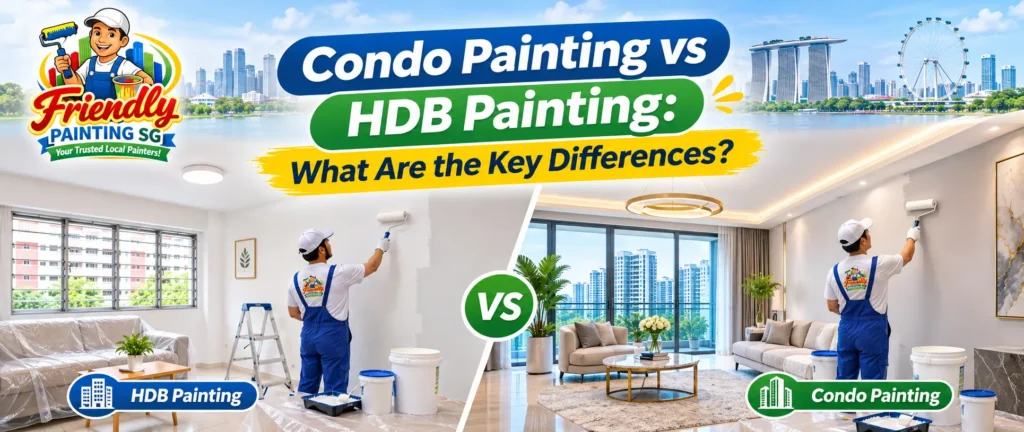
Condo painting vs HDB painting is an important comparison for Singapore homeowners planning to refresh their interiors. Although both involve applying paint to walls and ceilings, the differences go beyond property type. Painting costs, surface preparation, renovation regulations, access requirements, and finishing expectations can all influence the project.
In Singapore, Housing & Development Board (HDB) flats and private condominiums have different property management arrangements. Therefore, understanding these differences helps homeowners choose suitable paints, organise their renovation schedules, and avoid unnecessary expenses.
Whether you own a resale HDB flat, a newly completed BTO apartment, or a private condominium, this guide explains the practical differences between the two painting projects. It also covers Singapore painting costs, paint durability, moisture protection, and how to select a reliable painting contractor.
What Is the Difference Between Condo Painting and HDB Painting?
The main difference between condo and HDB painting lies in the property layout, renovation management, surface conditions, and desired finishing standards.
HDB painting typically focuses on creating a comfortable, attractive, and practical living environment. Many homeowners prefer durable, washable paints that are easy to maintain and suitable for Singapore’s humid climate.
Condo painting may involve additional considerations, including decorative walls, customised interior designs, higher ceilings, and management requirements. However, these features are not present in every condominium.
Importantly, condo painting is not automatically more complicated or expensive than HDB painting. The actual scope of work determines the difficulty and cost.
For homeowners seeking a customised finish, choosing suitable condo painting services in Singapore can help address different wall conditions, interior layouts, and finishing requirements.
Condo Painting vs HDB Painting: Quick Comparison Table
| Comparison Factors | HDB Painting | Condo Painting |
|---|---|---|
| Property type | Public housing flat | Private residential condominium |
| Painting cost | Often based on flat type and scope | Often based on unit size and scope |
| Renovation rules | HDB guidelines apply | MCST rules may apply |
| Wall preparation | Depends on age and condition | Depends on finishes and condition |
| Paint selection | Commonly washable interior paints | Standard or decorative finishes |
| Ceiling height | Usually conventional residential height | May include higher ceilings |
| Design preferences | Practical and personalised | Practical or design-focused |
| Contractor access | Usually straightforward | May require management registration |
| Project duration | Depends on size and preparation | Depends on size, access and finishes |
| Maintenance | Regular cleaning and repainting | Regular cleaning and repainting |
The comparison shows that property ownership alone does not determine painting requirements.
For example, repainting a large executive HDB flat with damaged walls could require more work than refreshing a small condominium with well-maintained surfaces.
Similarly, a condo featuring textured walls, decorative ceilings, or specialised coatings may require additional preparation and skilled application.
Ultimately, homeowners should compare painting projects according to their actual requirements rather than assuming one property type is always more demanding.
Painting Costs for Condos vs HDB Flats in Singapore
Painting cost is one of the most important factors when comparing residential painting services in Singapore.
Generally, painting contractors assess the area requiring treatment, existing wall conditions, selected products, labour requirements, and finishing complexity before preparing a quotation.
While HDB painting packages are often advertised according to flat type, condominium painting quotations may be customised according to floor area and interior features.
However, a larger property does not always mean proportionately higher painting costs.
A smaller apartment with extensive peeling paint, moisture damage, or complicated decorative surfaces may require more preparation than a larger home in good condition.
Key Factors Affecting HDB Painting Costs
Several factors influence the overall cost of HDB painting services.
Whether you own a 3-room, 4-room, or 5-room flat, comparing HDB painting services can help you understand the preparation, paint options, and workmanship included in a quotation.
1. Flat size and room configuration
A 3-room HDB flat generally has less paintable wall area than a 5-room flat. Consequently, larger properties often require additional paint and labour.
However, the number of rooms alone cannot accurately determine the total cost. Ceiling height, wall dimensions, and built-in furniture also affect the usable painting area.
2. Existing wall conditions
Walls with cracks, flaking paint, stains, or uneven plaster need additional attention.
For instance, damaged surfaces may require scraping, patching, sanding, and sealing before new paint can be applied.
3. Paint quality and finish
Standard interior emulsion paints are often more economical than premium washable or specialty coatings.
Although premium products may increase the initial budget, suitable finishes can offer easier cleaning and better resistance to everyday wear.
4. Number of paint coats
A standard repaint may involve two finishing coats, depending on the product instructions and surface condition.
Nevertheless, substantial colour changes or poorly covered surfaces can require additional preparation or coats.
5. Furniture and protection requirements
Occupied homes require careful protection of flooring, appliances, furniture, and electrical fittings.
As a result, painting a furnished HDB flat may involve more preparation time than an empty unit.
Why Condo Painting May Cost More
Condo painting can involve additional expenses when the property contains more demanding architectural or design features.
For example, some condominiums include high ceilings, recessed lighting, large feature walls, and customised decorative finishes.
These elements can require additional masking, specialised access equipment, and more detailed workmanship.
Furthermore, certain developments require contractors to follow specific procedures for registration, deliveries, and access to shared facilities.
Some projects may also require additional protection for lifts, corridors, and other common areas.
However, these requirements vary by development.
A simple repaint in a compact condominium may cost less than a comprehensive HDB renovation involving extensive repairs.
Therefore, the best way to understand condo painting costs is to obtain a quotation based on the actual painting scope.
How to Compare Painting Quotations Fairly
Instead of choosing the lowest advertised painting package, compare quotations based on their included services.
A comprehensive quotation should identify:
- Areas to be painted, including walls and ceilings
- Paint brand, product range, and finish
- Proposed number of coats and primer requirements
- Surface preparation and minor repair work
- Furniture protection and cleaning arrangements
- Estimated project duration
- Additional charges and exclusions
- Workmanship warranty, if offered
Also, ask whether GST is included where applicable.
For example, one quotation may include wall repairs and ceiling painting, while another covers only basic wall repainting.
Although the second quotation appears cheaper, it may not represent better overall value.
A clearly defined scope helps homeowners control costs and reduces the likelihood of misunderstandings during the project.
Painting Rules and Approval Requirements in Singapore
Painting regulations represent another important difference between HDB flats and private condominiums.
Singapore homeowners should understand which requirements apply before arranging contractors or scheduling renovation work.
For HDB flats, renovation activities are governed by relevant HDB guidelines.
Meanwhile, condominium residents must consider their development’s Management Corporation Strata Title (MCST) rules, alongside any applicable statutory requirements.
HDB Painting Guidelines and Restrictions
Ordinary interior repainting generally does not require an HDB renovation permit.
However, the requirements can change if the project includes additional renovation activities, such as structural alterations or certain wall-finishing replacements.
HDB distinguishes between different types of building and wall-finishing works, some of which require approval. HDB
Therefore, homeowners should not assume that every activity involving a wall is classified as simple painting.
For example, repainting an existing bedroom wall is different from demolishing a partition or replacing regulated wall finishes.
Special considerations also apply to household shelters.
HDB permits painting of household shelter walls, ceilings, and doors without a renovation permit, subject to specific restrictions. Painting must not interfere with essential shelter door components or operational features.
Before combining painting with additional renovation activities, homeowners should verify the relevant HDB requirements.
Before starting renovation work, homeowners should review the official HDB renovation guidelines to understand which activities require approval and which restrictions may apply.
Condo Management (MCST) Rules for Painting
Condominium painting arrangements can vary considerably between developments.
The MCST manages common property and administers applicable estate by-laws.
Therefore, a condo owner may need to coordinate with the management office before engaging contractors.
Depending on the development, requirements may include contractor registration, permitted working hours, lift protection, and renovation deposits.
Some condominiums also regulate the use of common areas for transporting tools and materials.
The Building and Construction Authority (BCA) provides guidance on strata management, estate by-laws, and the maintenance of common property. Building and Construction Authority
Consequently, homeowners should obtain the latest renovation guidelines directly from their management office.
Common condo painting considerations include:
- Protecting shared corridors and lift interiors
- Following permitted contractor access hours
- Managing paint deliveries and equipment
- Preventing damage to common property
- Observing restrictions affecting external appearances
These procedures are not identical across every condominium.
When Do Homeowners Need Approval Before Painting?
The need for approval depends on the actual work and applicable property rules.
For standard HDB interior repainting, an HDB renovation permit is generally unnecessary.
Nevertheless, additional regulated renovation work may require approval.
For condominiums, homeowners should check whether management notification, registration, or formal approval is necessary.
Painting exterior surfaces, balcony features, or elements affecting the building’s appearance may involve different requirements from ordinary interior wall painting.
Therefore, contact the relevant authority or management office before starting work that goes beyond straightforward interior repainting.
This simple precaution can prevent delays, disputes, and unexpected renovation complications.
Paint Types and Finishes for Condo and HDB Homes
Choosing suitable interior paint affects the appearance, cleaning requirements, and longevity of painted surfaces.
Fortunately, both HDB flats and condominiums can use many of the same paint systems.
The correct selection depends more on room conditions, surface compatibility, and homeowner preferences than on the property category itself.
In Singapore, humidity, condensation, indoor ventilation, and daily household activity should influence paint selection.
Best Paint Finishes for HDB Flats
HDB homeowners often prioritise practical finishes that balance appearance, durability, and maintenance.
Several options are worth considering.
Matt finish
Matt paint creates a soft, low-sheen appearance that can help reduce the visibility of minor surface imperfections.
It is suitable for bedrooms and living areas where a subtle finish is preferred.
However, not all matt paints are equally washable, so homeowners should examine the specific product’s cleaning properties.
Eggshell finish
Eggshell finishes provide a gentle sheen and can offer improved cleanability, depending on the formulation.
They work well in family living spaces and frequently used rooms.
Satin finish
Satin paint produces a more noticeable sheen and is often easier to wipe clean.
Therefore, it may suit selected high-contact areas where the paint manufacturer recommends its use.
Washable interior paint
Washable products are particularly useful for homes with children, pets, or busy communal spaces.
Nevertheless, washable performance depends on the actual coating system, curing, and cleaning methods.
Homeowners should avoid assuming that every product labelled premium has identical durability.
Popular Paint Finishes for Condominium Interiors
Condominium homeowners may choose standard interior paints or incorporate specialised decorative finishes.
For example, a contemporary living room may feature a muted matt finish, while a selected feature wall uses a textured decorative coating.
Popular design approaches include warm neutral palettes, contrasting feature walls, soft off-white interiors, and carefully coordinated accent colours.
However, decorative complexity should serve a practical purpose.
A highly textured wall may look attractive but can be more difficult to clean or repair than a conventional painted surface.
Similarly, high-sheen finishes may emphasise uneven walls, making proper surface preparation especially important.
Before selecting a decorative system, consider:
- Compatibility with the existing wall substrate
- Cleaning and maintenance requirements
- Lighting conditions
- Repairability
- Application complexity
- Manufacturer recommendations
A visually attractive finish should also remain practical for everyday living.
How Humidity Affects Paint Durability
Singapore’s tropical climate creates an important challenge for interior paint maintenance.
High humidity, condensation, and insufficient ventilation can contribute to mould growth and coating deterioration.
However, humidity alone does not automatically cause paint failure.
Common contributing factors include water leaks, damp substrates, incompatible coatings, inadequate surface preparation, and condensation.
For example, a wall repeatedly exposed to moisture near a leaking window may develop bubbling or peeling paint.
Applying another coat without correcting the moisture source is unlikely to provide a durable solution.
Likewise, anti-mould paint should not be treated as a permanent remedy for unresolved water intrusion.
For better results, identify the source of moisture, repair the affected area, allow appropriate drying, and select a compatible coating system.
The National Environment Agency also recommends using low-VOC-emission materials and maintaining suitable indoor ventilation to support air quality. National Environment Agency
These principles apply equally to HDB flats and condominiums.
Surface Preparation and Painting Process Differences
Proper wall preparation is essential for achieving an even and durable painted finish.
In fact, applying expensive paint over an unsuitable surface can produce disappointing results.
Before painting, contractors should assess the existing coating, inspect damaged areas, and identify problems that may affect adhesion.
Although the fundamental process is similar for condos and HDB flats, the amount of preparation can differ significantly.
Preparing HDB Walls for Repainting
Resale HDB flats may contain several layers of old paint, patched surfaces, or signs of previous renovation work.
Meanwhile, newly completed flats can have different substrate conditions, including uneven surfaces or areas requiring suitable sealing.
A typical preparation process may involve removing loose paint, cleaning the surface, filling minor defects, sanding repaired areas, and applying primer where necessary.
However, not every wall needs the same treatment.
For instance, a sound existing coating may only require cleaning and appropriate preparation before repainting.
By contrast, a wall with severe flaking may need more extensive removal and repair.
Before starting, homeowners should also address moisture problems rather than concealing them beneath new paint.
Good preparation helps improve:
- Adhesion between the substrate and coating
- Uniformity of the final appearance
- Resistance to premature peeling
- Coverage around repaired sections
- Overall consistency of the finish
The right preparation method should follow the wall condition and paint manufacturer’s instructions.
Preparing Condo Walls and Feature Surfaces
Condominium painting may involve decorative surfaces, existing wallpaper, specialty coatings, or built-in interior features.
These conditions require careful assessment.
For example, a previously textured feature wall cannot always be transformed into a perfectly smooth surface through ordinary painting alone.
It may require additional preparation, skim coating, or another appropriate finishing method.
Similarly, painting over glossy surfaces may require abrasion or a compatible adhesion primer.
Contractors should also protect expensive flooring, cabinetry, decorative fittings, and fixed furniture.
Where higher walls are involved, safe access equipment may be necessary.
Thus, preparation should be planned according to the surface and surrounding finishes rather than using a standard method for every room.
Common Painting Problems in Both Property Types
Despite their differences, HDB flats and condominiums experience many of the same paint-related problems.
| Painting Problem | Possible Cause | Appropriate Response |
|---|---|---|
| Peeling paint | Poor adhesion or moisture | Remove loose coating and address the cause |
| Bubbling paint | Trapped moisture or substrate issues | Investigate before repainting |
| Hairline cracks | Minor surface movement or shrinkage | Assess and repair using suitable materials |
| Mould patches | Persistent dampness or condensation | Correct moisture conditions and treat affected areas |
| Uneven colour | Inconsistent coverage or application | Follow correct coating procedures |
| Visible roller marks | Application technique or drying conditions | Use suitable tools and proper technique |
| Stains returning | Unsealed contamination or moisture | Address the source and use compatible stain-blocking primer |
Importantly, persistent cracks, water penetration, or recurring mould may require specialist assessment rather than a simple repaint.
Structural movement and active leakage should not be treated as cosmetic paint defects.
How Long Does Condo Painting vs HDB Painting Take?
Painting duration depends primarily on the size and condition of the home, project complexity, and available working hours.
A straightforward repaint in a reasonably maintained apartment may take only a few working days.
However, extensive preparation, complicated finishes, and additional drying requirements can extend the timeline.
For example, a typical 4-room HDB flat may take approximately two to four working days for a conventional repaint, depending on the contractor’s crew size, preparation, and scope.
A condominium of similar paintable area may take a comparable amount of time.
Nevertheless, high ceilings, decorative finishes, or strict access arrangements can increase the duration.
These estimates are illustrative rather than guaranteed completion times.
Importantly, the time needed to apply paint differs from the time required for it to dry or fully cure.
Homeowners should follow the selected manufacturer’s recommendations before washing newly painted surfaces or placing objects against them.
If you are preparing to move into a condominium, understanding when to repaint your condo before moving in can help you plan around furniture delivery, painting schedules, and ventilation.
Factors That Can Delay a Painting Project
Several circumstances can affect a residential painting schedule.
Extensive repairs: Damaged plaster, cracks, and unstable paint layers may require additional preparation and drying.
Moisture problems: Wet surfaces should not be repainted before the underlying issue is addressed and the substrate is suitable.
Multiple colour changes: Switching from very dark colours to light shades may require additional preparation or coats.
Occupied rooms: Moving and protecting furniture takes time, especially when the household continues using the property.
Management restrictions: Some condominium developments limit contractor working hours or deliveries.
Specialty finishes: Textured coatings and decorative applications may involve additional stages.
Therefore, an accurate timeline should account for preparation, painting, drying, inspection, and cleaning.
Homeowners planning to move into a freshly painted property should also allow sufficient ventilation before normal occupation.
How to Choose the Right Painting Service in Singapore
Choosing an appropriate painting contractor is important for both HDB flats and condominiums.
While attractive paint colours contribute to the final appearance, successful results also depend on workmanship, surface assessment, product compatibility, and clear project management.
A reliable contractor should explain the proposed process and identify potential problems before work begins.
Rather than focusing exclusively on advertised painting packages, homeowners should evaluate the complete service.
Questions to Ask Before Hiring a Painting Contractor
Before appointing a painting company in Singapore, consider asking these questions.
What preparation is included?
Request a clear explanation of cleaning, sanding, filling, primer application, and repairs.
A quotation stating only “painting included” may not provide enough information.
Which paint products will be used?
Ask for the exact manufacturer, product range, finish, and proposed coating system.
This helps you assess suitability and compare quotations fairly.
How many coats will be applied?
The contractor should identify the expected coating process and explain what happens if additional work is necessary.
Are ceilings and doors included?
Some quotations cover walls only, while others include ceilings, doors, or selected woodwork.
Clarifying the scope prevents unexpected charges.
How will furniture and flooring be protected?
Appropriate protective measures help prevent paint splashes, dust contamination, and damage.
Who handles condominium management arrangements?
For condo painting, confirm whether contractor registration, renovation forms, deposits, and shared-area protection are necessary.
What happens if defects appear after completion?
Ask whether workmanship coverage is offered and request its terms in writing.
Together, these questions provide a clearer understanding of what the contractor will deliver.
Common Mistakes to Avoid When Comparing Painting Services
One common mistake is selecting the cheapest quotation without checking the included work.
A low initial price may exclude necessary surface repairs, primer, ceiling painting, or furniture protection.
Another mistake is choosing a product based entirely on colour.
Although colour affects interior design, paint finish, washability, substrate suitability, and moisture exposure are equally important.
Some homeowners also overlook existing dampness.
For example, repainting a mould-affected wall without improving moisture control may lead to recurring problems.
Furthermore, condominium residents sometimes arrange painting before checking management procedures.
This can create unnecessary scheduling difficulties.
Finally, homeowners should inspect completed work before accepting handover.
Check for uneven coverage, missed areas, obvious roller marks, paint splashes, and incomplete cleaning.
An inspection under both natural and normal room lighting can help reveal visible defects.
Choosing a suitable painting contractor is ultimately about achieving a dependable result rather than obtaining the lowest possible upfront price.
Final Verdict: What Should Homeowners Consider Before Painting?
When comparing condo painting vs HDB painting, the most significant differences involve renovation management, property layouts, preparation complexity, and potential finishing requirements.
HDB painting generally follows the applicable HDB framework, while condominium painting may involve MCST procedures and estate-specific contractor requirements.
Nevertheless, both property types benefit from the same essential painting principles: proper surface preparation, suitable products, moisture control, careful application, and realistic project planning.
Condo painting is not inherently superior or more expensive. Likewise, HDB painting is not always simpler.
A well-maintained condo with conventional walls may be easier to repaint than an older HDB flat requiring extensive repairs.
Therefore, homeowners should evaluate the actual surface conditions, desired finish, painting scope, and maintenance expectations before making a decision.
Whether you are refreshing a family HDB flat or updating a condominium interior, choosing a suitable painting service in Singapore can help achieve an attractive finish that is easier to maintain.
The most effective approach is to request a detailed assessment and written quotation that reflects your property’s specific requirements.
Frequently Asked Questions About Condo vs HDB Painting
1. Is condo painting more expensive than HDB painting?
Condo painting can cost more when the property has high ceilings, complicated decorative finishes, or additional access requirements. However, the final cost depends on paintable area, surface condition, selected products, and labour. A straightforward condo repaint may cost less than a heavily damaged HDB repaint.
2. Do I need approval to paint my HDB flat in Singapore?
Ordinary interior repainting generally does not require an HDB renovation permit. However, certain additional renovation activities may require approval. Always check the applicable HDB guidelines if the project includes wall alterations, regulated finishing work, or changes beyond conventional painting.
3. Do condo owners need MCST approval for interior painting?
Not every condominium requires formal approval for basic interior painting. However, some developments impose contractor registration, renovation notification, permitted working hours, or other management procedures. Contact your condominium management office before arranging the work.
4. How often should you repaint a condo or HDB flat?
Many homeowners use approximately three to seven years as a planning interval for interior repainting, but there is no universal schedule. Paint quality, surface exposure, cleaning habits, moisture, and everyday wear influence repainting frequency. Well-maintained coatings may remain serviceable longer.
5. Which paint is best for Singapore’s humid weather?
Suitable options include quality interior emulsion paints with appropriate moisture resistance, washability, and low-VOC formulations. For areas vulnerable to condensation, consider products specifically designed for those conditions. However, fixing water leaks and improving ventilation remain essential.
6. How long does it take to paint a 4-room HDB flat?
A conventional repaint may take approximately two to four working days, depending on the project scope, wall condition, and crew size. Significant repairs or additional coating stages can extend the schedule. Paint curing may also continue after the application work is completed.
7. Can I stay at home during a painting project?
In some cases, yes. However, occupants should consider ventilation, dust, paint emissions, and access to living spaces. Children, people with respiratory sensitivities, and pets may need additional precautions. Follow product safety instructions and contractor guidance before using freshly painted rooms.
8. Is washable paint suitable for both condos and HDB flats?
Yes. Washable interior paint can be suitable for both property types, particularly in living rooms, corridors, and family spaces. However, performance varies by product. Select a finish appropriate for the surface and follow the manufacturer’s recommended curing and cleaning procedures.
9. What should be included in a professional painting quotation?
A detailed quotation should specify the painting areas, paint brand and range, surface preparation, number of coats, repair work, protection arrangements, estimated schedule, exclusions, and total charges. Any offered workmanship warranty should also be clearly documented.
10. How can I make interior paint last longer in Singapore?
Maintain suitable ventilation, control indoor moisture, repair leaks promptly, and clean painted surfaces according to manufacturer instructions. Avoid aggressive scrubbing and harsh cleaning chemicals unless the coating is designed to tolerate them. Address early signs of peeling or dampness before they develop into larger problems.