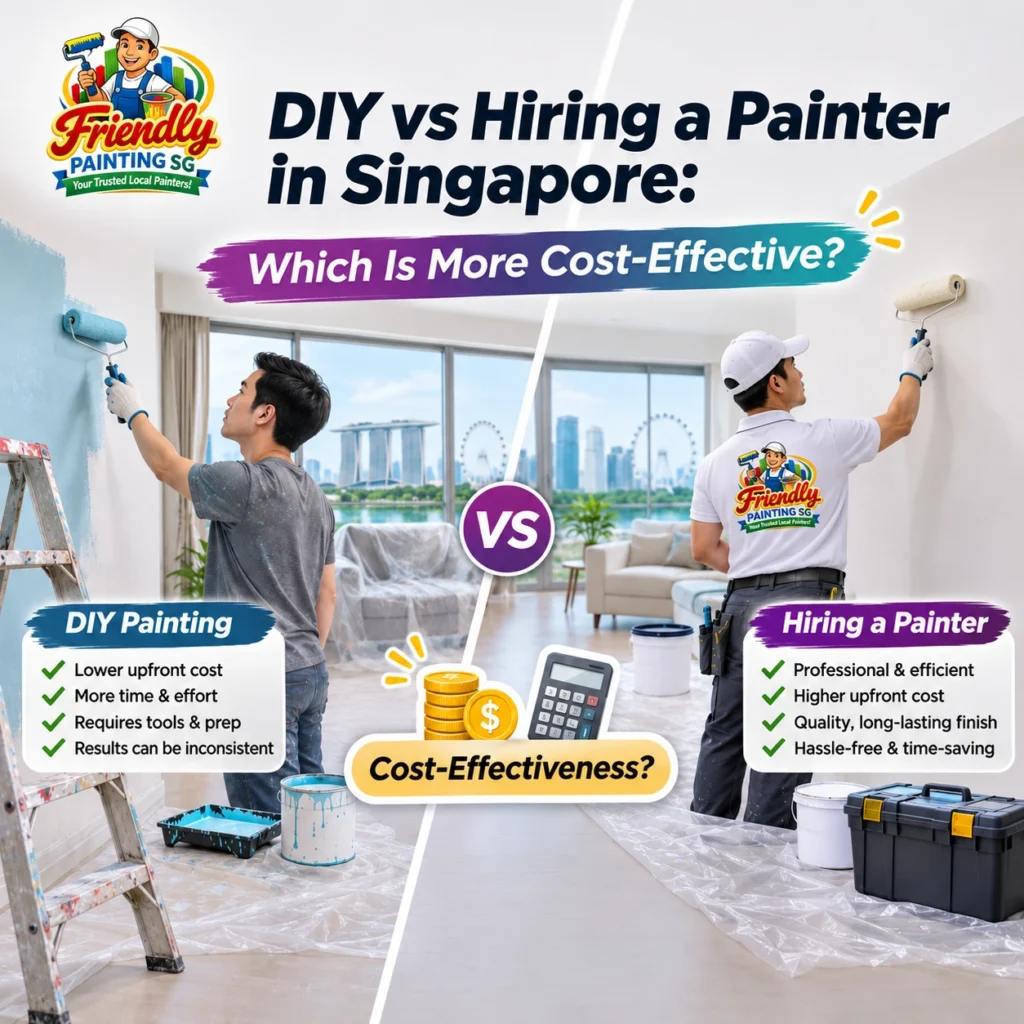
Painting your home can transform its appearance without requiring a complete renovation. However, Singapore homeowners often face one important question: Should they paint their homes themselves or hire experienced painters?
The decision involves more than comparing paint prices. Although DIY painting eliminates labour charges, it requires time, preparation, equipment, and practical skills. Meanwhile, hiring a painter involves higher upfront costs but may reduce mistakes, inconvenience, and additional repair expenses.
When comparing DIY vs professional painting Singapore, the most cost-effective choice depends on your property size, wall condition, available time, and expectations for the finished result.
For example, painting a small HDB bedroom yourself may be affordable and manageable. However, repainting an entire four-room HDB flat can become physically demanding, particularly when walls require extensive preparation.
This guide explores painting costs, hidden expenses, workmanship, long-term durability, and practical considerations for Singapore HDB flats, condominiums, and landed properties.
Is DIY Painting Really Cheaper in Singapore?
DIY painting is generally cheaper upfront because homeowners do not pay for professional labour. Nevertheless, material costs, equipment purchases, preparation time, and potential mistakes can reduce those savings.
In contrast, professional painting services usually combine labour, painting equipment, and agreed preparation work into a service quotation.
Why Singapore Homeowners Compare DIY and Professional Painting
Many homeowners consider repainting when moving into a resale HDB flat, renovating a condominium, or refreshing an older interior.
Common reasons include:
- Reducing home improvement expenses.
- Improving interior appearance before moving in.
- Covering faded colours and minor wall marks.
- Preparing rental properties for new tenants.
- Updating bedroom and living room colours.
- Addressing peeling or deteriorating paint.
While budget is important, homeowners should also consider the work required to achieve a satisfactory finish.
What Makes a Painting Option Truly Cost-Effective?
The cheapest initial option does not always deliver the best value.
A meaningful comparison should consider total expenditure, personal time, workmanship, expected durability, and future maintenance requirements.
For instance, a poorly prepared wall may require repainting sooner than expected. Consequently, an inexpensive painting project can become costly if the original work needs substantial correction.
DIY vs Professional Painting Singapore: Key Differences
DIY and professional painting involve similar basic activities. However, the main differences concern experience, efficiency, tools, responsibility, and finishing quality.
What Does DIY House Painting Involve?
DIY house painting requires homeowners to manage the project themselves.
Typical activities include cleaning walls, filling small holes, sanding rough areas, masking fixtures, purchasing materials, applying primer when necessary, and completing the paint coats.
Afterward, homeowners must clean their equipment and restore the room.
Although these tasks may sound straightforward, achieving consistent coverage requires attention to detail.
What Do Professional Painting Services Include?
Professional painting services in Singapore may offer wall preparation, paint application, furniture protection, and final cleaning.
However, service packages vary. Some quotations include only basic preparation, whereas others cover more extensive surface treatment.
Therefore, always confirm the exact scope before hiring.
DIY vs Professional Painting: Quick Comparison Table
| Comparison Factor | DIY Painting | Hiring a Painter |
|---|---|---|
| Initial expenditure | Usually lower | Usually higher |
| Labour | Homeowner’s time | Paid painting crew |
| Tools | Purchased or borrowed | Usually supplied |
| Painting experience | Depends on homeowner | Depends on contractor |
| Project duration | Often longer | Often shorter |
| Finish consistency | Skill-dependent | Skill-dependent |
| Wall repairs | DIY or separately hired | May be included |
| Furniture protection | Homeowner’s responsibility | Depends on package |
| Cleanup | Homeowner | Depends on quotation |
| Long-term value | Good for simple jobs | Often attractive for complex jobs |
Upfront Cost, Time, Quality, and Convenience
DIY painting can be financially appealing when homeowners already own the necessary equipment.
However, purchasing tools for a one-time project can reduce the difference between DIY and hiring a painter.
Professional services generally provide greater convenience because homeowners do not need to perform every stage themselves.
Long-Term Durability and Maintenance Requirements
Paint durability depends on surface preparation, product suitability, environmental conditions, and application quality.
A carefully completed DIY job can last well. Equally, professional work can fail prematurely when preparation is inadequate.
Therefore, workmanship matters more than the job label alone.
How Much Does DIY House Painting Cost in Singapore?
DIY painting expenses vary according to room size, paint quality, surface condition, and the equipment already available.
Paint, Primer, and Wall Preparation Materials
Paint is usually one of the main material expenses.
Homeowners must consider the required quantity, number of coats, colour selection, and whether primer or sealer is necessary.
For example, changing a dark wall to a light colour may require additional preparation and coverage.
Furthermore, certain surfaces need suitable primers to support adhesion or prevent stains from showing through.
Painting Tools and Equipment Expenses
A complete DIY painting setup commonly requires several supplies.
Rollers, Brushes, Trays, and Protective Sheets
Rollers are useful for covering larger wall surfaces, while brushes help with edges, corners, and detailed areas.
Painting trays, extension poles, and protective sheets make the process more organised.
Ladders, Sandpaper, Fillers, and Masking Tape
Other equipment may include:
- Suitable step ladders.
- Sandpaper and sanding blocks.
- Wall filler and filling knives.
- Masking tape.
- Cleaning cloths.
- Protective gloves and eyewear.
These expenses are particularly relevant for homeowners attempting their first painting project.
Hidden Costs of DIY Painting
Apart from materials, several less obvious expenses may arise.
Wasted Paint and Unexpected Material Purchases
Beginners may purchase too much paint or underestimate the amount required.
Incorrect tools, unsuitable paint, or inadequate preparation can also lead to additional purchases.
Fixing Uneven Coats, Drips, and Painting Mistakes
Common problems include roller marks, patchy coverage, paint drips, and visible brush strokes.
Correcting these issues may involve sanding and repainting affected sections.
Consequently, DIY painting becomes less economical when substantial rework is necessary.
How to Estimate Your Total DIY Painting Budget
Use the following calculation:
DIY painting cost = Paint + Primer + Tools + Preparation materials + Protective supplies + Rework expenses
You can also assign a value to your own time for a more complete comparison.
Calculating Paint Quantity Based on Wall Area
First, estimate the total paintable surface.
Multiply each wall’s width by its height, then subtract relevant door and window areas.
Next, consider the number of coats and the manufacturer’s stated paint coverage.
Why Floor Area and Paintable Wall Area Are Different
A flat’s floor area does not indicate its exact paintable wall area.
Two apartments with similar floor sizes may have different room layouts, ceiling heights, and wall surfaces.
Therefore, using floor area alone can produce an inaccurate materials estimate.
How Much Does Hiring a Painter Cost in Singapore?
The cost of hiring painters depends on the property’s size, preparation requirements, product selection, and overall project scope.
Published Singapore painting price guides vary considerably. For context, some 2026 guides place standard whole-flat repainting of a four-room HDB within approximately S$700–S$2,700, depending on the provider and inclusions. These are indicative market observations rather than a guaranteed quotation. Homees+2
Key Factors Affecting Professional Painting Costs
HDB Flat Size and Number of Rooms
Larger properties usually require more paint, labour, and preparation.
However, the number of rooms alone does not determine the price. Wall dimensions and overall condition are equally important.
Condo and Landed Property Painting Requirements
Condominiums may involve additional access arrangements, higher ceilings, or management requirements.
Meanwhile, landed properties can include stairwells, large interior spaces, and other complicated areas.
As a result, these projects may involve additional labour and equipment.
Paint Quality, Wall Condition, and Number of Coats
Paint specifications influence the final quotation.
Moreover, damaged walls may require substantial repairs before any finishing coats can be applied.
What Is Usually Included in a Painting Quotation?
Depending on the contractor, a quotation may include paint supplies, labour, basic surface preparation, furniture protection, and cleanup.
However, never assume that every service is automatically included.
Request written confirmation of the paint brand, product range, number of coats, preparation work, and areas covered.
Additional Charges Homeowners Should Check
Potential additional charges include extensive plaster repairs, stain treatment, mould-related work, difficult access, and moving heavy furniture.
Therefore, ask whether these items are included before accepting a quotation.
How to Compare Painting Quotations Fairly
Compare quotations based on identical requirements.
For example, one contractor may quote for walls only, while another includes ceilings and door frames.
The cheaper quotation is not necessarily better when the service scope differs.
DIY vs Professional Painting: Which Offers Better Value?
A fair comparison considers the total project cost rather than paint and labour expenses separately.
Comparing Upfront Expenses
DIY painting generally offers lower initial expenditure.
Nevertheless, this advantage becomes smaller when homeowners need to purchase all their equipment or prepare damaged walls.
Professional painting costs more initially but may include equipment and coordinated labour.
Factoring in Your Time and Physical Effort
Time is a major consideration.
DIY painting requires preparation, application, drying intervals, and cleanup. Additionally, larger projects can occupy several weekends.
Homeowners with demanding schedules may consider this inconvenience significant.
Comparing Finish Quality and Paint Durability
An experienced painter may achieve more consistent coverage, especially around corners, ceilings, and detailed surfaces.
However, professional services are not automatically superior.
Homeowners should assess the contractor’s workmanship, preparation methods, and materials rather than relying only on advertising claims.
Potential Repainting and Maintenance Costs
Paint durability depends on surface preparation, product quality, and Singapore’s humid climate. Therefore, understanding how often to repaint an HDB flat in Singapore can help homeowners plan maintenance, avoid unnecessary expenses, and determine whether DIY or professional painting offers better long-term value.
Poor adhesion, insufficient preparation, and unsuitable products can cause premature paint deterioration.
For this reason, long-term value depends on getting the application process right.
Cost Comparison for Different Home Sizes
| Home or Project Type | DIY Cost Advantage | Professional Painting Advantage |
|---|---|---|
| Single feature wall | Often significant | Convenient, but labour may outweigh savings |
| Small bedroom | Usually attractive | Helpful for tight schedules |
| 3-room HDB | Depends on equipment and time | Efficient whole-home coordination |
| 4-room HDB | More potential labour savings | Reduced homeowner effort |
| 5-room HDB | Greater time commitment | Useful for extensive projects |
| Condominium | Depends on layout | Helpful for complicated surfaces |
Small HDB Bedrooms and Feature Walls
These projects are often suitable for DIY painting because the working area is manageable.
Three-Room and Four-Room HDB Flats
For medium-sized flats, the decision depends heavily on personal availability and wall condition.
Five-Room HDB Flats and Condominiums
Large properties involve more extensive preparation and application work.
Consequently, professional painting becomes more appealing when homeowners prioritise convenience and efficient completion.
Advantages and Disadvantages of DIY Painting
DIY painting offers flexibility and potential savings. However, the process also presents practical challenges.
Benefits of Painting Your Home Yourself
Greater Control Over Colours and Scheduling
Homeowners can choose their preferred colours and complete the project at a comfortable pace.
They can also experiment with small areas before committing to an entire room.
Potential Savings on Small Painting Projects
For straightforward jobs, avoiding labour charges may provide meaningful savings.
This is particularly true when tools and leftover materials are already available.
Common Challenges of DIY Painting
Surface Preparation and Uneven Paint Coverage
Improper sanding, cleaning, or priming may affect the finished appearance.
Likewise, inexperienced application can produce inconsistent coverage.
Time Constraints, Fatigue, and Cleaning
Painting requires repeated physical movements and careful attention.
Additionally, protecting furniture and cleaning afterward can be tiring.
Working Safely Around High Walls and Ceilings
Painting elevated surfaces introduces access and fall risks.
Therefore, homeowners should avoid unsafe climbing arrangements and consider experienced help for difficult areas.
Benefits and Limitations of Hiring Professional Painters
Professional painting can simplify a home improvement project, although service quality varies between providers.
Skilled Surface Preparation and Application
Experienced painters should understand how to assess surfaces and select appropriate preparation methods.
Proper preparation can improve adhesion, coverage, and visual consistency.
Efficient Project Planning and Execution
A coordinated painting crew can divide tasks and complete different stages efficiently.
This may reduce disruption, particularly in occupied homes.
Access to Appropriate Tools and Painting Techniques
Professional crews generally have equipment suited to different surfaces and room layouts.
As a result, homeowners may avoid purchasing specialised tools for a single project.
Possible Drawbacks of Professional Painting Services
Higher Initial Labour Costs
Labour is an additional expense that DIY homeowners avoid.
Therefore, hiring a painter may not be economical for every small project.
Scheduling, Service Scope, and Quality Differences
Contractor availability, preparation standards, and communication can vary.
Before hiring, confirm the agreed scope and completion arrangements.
When Is DIY Painting the Better Choice?
DIY painting is most suitable when the project is straightforward, safe, and manageable.
Painting a Small Bedroom or Accent Wall
A single room or accent wall generally requires less preparation and equipment than a complete property repaint.
Consequently, it can be a sensible starting point for beginners.
Refreshing Walls That Are Already in Good Condition
Smooth, clean, dry walls often require less corrective work.
However, homeowners should still follow product instructions and prepare surfaces properly.
Having the Skills, Time, and Proper Equipment
DIY painting becomes more attractive when the homeowner has previous experience and access to suitable tools.
Moreover, a flexible schedule makes it easier to accommodate drying and recoating intervals.
Situations Where DIY Painting May Cost More
DIY can become expensive when incorrect products, extensive repairs, or repeated application mistakes increase material consumption.
In these situations, hiring an experienced painter may offer better overall value.
When Should You Hire a Professional Painter in Singapore?
Larger properties often involve high ceilings, extensive wall surfaces, and more complicated preparation. In these situations, landed house painting services may be a practical alternative to handling the entire project yourself.
Painting an Entire HDB Flat or Condominium
Whole-home painting involves multiple rooms, ceilings, edges, and furniture arrangements.
Professional assistance can make the process more manageable.
Dealing With Peeling Paint, Stains, or Damaged Walls
Damaged surfaces may require specialised preparation before painting.
Importantly, active leaks and moisture problems must be resolved before applying new paint.
Preparing a Home Before Moving In or Renting Out
Time-sensitive projects can benefit from coordinated painting services.
For example, landlords may need a property refreshed before tenants move in.
Projects Requiring Extensive Preparation or High-Reach Work
Complicated repairs and difficult access increase project risks.
Therefore, professional assistance may be the safer and more practical choice.
Common DIY Painting Mistakes That Increase Costs
Avoiding basic painting mistakes can significantly improve the financial value of DIY work.
Skipping Proper Wall Cleaning and Preparation
Dust, grease, and loose paint may interfere with adhesion.
As a result, homeowners should clean and prepare surfaces before applying new coats.
Choosing the Wrong Paint or Primer
Different surfaces require suitable coating systems.
For instance, a problematic stained wall may need an appropriate stain-blocking primer rather than ordinary paint alone.
Applying Incorrect Paint Thickness
Excessively thick coats may cause runs or uneven drying.
Meanwhile, overly thin coats can produce inconsistent coverage.
Always follow the manufacturer’s application guidance.
Ignoring Drying and Recoating Times
Applying another coat too early may interfere with the finish.
Singapore’s humidity can also affect drying conditions, making ventilation important.
Failing to Protect Furniture, Floors, and Fixtures
Paint spills can create additional cleaning expenses.
Therefore, cover furniture and flooring before beginning work.
How to Save Money on House Painting in Singapore
Reducing painting costs does not necessarily mean choosing the cheapest paint or contractor.
Instead, homeowners should minimise unnecessary work and avoid preventable mistakes.
Choose Paint Based on Room Conditions and Usage
Different areas have different requirements.
For example, frequently used spaces may benefit from washable finishes, while damp-prone areas require appropriate moisture management.
Compare Detailed Painting Quotes
Request itemised quotations from suitable providers.
Furthermore, confirm the exact paint products, preparation requirements, and any exclusions.
Prepare Rooms Before Painting Begins
Where appropriate, homeowners can remove small belongings and clear access to walls.
This may reduce preparation time, although any labour savings should be confirmed with the contractor.
Combine DIY Preparation With Professional Painting Where Appropriate
A hybrid approach can sometimes provide good value.
For example, homeowners may handle simple furniture arrangements while leaving specialist preparation and paint application to experienced workers.
Plan Painting Work Before Moving Furniture Into a Home
Painting an empty property is often easier than working around furniture.
Therefore, scheduling work before moving in may reduce inconvenience and simplify preparation.
DIY vs Professional Painting for Singapore HDB and Condo Homes
Singapore properties have specific practical considerations involving building layouts, management rules, and climate.
Special Considerations for HDB Flats
According to Singapore’s Housing & Development Board, ordinary painting of walls, ceilings, and doors does not require an HDB renovation permit. However, specific restrictions apply to household shelter components, and other associated renovation work may have separate requirements. HDB
Homeowners should distinguish normal repainting from structural alterations or more extensive renovation work.
Before starting a DIY painting project, homeowners should review the official HDB renovation guidelines. Although ordinary interior wall and ceiling painting does not require an HDB permit, specific conditions and restrictions still apply.
Condo Management Rules and Work Arrangements
Condominium residents should check their management corporation’s requirements before arranging painting work.
Depending on the development, contractors may need to follow access procedures, permitted working hours, or other house rules.
Singapore’s Humid Climate and Paint Performance
Humidity affects the conditions in which interior paint is applied and maintained.
Moisture, Ventilation, and Surface Conditions
Poor ventilation and persistent moisture can contribute to paint deterioration.
However, repainting alone does not resolve leaks or underlying dampness.
Choosing Suitable Interior Paint Finishes
Choose coatings based on the room’s requirements, surface condition, and manufacturer’s guidance.
Where condensation or mould is recurring, correct the moisture problem before repainting.
How to Choose a Reliable Painting Contractor in Singapore
Hiring a painting contractor should involve more than selecting the lowest quotation.
Review Experience and Relevant Past Projects
Look for evidence of completed projects involving similar property types.
For example, experience with occupied HDB flats may be relevant when furniture protection and scheduling are important.
Request a Clear, Itemised Quotation
A useful quotation should explain what is included.
This allows homeowners to compare different service providers more accurately.
Check Paint Specifications and Preparation Methods
Confirm the product range, expected number of coats, and surface preparation process.
Additionally, ask how the contractor will address damaged or stained areas.
Understand Workmanship Terms and After-Service Support
Find out whether the contractor provides any workmanship-related support.
Where a warranty is offered, request written details of its coverage, exclusions, and duration.
Questions to Ask Before Hiring a Painter
Before confirming a booking, consider asking:
- Which paint brand and product range will you use?
- How many coats are included?
- Will you repair minor cracks and surface defects?
- Are ceilings, doors, and trims included?
- Who will protect furniture and flooring?
- How will additional charges be approved?
- What happens if defects are discovered after completion?
Clear answers help prevent misunderstandings and unexpected expenditure.
Final Verdict: DIY or Professional Painting — Which Is More Cost-Effective?
Both DIY painting and professional painting can be cost-effective when matched to the right project.
Best Choice for Budget-Conscious Homeowners
DIY painting is generally the more economical option for small, straightforward areas when homeowners have sufficient time, basic skills, and suitable equipment.
For example, refreshing a single bedroom wall may not justify the expense of hiring a crew.
However, homeowners should account for all required materials rather than comparing paint prices with a complete contractor quotation.
Best Choice for Larger or More Complex Painting Projects
Professional painting often provides stronger practical value for whole-home repainting, complicated preparation, and projects with tight deadlines.
Although labour increases the initial cost, experienced assistance can reduce the homeowner’s workload and may help minimise avoidable rework.
Making the Right Decision Based on Total Value
Ultimately, the most cost-effective painting method depends on your circumstances.
Consider the project’s size, wall condition, available time, equipment requirements, and expectations for the final result.
The key takeaway: DIY painting usually offers better upfront savings for smaller projects. Professional painting becomes increasingly attractive when convenience, extensive preparation, and efficient whole-home completion matter more.
Instead of choosing solely by price, compare the complete cost and expected outcome.
Frequently Asked Questions About DIY vs Professional Painting in Singapore
1. Is DIY painting cheaper than hiring a professional painter in Singapore?
DIY painting is generally cheaper upfront because homeowners avoid labour charges. However, tools, preparation materials, and corrective work can increase expenses. For smaller projects, DIY often offers better savings. Larger or more complicated projects may provide better overall value when handled by experienced painters.
2. How much can homeowners save by painting their own HDB flat?
Savings depend on the flat’s size, paint selection, equipment already owned, and local painting quotations. Homeowners can estimate potential savings by subtracting their complete DIY expenses from a comparable professional quotation. Personal time and possible rework should also be considered.
3. Is it worth hiring a painter for just one room?
Hiring a painter can be worthwhile when the room has damaged walls, difficult ceilings, or complicated preparation requirements. However, homeowners with suitable tools and basic skills may find DIY more affordable for a simple bedroom refresh.
4. How long does it take to paint an HDB flat yourself?
The duration depends on flat size, wall condition, preparation, drying intervals, and the number of people involved. Painting an entire flat can require several working sessions or weekends. Professional crews may complete the work more quickly through coordinated labour.
5. What are the hidden costs of DIY house painting?
Common hidden expenses include masking supplies, fillers, sandpaper, protective materials, equipment purchases, wasted paint, and additional coats. Furthermore, correcting mistakes can increase both the final cost and the time required.
6. Does professional painting last longer than DIY painting?
Not necessarily. Durability depends on surface preparation, coating quality, application methods, and environmental conditions. A carefully completed DIY project can perform well, while poorly executed professional work may deteriorate prematurely.
7. Can I paint my HDB flat without hiring a contractor?
Yes. Ordinary interior wall and ceiling painting generally does not require an HDB renovation permit. However, homeowners must comply with relevant restrictions, particularly those concerning household shelter components. Other renovation activities may require separate approval.
8. What type of paint is best for Singapore’s humid climate?
Suitable interior paint depends on the surface, ventilation, room usage, and moisture conditions. Washable finishes may suit busy living areas, while damp-prone rooms require attention to moisture management. Homeowners should follow manufacturer recommendations rather than assuming one paint type suits every space.
9. How can I reduce the cost of professional painting services?
Start by requesting detailed quotations and comparing equivalent services. Additionally, identify unnecessary extras, prepare accessible rooms where appropriate, and select suitable paint products based on actual needs. Clear communication can help prevent unexpected charges.
10. Should I DIY or hire a painter before moving into a new home?
DIY may work well for small projects when the moving schedule is flexible. However, professional painting is often more convenient for complete HDB or condominium repaints, especially when work must be completed before furniture arrives.