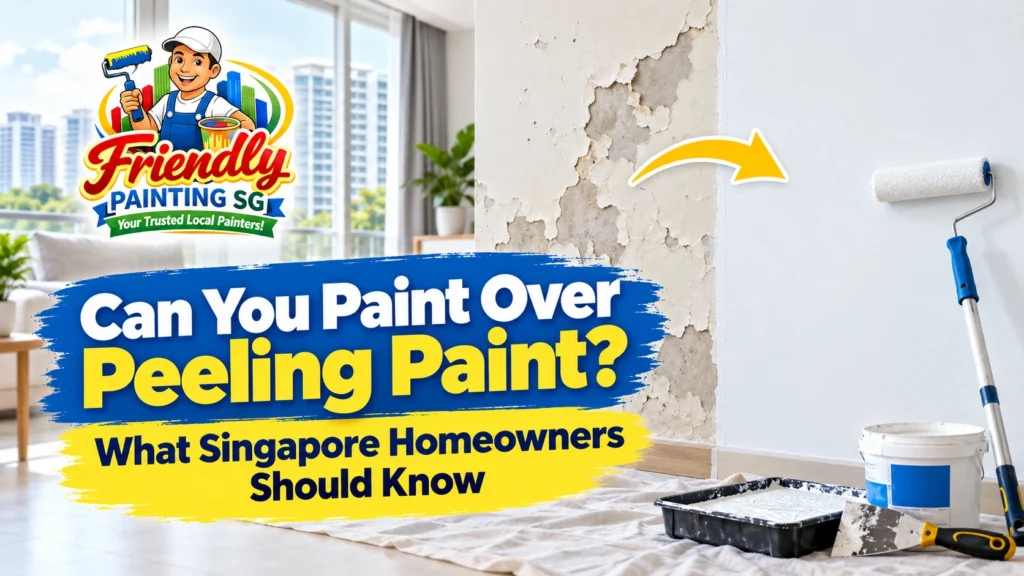
Painting over peeling paint in Singapore may seem like a quick way to refresh damaged walls, but applying new paint directly over loose or flaking surfaces rarely produces lasting results. Whether you live in an HDB flat, condominium, or landed property, proper wall preparation is essential to achieving a smooth, durable finish.
The short answer is no—you should not paint directly over peeling paint. First, remove unstable paint, identify and resolve any moisture problems, repair damaged areas, and apply a suitable primer or sealer. Once the wall is clean, dry, and stable, you can repaint it using an appropriate coating system.
Singapore’s humid tropical climate adds another challenge. Moisture, condensation, water seepage, and inadequate ventilation can weaken paint adhesion over time. As a result, a seemingly minor patch of peeling paint may indicate an underlying maintenance problem.
This guide explains why walls peel, how to repair damaged paint step by step, which products to consider, and when Singapore homeowners should seek help from an experienced painting contractor.
Can You Paint Over Peeling Paint Without Removing It?
Painting over peeling paint without preparing the surface is not recommended. Although a fresh coat may temporarily hide the problem, it cannot restore adhesion between the existing loose paint and the wall.
When the old coating eventually separates, the new layer comes off with it.
However, this does not mean every wall must be completely stripped before repainting. The correct approach depends on how much paint is damaged and whether the remaining coating is firmly attached.
What Happens If You Paint Directly Over Peeling Paint?
Several problems can appear when new paint is applied to an unstable surface.
- Continued peeling: Loose paint underneath the new coating can continue separating from the wall.
- Uneven appearance: Raised edges, cracks, and old paint flakes remain visible after repainting.
- Poor adhesion: The fresh coating may fail because the underlying layer cannot support it.
- Wasted materials: Additional paint and labour may be required to correct the failed finish.
- Recurring moisture damage: If water seepage caused the original problem, repainting alone will not stop it.
For example, consider an HDB bedroom wall with peeling paint near an air-conditioning unit. If the problem is caused by condensation or a leaking drainage pipe, applying another coat of paint will not solve the underlying issue.
Instead, the moisture source needs to be identified and repaired before any decorative work begins.
When Can You Repaint Without Stripping the Entire Wall?
Complete paint removal is not always necessary.
If the damage affects only a small section and the surrounding paint remains firmly attached, you may be able to repair the affected area and repaint.
A suitable repair generally involves removing loose material, smoothing the edges, repairing the exposed surface, priming where required, and applying new paint.
However, extensive flaking, repeated blistering, or widespread adhesion failure may require more substantial removal.
The important distinction is between sound existing paint, which may remain, and unstable paint, which must be removed.
Why Surface Preparation Matters More Than an Extra Coat of Paint
Additional layers cannot compensate for a poorly prepared wall.
Even premium interior paint can fail when applied over dust, grease, moisture, chalking, or deteriorating plaster.
Singapore’s Housing & Development Board provides practical advice on wall maintenance, crack repairs, and ventilation through HDB’s wall maintenance guidelines.
Therefore, identifying surface defects and preparing damaged areas before repainting is essential for achieving a durable finish.
Why Does Paint Peel Off Walls in Singapore?
Peeling paint can have several causes. Understanding them is important because different problems require different solutions.
Singapore’s warm, humid environment can contribute to moisture-related paint defects, but humidity is not always the sole explanation.
High Humidity and Moisture Buildup
Singapore experiences high humidity throughout the year.
In poorly ventilated rooms, moisture may accumulate on cooler surfaces, particularly around air-conditioned spaces and enclosed bathrooms.
Over time, persistent moisture can affect some paint systems and contribute to blistering or peeling.
Common problem areas include bedrooms with inadequate air circulation, kitchens, bathrooms, and walls behind large furniture.
Nevertheless, a properly prepared wall with a compatible paint system should not peel simply because the surrounding air is humid.
Water Seepage and Hidden Wall Leaks
Water seepage is a more serious cause of recurring paint damage.
Possible sources include leaking pipes, defective waterproofing, roof leaks, and water entering through exterior walls.
Signs that suggest a moisture problem include:
- Dark patches that return after cleaning
- Paint bubbling beneath the surface
- Damp or softened plaster
- Yellowish or brownish stains
- Mould growth accompanied by persistent dampness
- Paint deterioration that repeatedly appears in the same location
For HDB homeowners, ceiling leaks may sometimes originate from the floor of the unit above. In such cases, the source must be addressed before repainting.
Poor Surface Preparation and Missing Primer
A wall may look clean while still containing fine dust, chalky residue, grease, or loosely attached paint.
These contaminants interfere with adhesion.
Similarly, bare plaster or repaired areas may require a suitable sealer before receiving the final paint.
Skipping these steps can produce an attractive initial finish that deteriorates prematurely.
Using Incompatible or Low-Quality Paint
Different surfaces and coatings require compatible materials.
Applying an unsuitable product over an existing finish may reduce adhesion, particularly when the old coating is glossy, contaminated, or incompatible with the new paint.
In addition, products designed for exterior weather exposure are not automatically suitable for bedrooms and other indoor spaces.
Always choose coatings according to their intended application and the manufacturer’s instructions.
Ageing Paint, Poor Ventilation, and Everyday Wear
All paint systems experience wear over time.
Cleaning, furniture contact, sunlight, moisture exposure, and everyday use can gradually reduce a coating’s condition.
Older homes may also contain several layers of paint applied during previous renovations. If one underlying layer loses adhesion, newer layers may eventually detach with it.
Consequently, identifying the condition of the entire paint system is important before deciding how extensively to repair the wall.
How to Identify Peeling Paint Before Repainting
Before scraping or sanding, inspect the affected area carefully.
Different visible defects may have similar appearances but require different treatment.
Common Signs of Paint Adhesion Failure
Flaking, Cracking, and Loose Paint
Flaking occurs when small pieces of the coating detach from the surface.
Cracking appears as fine or larger breaks in the paint film. In some cases, cracks extend into the plaster beneath.
Loose paint may lift when lightly touched or scraped.
If the surrounding coating is also poorly attached, the damaged area may be larger than it initially appears.
Bubbling, Blistering, and Damp Patches
Paint bubbles form when the coating lifts away from the underlying surface.
Moisture is one possible cause, although trapped air, unsuitable application conditions, and coating incompatibility can also contribute.
If the wall remains damp, investigate the water source instead of opening the bubbles and immediately repainting.
Powdery Walls and Peeling Ceiling Paint
A powdery surface may indicate chalking, deteriorated paint, or unstable plaster.
Such surfaces require proper cleaning and assessment before priming.
Ceiling damage deserves particular attention.
Peeling ceiling paint is different from spalling concrete. If concrete is cracking, bulging, or falling away, a qualified contractor should assess the condition rather than treating it as an ordinary painting defect.
How to Check Whether the Wall Is Dry and Stable
Start with a visual inspection.
Look for damp patches, mould, water stains, peeling edges, and damaged plaster.
Next, check whether the paint is loose or firmly attached. A qualified painter may use appropriate adhesion testing methods to assess the existing coating.
Moisture testing may also be necessary if the wall has experienced water seepage.
A surface that feels dry to the touch is not necessarily dry enough for painting. Follow the coating manufacturer’s substrate moisture requirements rather than relying on appearance alone.
When Peeling Paint Indicates a More Serious Problem
Some situations require further investigation before decorating.
Examples include recurring dampness, extensive mould, deteriorating plaster, active leaks, and damage that continues spreading after previous repainting.
Likewise, cracks accompanied by bulging concrete or exposed reinforcement should not be treated as simple paint defects.
Address the underlying condition first. Otherwise, repeated repainting may only delay the necessary repair.
How to Fix Peeling Paint on Walls Before Repainting: Step-by-Step
Learning how to fix peeling paint on walls can help homeowners distinguish a manageable cosmetic repair from a larger maintenance problem.
The following process is suitable for ordinary interior wall paint damage where the underlying surface is sound and there is no active water leakage or structural deterioration.
Step 1: Identify and Fix the Source of Moisture
Before removing paint, determine why it failed.
Check nearby air-conditioning units, plumbing connections, exterior walls, and areas exposed to regular condensation.
If the wall is damp, repair the source of moisture and allow the substrate to dry adequately.
Where leakage is recurring or difficult to locate, engage an appropriate specialist.
Painting should begin only after the underlying problem has been resolved.
Step 2: Protect Furniture, Floors, and Electrical Fittings
Move furniture away from the affected wall.
Cover the floor with protective sheets and use painter’s tape around suitable fixtures and trim.
Wear safety glasses, gloves, and appropriate respiratory protection when necessary.
If peeling paint is near electrical outlets, switches, or wiring, take appropriate electrical precautions and engage a qualified electrician where required.
Avoid disturbing unknown older coatings or hazardous materials without proper assessment.
Step 3: Scrape Away Loose and Flaking Paint
Use a suitable paint scraper to remove paint that has already detached or is no longer firmly bonded.
Work carefully to avoid unnecessarily damaging the wall beneath.
Do not attempt to preserve unstable paint merely because it is inconvenient to remove.
How to Remove Peeling Paint Without Damaging the Wall
Hold the scraper at a shallow angle and apply controlled pressure.
Begin at an already loose edge and work outward until the surrounding coating is sound.
Avoid gouging plaster or creating deep marks.
If paint continues lifting across a wide area, stop and assess whether broader removal is necessary.
Do You Need to Remove All Old Paint?
Not necessarily.
Firmly attached, compatible existing paint may remain after suitable preparation.
However, all loose, defective, or contaminated layers should be removed.
Widespread failure may justify stripping a larger section or the entire wall to achieve a stable base.
Step 4: Sand and Clean the Wall Surface
After scraping, smooth the transition between the exposed area and the remaining paint.
Use suitable abrasive paper or a sanding tool according to the surface condition.
The objective is to remove rough edges and improve the finish without excessively damaging the substrate.
Next, remove sanding dust with an appropriate cleaning method.
Allow the wall to dry completely before applying further materials.
Dust left behind can undermine the adhesion of fillers, primers, and paint.
Step 5: Repair Cracks, Holes, and Uneven Areas
Apply an appropriate wall filler or repair compound to minor imperfections.
Different materials are suitable for different substrates and depths of repair, so select a product designed for the job.
Allow it to cure or dry according to the manufacturer’s instructions.
Once ready, sand the repaired area to create a smooth transition.
However, do not simply fill cracks that are widening, recurring, or associated with movement or structural deterioration. Those conditions may require specialist assessment.
Step 6: Apply the Correct Wall Primer or Sealer
Priming helps prepare the repaired substrate for the finishing coats.
Bare plaster, patched areas, porous surfaces, and certain existing coatings may require different primers.
Why Primer Helps Prevent Paint Peeling
A suitable primer or sealer can promote adhesion, control excessive surface absorption, and create a more consistent base.
However, it does not permanently bond loose paint back to the wall or eliminate active moisture problems.
Consequently, it should be viewed as part of a complete preparation process rather than a shortcut.
Choosing a Suitable Sealer for Singapore Homes
When selecting a sealer, consider the substrate, existing coating, repaired areas, and anticipated exposure.
For example, a masonry wall repaired with filler may need a compatible masonry sealer before an interior emulsion.
Some products are designed for alkaline surfaces, while others address specific adhesion or stain-blocking requirements.
Check whether the product is intended for interior use, its ventilation requirements, and its compatibility with the chosen topcoat.
Step 7: Repaint the Wall With Suitable Interior Paint
After the primer has dried or cured as required, apply the selected finishing paint.
Use the recommended roller or brush and follow the manufacturer’s coverage and application guidance.
Avoid excessively thick coats.
For small repairs, painting the entire wall section may produce a more consistent appearance than touching up only the damaged patch.
How Many Coats of Paint Are Needed?
Many interior paint systems specify two finishing coats, although the correct number depends on the product, colour, substrate, and required coverage.
Follow the technical data sheet rather than assuming every project needs the same number.
How Long Should Paint Dry Between Coats?
Recoat times vary by formulation and environmental conditions.
Check the manufacturer’s instructions for the specific paint being used.
Applying another coat too early can affect drying, adhesion, and the final appearance.
Why Humidity and Ventilation Affect Drying Time
High humidity can slow the evaporation of water from certain coatings.
Poor airflow may extend drying further, particularly in enclosed bathrooms and bedrooms.
Therefore, maintain suitable ventilation while respecting the manufacturer’s application conditions.
Avoid directing excessive heat at the wall in an attempt to force rapid drying.
What Is the Best Paint for Peeling Walls in Singapore?
There is no single paint product that solves every peeling-wall problem.
The most appropriate choice depends on the substrate, existing coating, moisture exposure, room usage, and condition of the repaired surface.
For homeowners comparing interior paint options, it is more useful to evaluate performance requirements than rely entirely on product popularity.
Choosing Paint for Humid Indoor Conditions
For living rooms and bedrooms, a quality interior emulsion suitable for masonry or plaster may be appropriate.
Consider washability, finish, adhesion requirements, indoor air quality characteristics, and compatibility with the selected primer.
For areas exposed to frequent condensation, a coating formulated for the relevant conditions may provide better suitability.
Nevertheless, persistent water seepage must be corrected independently.
Anti-Mould Paint vs Standard Interior Emulsion
Anti-mould paint contains formulations intended to resist fungal growth on the paint film under specified conditions.
Standard interior emulsion is generally designed for decorative coverage and routine interior performance.
The differences depend on the individual products rather than their category names alone.
Importantly, anti-mould coatings do not remove established mould contamination or repair a damp wall.
Existing contamination should be addressed safely, and the moisture conditions that caused it must be corrected.
When Moisture-Resistant Paint Is Appropriate
Moisture-resistant coatings may be useful in kitchens, bathrooms, and other areas subject to intermittent humidity.
However, moisture resistance should not be confused with waterproofing.
A wall affected by active leakage typically requires the source of the leak to be repaired before repainting.
Applying a more resistant decorative coating over a leaking wall is unlikely to provide a durable solution.
Why the Right Primer and Surface Condition Matter More Than Paint Brand
Well-known paint brands offer different products for different purposes.
A coating suitable for a dry bedroom may not perform equally well on damp masonry or a poorly prepared ceiling.
Before purchasing, confirm:
- Whether the paint is suitable for the wall material
- Whether a primer or sealer is necessary
- Whether the old coating is compatible
- Whether the surface meets moisture requirements
- What drying and recoating conditions are specified
Matching the complete coating system to the wall is more important than selecting paint based solely on brand recognition.
Painting Over Peeling Paint in HDB Flats, Condos, and Landed Homes
Although the basic repair process is similar across different property types, building design, wall exposure, and maintenance responsibilities can affect how homeowners should handle paint problems.
How to Repair Peeling Paint on HDB Walls
HDB flats commonly feature painted plastered or masonry surfaces in bedrooms, living rooms, kitchens, and service areas.
For ordinary cosmetic damage, homeowners can begin by inspecting the wall, removing unstable paint, smoothing the affected area, and applying a compatible coating system.
However, repairing peeling paint on an HDB wall requires additional care when water seepage, recurring dampness, or damaged plaster is present.
For example, peeling near a bathroom wall could indicate more than a paint adhesion problem. The waterproofing or plumbing may need investigation before repainting.
For homeowners dealing with widespread flaking or damaged interior walls, reliable HDB painting services in Singapore can help with proper surface preparation, repairs, and repainting.
HDB’s home maintenance guidance distinguishes routine interior maintenance from certain building-related repairs, making it important to identify the actual defect before beginning work.
Peeling Paint on HDB Bathroom and Kitchen Ceilings
Bathrooms and kitchens are particularly vulnerable to moisture-related problems because of steam, water usage, and ventilation conditions.
When ceiling paint peels, determine whether the issue involves condensation, water seepage, or deterioration of the concrete beneath.
These problems require different approaches.
If only the coating is damaged and the substrate is sound, conventional surface preparation and repainting may be appropriate.
However, if concrete is bulging, cracking, or breaking away, the problem may involve spalling concrete.
HDB identifies spalling concrete as a maintenance issue that can worsen if left untreated and may require prompt contractor repair.
Never treat falling concrete as ordinary peeling paint.
Repainting Peeling Walls in Condominiums
Condominium residents should consider both the wall condition and their building’s maintenance arrangements.
Interior cosmetic repairs may be relatively straightforward. However, water seepage from exterior walls, shared building elements, or neighbouring units can be more complicated.
Where a problem may involve common property, contact the condominium’s management corporation or managing agent to establish the appropriate inspection and repair process.
In addition, check relevant renovation requirements before carrying out extensive work.
For example, a peeling bedroom wall caused by a minor adhesion problem may need only local repair. By contrast, repeated water staining beneath a window may require inspection of the building envelope or window installation.
Special Considerations for Landed Property Walls
Landed homes often have more exterior wall exposure and additional surfaces affected by weather, sunlight, and rain.
Therefore, homeowners should distinguish interior peeling from exterior coating deterioration.
Exterior walls may require weather-resistant coating systems, proper crack treatment, and investigation of water entry.
Paint failure around balconies, roof edges, and exterior window frames can sometimes indicate problems with sealants, waterproofing, or drainage.
Simply repainting these areas without correcting the defect may lead to repeated failure.
When to Contact HDB, Building Management, or a Contractor
Knowing whom to contact can prevent unnecessary delays.
| Property or Problem | Appropriate Next Step |
|---|---|
| Small cosmetic paint defect inside an HDB flat | Assess for DIY repair or engage a painter |
| HDB ceiling leak from the flat above | Discuss with the upper-floor owner and follow HDB guidance |
| Water entering from HDB common property | Contact the relevant Town Council |
| Possible condo common-property leakage | Contact the MCST or managing agent |
| Exterior wall damage at a landed home | Arrange an appropriate building or waterproofing assessment |
| Extensive ceiling concrete deterioration | Engage a competent repair contractor promptly |
For inter-floor ceiling leakage in HDB flats, responsibility and applicable assistance arrangements depend on the circumstances. HDB provides guidance for investigating and coordinating repairs.
7 Common Mistakes to Avoid When Painting Over Peeling Paint
Even when using quality materials, a repainting project can fail if the preparation process is rushed.
Here are seven mistakes worth avoiding.
1. Painting Directly Over Loose Paint
One of the most common errors is covering damaged paint without scraping it away.
The new coating may appear satisfactory initially, but it remains dependent on the weak underlying paint.
Better approach: Remove loose material until the remaining surface is sound, then prepare and repaint properly.
2. Ignoring Dampness and Water Leakage
A fresh coat cannot stop moisture entering a wall.
In fact, repeated painting may temporarily hide a developing problem without resolving it.
Better approach: Investigate stains, recurring bubbles, and damp patches. Address the source and confirm that the substrate is suitable for painting.
3. Skipping Primer or Sealer
Bare repair patches and porous surfaces may absorb paint differently from the surrounding wall.
Without suitable preparation, this can produce uneven coverage or reduced adhesion.
Better approach: Use a compatible primer or sealer where the coating system requires one.
4. Applying Paint Before the Wall Dries
Painting over a damp substrate can trap moisture or interfere with coating performance.
This is especially important after leak repairs, wet cleaning, plastering, or filling.
Better approach: Allow adequate drying or curing and verify that the surface meets the product’s requirements.
5. Using the Wrong Paint for the Surface
Not every interior paint is suitable for every material or environment.
A poorly matched product may struggle with adhesion or exposure conditions.
Better approach: Confirm compatibility with the wall, primer, and existing coating before purchasing.
6. Failing to Repair Cracks and Damaged Plaster
New paint does not correct uneven plaster, open cracks, or deteriorating surfaces.
Even if the coating adheres, the finished wall may remain visibly damaged.
Better approach: Repair stable, non-structural defects with suitable materials and refer more serious deterioration for assessment.
7. Applying Thick Coats Instead of Properly Prepared Layers
Heavy application may create runs, uneven drying, or other finish defects.
More paint is not necessarily better.
Better approach: Apply the recommended film thickness and number of coats, allowing appropriate time between applications.
DIY vs Painting Service: Which Is Better for Peeling Walls?
Some homeowners prefer handling small wall repairs themselves. Others choose a painting contractor to save time or address extensive damage.
Neither option is universally better.
The decision should depend on the size of the affected area, the cause of deterioration, the equipment required, and the homeowner’s experience.
When Can You Fix Peeling Paint Yourself?
DIY repair may be reasonable when the damage is small, accessible, and clearly cosmetic.
For example, a minor peeling patch on a dry bedroom wall may be manageable with basic preparation tools and suitable materials.
However, homeowners should understand each product’s instructions and follow appropriate safety precautions.
DIY work is less suitable when the cause is uncertain or the repair involves high ceilings, persistent dampness, electrical hazards, or deteriorating concrete.
Signs You Need an Experienced Painting Contractor
Consider hiring a contractor when:
- Paint is peeling across several walls or rooms.
- Previous repainting attempts have failed.
- Extensive plaster repair is needed.
- The surface requires substantial preparation.
- Ceiling work presents access or safety challenges.
- You want a consistent finish across a large area.
Where the defect involves active leakage, mould contamination, or structural damage, the appropriate specialist may be needed before a painter begins.
What to Expect From a Wall Repair and Repainting Service
A well-defined painting project should begin with an assessment of the visible defects.
The contractor should clarify which preparation steps are included, whether loose paint will be removed, how cracks and patches will be treated, and which coating system will be used.
You should also understand the expected number of coats, the areas covered, surface protection measures, and any exclusions.
Homeowners planning a complete room refresh can consider interior painting services that include wall preparation, minor surface repairs, primer application, and suitable finishing coats.
Importantly, ordinary painting quotations may not include plumbing repairs, waterproofing, or major plaster restoration.
Clarifying these details in advance helps avoid disagreements.
Questions to Ask Before Hiring a Painter in Singapore
Before appointing a contractor, ask about the likely reason for the peeling paint and the proposed repair method.
Also find out whether the quotation includes scraping, sanding, filling, priming, painting, and cleanup.
Request details about paint brands and product ranges rather than accepting vague descriptions such as premium paint.
Finally, discuss how unexpected substrate damage will be handled and whether any workmanship warranty is offered.
How Much Does It Cost to Repair and Repaint Peeling Walls in Singapore?
The cost of repairing peeling paint depends on more than the size of the visible patch.
A small area with significant moisture damage may require more work than a larger dry wall with minor cosmetic defects.
Therefore, it is difficult to provide one accurate price without inspecting the surface.
Factors That Affect Peeling Paint Repair Costs
Several variables influence the final quotation.
These include the area requiring repair, extent of loose paint removal, plaster condition, wall height, accessibility, and materials.
Other factors include furniture protection, required preparation time, number of finishing coats, and the need for specialist investigations.
For instance, repairing a dry bedroom wall may involve relatively straightforward scraping and painting. By comparison, a bathroom ceiling affected by water leakage may require a separate waterproofing repair before decorative work begins.
Small Patch Repair vs Full Wall Repainting
A small patch repair typically uses fewer materials.
However, matching the original paint colour and sheen can be challenging because existing paint may have faded or aged.
As a result, repainting the entire wall may provide a more uniform appearance.
Full wall repainting involves more surface area but can reduce visible differences between old and new coatings.
The best option depends on the condition of the surrounding finish and the desired result.
Why Moisture Damage and Plaster Repairs Affect Pricing
Moisture-related repairs often involve additional investigation and preparation.
Damaged plaster may need removal and replacement before the finishing system is applied.
Furthermore, repairs involving waterproofing, leaking pipes, or deteriorating concrete require separate expertise.
These costs should not be confused with ordinary decorative painting charges.
How to Compare Painting Quotations Without Overpaying
When evaluating quotations, compare the scope of work rather than considering the total price alone.
A cheaper quotation may exclude essential preparation or repair steps.
| Quotation Item | What Homeowners Should Check |
|---|---|
| Surface preparation | Is loose paint removal included? |
| Wall repairs | Are filling and sanding covered? |
| Primer or sealer | Is the exact product specified? |
| Finishing paint | Which paint range and finish will be used? |
| Number of coats | Is the coating system clearly described? |
| Moisture-related work | Are leak repairs included or excluded? |
| Cleanup | Will debris and protective materials be removed? |
| Additional charges | How will unexpected damage be priced? |
A detailed written quotation makes it easier to evaluate value and avoid paying twice for incomplete work.
How to Prevent Paint From Peeling Again in Singapore’s Humid Climate
Preventing repeated paint deterioration requires a combination of moisture management, suitable materials, and basic maintenance.
Although no coating lasts indefinitely, appropriate preparation and regular inspections can reduce avoidable failures.
Improve Indoor Ventilation and Control Condensation
Good ventilation helps manage moisture accumulation in kitchens, bathrooms, and enclosed spaces.
Use available exhaust fans where appropriate and maintain adequate air circulation.
In air-conditioned rooms, check for excessive condensation around cooling equipment and nearby surfaces.
If persistent humidity is a problem, a suitably sized dehumidifier may help control indoor moisture.
However, ventilation alone will not fix water entering through a damaged building element.
Repair Water Leaks Before They Damage Painted Walls
Small leaks can gradually damage plaster and paint.
Therefore, investigate unusual stains, recurring damp patches, or sudden paint blistering.
Check accessible plumbing connections and air-conditioning drainage where relevant.
If the source is concealed or connected to shared building elements, arrange an appropriate inspection.
Early repairs may help prevent more extensive damage.
Choose Compatible Paint and Primer Systems
Select products intended for the substrate and environmental conditions.
Avoid combining primers, sealers, and topcoats without confirming compatibility.
Follow the manufacturer’s surface preparation, moisture, drying, and application guidance.
For new plaster or repaired masonry, ensure that curing and other substrate requirements have been met before painting.
Maintain Bathroom, Kitchen, and Bedroom Walls
Regular cleaning and maintenance help preserve painted surfaces.
Use cleaning methods suitable for the finish, and avoid aggressive scrubbing or harsh chemicals that may damage the coating.
Inspect areas behind furniture, around bathroom ceilings, and near air-conditioning equipment.
If mould appears, address the underlying moisture conditions rather than repeatedly painting over the affected area.
Inspect Early Signs of Paint Damage Regularly
An occasional inspection can help identify problems before they spread.
Look for changes in colour, small blisters, powdery residue, cracking, and loose paint edges.
Pay particular attention after prolonged rain, plumbing incidents, or previous leakage.
Early detection allows homeowners to investigate the cause and determine whether a small repair is sufficient.
When Should You Hire a Painting Service in Singapore?
A painting service can be useful when the damaged area is extensive, preparation is complicated, or a consistent finished appearance is important.
However, homeowners should choose a contractor based on the actual repair requirements rather than assuming every peeling wall needs complete repainting.
Recurring Peeling Paint and Widespread Wall Damage
If the same wall keeps peeling after previous repairs, the problem deserves further investigation.
Possible causes include unresolved moisture, incompatible coatings, poor preparation, or unstable plaster.
An experienced contractor can assess visible coating defects and recommend suitable preparation.
Where the cause extends beyond painting, additional specialist input may be necessary.
Damp Ceilings, Mould, and Difficult-to-Reach Areas
Ceilings and elevated surfaces present practical safety challenges.
Likewise, moisture-damaged walls may require specialist work before decorative repairs can proceed.
For widespread mould, recurring water seepage, or suspected concrete deterioration, begin with the relevant qualified professional instead of attempting to conceal the problem with paint.
Benefits of Proper Wall Preparation and Repainting
A properly planned repainting project can improve the appearance of a room while addressing ordinary surface defects.
Potential benefits include smoother walls, more consistent colour, improved paint adhesion, and fewer premature failures caused by poor preparation.
However, the quality of the outcome depends on workmanship, substrate condition, and material selection.
No painting service should guarantee that peeling will never recur, particularly when underlying building conditions are beyond the painter’s control.
Choosing a Reliable Painting Service for Your Home
Homeowners comparing painting services in Singapore should look for clear quotations, transparent repair methods, and products appropriate for the property.
For those planning interior repainting or surface restoration, Friendly Painting Singapore is one service option to consider when requesting an assessment and quotation.
Whether you live in an HDB flat, condominium, or landed property, choosing experienced painting services in Singapore can help ensure that surface preparation and repainting are matched to your home’s condition.
Before proceeding, confirm the work required for your HDB flat, condo, or landed property, including whether surface repairs, priming, and finishing coats are covered.
A sensible approach prioritises identifying the cause of the damage and preparing the wall correctly—not simply covering the peeling paint.
Frequently Asked Questions About Painting Over Peeling Paint in Singapore
1. Can you paint directly over peeling paint?
No. Painting directly over loose or flaking paint is not recommended because the new coating depends on an unstable underlying layer. Remove loose paint, smooth the surface, and apply suitable primer and finishing coats. If moisture caused the problem, resolve it before repainting.
2. Do you need to remove all old paint before repainting?
Not always. If the existing paint is firmly attached, clean, dry, and compatible with the new coating system, complete removal may be unnecessary. However, loose or deteriorating paint must be removed. Widespread adhesion failure may require stripping a much larger area.
3. Can primer stop paint from peeling?
A suitable primer can improve adhesion and prepare repaired surfaces for painting. However, primer cannot permanently fix loose paint, active water leakage, or unstable plaster. For reliable results, remove defective coatings and address the underlying cause before applying primer.
4. What is the fastest way to fix peeling wall paint?
For a small, dry, cosmetic defect, the repair process involves scraping loose paint, sanding the edges, cleaning, filling imperfections, priming where needed, and repainting. Nevertheless, drying and curing periods should never be skipped simply to finish the work faster.
5. Why does paint keep peeling off HDB walls?
Recurring peeling paint in HDB flats may result from moisture seepage, condensation, poor surface preparation, incompatible coatings, or ageing paint. If the problem repeatedly appears in the same location, investigate potential leaks or substrate deterioration before repainting.
6. Can you paint over a damp wall in Singapore?
No. Painting over an actively damp wall can interfere with adhesion and lead to further blistering or peeling. First, identify and repair the moisture source. Then allow the wall to dry and confirm that it meets the paint manufacturer’s moisture requirements.
7. How do you fix peeling paint on a bathroom ceiling?
Begin by checking whether the problem involves ordinary paint deterioration, condensation, leakage, or damaged concrete. For sound, dry surfaces, remove defective paint, prepare the substrate, and apply a suitable coating system. If concrete is bulging, cracking, or falling, arrange a specialist assessment instead.
8. What type of paint is suitable for humid Singapore homes?
Choose an interior paint designed for the substrate and room conditions. In areas exposed to frequent condensation, an appropriate moisture-resistant or anti-mould coating may be useful. However, no decorative paint can replace necessary waterproofing or leak repairs.
9. How long should you wait before repainting a repaired wall?
The required time depends on the filler, plaster, primer, paint, and environmental conditions. Some products dry relatively quickly, while cement-based repairs may require substantially longer curing. Follow each manufacturer’s instructions and verify that the surface is adequately dry before repainting.
10. Should you hire a painter to repair peeling paint?
Hiring a painter may be worthwhile for large damaged areas, extensive preparation, ceiling work, or full-room repainting. Small cosmetic patches may be suitable for DIY repair. However, persistent dampness, serious mould problems, or concrete damage may require a different specialist before painting begins.
Final Verdict: Should You Paint Over Peeling Paint?
You should not apply fresh paint directly over loose or peeling paint. Although it may temporarily improve the appearance of your wall, the underlying adhesion problem can cause the new coating to fail.
For homeowners in Singapore, the most effective approach is to understand why the paint deteriorated before choosing a repair method.
A minor patch of loose paint on a dry bedroom wall may require only scraping, sanding, filling, priming, and repainting. However, repeated damage around bathroom ceilings, exterior walls, or plumbing areas may indicate a more complicated problem.
Singapore’s humid climate makes moisture management especially important. Therefore, maintaining ventilation, repairing water leaks, and selecting compatible coatings can help improve the durability of interior painted surfaces.
Whether you own an HDB flat, condominium, or landed home, a successful repainting project begins with a clean, stable, and properly prepared substrate.
If the damage is extensive or previous repairs have failed, consider arranging an assessment with Friendly Painting Singapore or another suitably experienced contractor. Clear identification of the problem, appropriate preparation, and careful application can help restore the appearance of your walls while reducing the risk of premature paint failure.
The key is simple: fix the cause first, prepare the surface properly, and then repaint.