
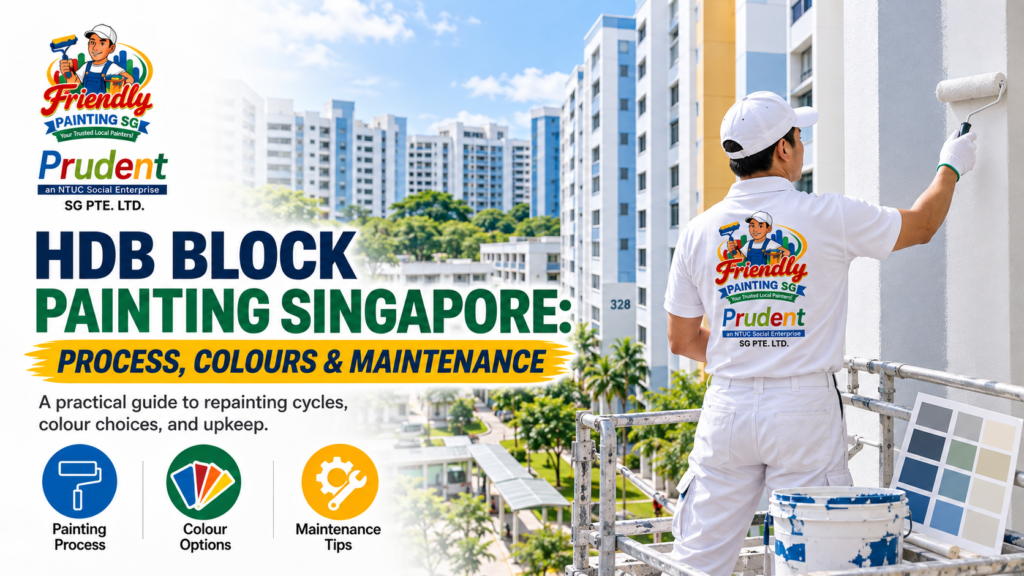
HDB block painting refers to the repainting and redecoration of the exterior and common areas of public housing blocks in Singapore. The work can form part of broader estate maintenance, repair or renewal programmes, rather than an individual homeowner renovation.
For residents, HDB block painting often raises practical questions. Why does a block need repainting? Who manages the work? Can residents choose the colours? What happens to stained or weathered walls? Does block repainting include the inside of individual flats?
The key distinction is simple: HDB block painting focuses on common property and the building exterior, while painting inside an individual HDB flat remains a separate residential painting project.
Town Councils manage and maintain common property in HDB estates, including areas such as corridors, void decks, lifts and other shared facilities. HDB notes that residents can approach their Town Council about routine maintenance and cyclical improvement works.
This guide explains how HDB block painting works in Singapore, why estates need repainting, how colour schemes may change, and what homeowners should understand before comparing block repainting with interior HDB painting.
What Is HDB Block Painting?
HDB block painting is the repainting of exterior and common-area surfaces within an HDB estate.
Depending on the project, work may involve areas such as:
- External block facades
- Void deck walls
- Common corridors
- Staircases
- Lift lobby areas
- Selected common-area ceilings
- Architectural features
- Other painted common property
The exact scope changes from project to project.
The purpose goes beyond changing the colour of a block. Repainting can form part of wider redecoration and repair work that helps maintain the appearance and condition of common property.
HDB’s Neighbourhood Renewal Programme states that projects selected from 2015 onward can include redecoration and repair works such as repainting blocks and repairing spalling concrete, crack lines and uneven common-area surfaces. Town Councils implement the programme.
Why Do HDB Blocks Need Repainting?
Exterior paint faces much harsher conditions than interior paint.
HDB blocks remain exposed to:
- Sunlight
- Rain
- Humidity
- Wind
- Airborne dirt
- Pollution
- Surface moisture
- General weathering
Over time, these conditions can affect how the facade looks.
Residents may notice:
- Faded colours
- Streaks
- Surface dirt
- Stains
- Uneven appearance
- Older paint looking dull
- Localised peeling or deterioration
Repainting helps refresh the visual appearance of the estate while maintenance teams can also address suitable repair issues as part of broader works.
Who Handles HDB Block Painting?
Town Councils manage the common property of HDB estates within their towns.
HDB explains that Town Councils control, maintain and improve common property such as corridors, void decks, lifts, public lighting and open spaces. Residents can contact their Town Council for information about routine maintenance and cyclical improvement works.
This makes block painting fundamentally different from repainting your own living room or bedroom.
An individual homeowner usually does not appoint painters to repaint the external facade of an HDB block.
Is HDB Block Painting Part of Estate Upgrading?
It can form part of broader estate improvement or redecoration work.
One example is the Neighbourhood Renewal Programme, or NRP.
HDB states that the NRP focuses on block and precinct improvements and that Town Councils implement the programme. Since 2015, selected NRP projects can include block repainting together with repair works.
This means repainting may happen alongside other improvements rather than as an isolated colour-change project.
Possible related works can include:
- Crack repairs
- Spalling concrete repairs
- Common-area repairs
- Improvements to shared facilities
- Estate enhancement works
The exact scope depends on the programme and precinct.
How Does the HDB Block Painting Process Work?
The exact workflow differs by project, but large-scale block repainting usually follows several practical stages.
1. Estate or Block Assessment
The relevant managing parties first assess the condition of the block and common areas.
They may review:
- Existing paint condition
- Surface defects
- Stains
- Cracks
- Spalling areas
- Access requirements
- Building height
- Common-area conditions
This assessment helps determine the repainting and repair scope.
2. Repair Work Before Painting
Painters should not simply cover damaged surfaces with new paint.
Where the project includes repairs, workers may first address suitable defects such as:
- Cracks
- Loose areas
- Damaged coatings
- Spalling concrete
- Surface deterioration
HDB specifically lists repair of spalling concrete and crack lines among works that can accompany redecoration under the NRP.
3. Surface Preparation
Workers then prepare the surfaces before applying new coatings.
Preparation may involve:
- Cleaning
- Removing loose paint
- Treating suitable surface contamination
- Repairing damaged areas
- Preparing repaired sections
- Priming where the coating system requires it
Good preparation matters because exterior paint depends heavily on the condition of the surface underneath.
4. Colour and Design Planning
Large residential blocks use colour as part of the overall estate appearance.
The project team may consider:
- Existing estate identity
- Surrounding blocks
- Architectural features
- Contrast
- Visibility
- Long-term maintenance
- Colour coordination
Some estates also involve residents in colour or design selection.
5. Painting the Block
Workers apply the specified exterior coating system according to the project plan.
Large buildings require careful coordination because painters need to work across extensive vertical surfaces while protecting nearby areas.
The project may progress in sections rather than covering the entire block at once.
6. Common-Area Painting
Where included in the project, workers may also repaint common spaces such as:
- Void decks
- Staircases
- Corridors
- Lift lobby areas
The exact scope depends on the estate project.
7. Inspection and Touch-Ups
The project team checks completed areas and addresses visible defects or incomplete sections where necessary.
This final stage helps create a more consistent overall finish.
How Often Do HDB Blocks Get Repainted?
There is no single repainting interval that every HDB block follows in exactly the same way.
The timing can depend on:
- Estate maintenance programme
- Existing coating condition
- Building age
- Weather exposure
- Repair needs
- Town Council planning
- Other scheduled improvement works
Residents should therefore avoid assuming that every block receives repainting after an identical number of years.
For specific information about an estate’s repainting or maintenance programme, the relevant Town Council remains the most appropriate source. HDB explicitly directs residents to Town Councils for routine maintenance and cyclical improvement matters.
Can Residents Choose HDB Block Paint Colours?
In some estate projects, residents may get opportunities to provide feedback or vote on proposed colour schemes or designs.
This does not mean every HDB block repainting project follows the same voting process.
The exact approach depends on the project and local estate planning.
Where consultation takes place, residents may see proposed colour schemes before the work begins.
This helps balance:
- Estate identity
- Building appearance
- Resident preference
- Architectural consistency
Why Do HDB Block Colours Change?
A newly repainted block does not always return to its previous colour scheme.
Estate planners may update colours to:
- Refresh the neighbourhood
- Create a more modern appearance
- Coordinate nearby blocks
- Highlight architectural elements
- Improve visual identity
- Support broader estate renewal
Colour design on a large residential block differs significantly from choosing paint for a bedroom.
A colour that works well on a small interior wall may behave very differently across a large exterior facade under direct sunlight.
What Is Cool Paint on HDB Blocks?
Some public housing projects have explored coatings designed to reduce solar heat absorption.
These coatings often fall under the broader concept of “cool paint” or heat-reflective coatings.
The idea is to reflect more solar energy than conventional darker exterior surfaces and reduce heat absorption at the building surface.
However, homeowners should not assume that every newly repainted HDB block uses the same type of cool-paint system.
The coating specification depends on the actual project.
Why Do Some HDB Blocks Develop Dark Stains or Marks?
Exterior walls stay exposed to Singapore’s humid climate, rain and airborne contaminants.
Over time, residents may notice:
- Dark streaks
- Patchy discolouration
- Dirt accumulation
- Algae-like surface growth
- Water-runoff marks
Several factors can contribute to these appearances.
For example:
- Repeated moisture
- Shaded surfaces
- Rainwater flow
- Dust
- Surface texture
- Existing coating condition
A visual mark does not automatically reveal its exact cause.
Maintenance teams need to inspect the surface before deciding how to clean, repair or repaint it.
Does Repainting Fix Cracks in an HDB Block?
Paint alone does not repair structural defects.
If workers find cracks, loose concrete or other defects, the relevant repair work needs to come before or alongside painting.
HDB’s NRP specifically lists crack-line and spalling-concrete repairs alongside repainting in applicable projects.
The correct sequence is generally:
inspect → repair defects → prepare surfaces → paint
not:
paint over the defect and hope it disappears
What Is Spalling Concrete, and Why Does It Matter Before Painting?
Spalling concrete occurs when portions of concrete break, flake or detach.
Paint cannot solve an active concrete defect.
HDB includes repair of spalling concrete and structural cracks within programmes that address ageing flats and building maintenance.
Where such defects affect common property or block surfaces, teams need to address the underlying condition before completing the decorative finish.
HDB Block Painting vs HDB Flat Painting
These two services sound similar but refer to very different projects.
| HDB Block Painting | HDB Flat Painting |
|---|---|
| Covers building exterior/common areas | Covers the interior of an individual flat |
| Usually managed through estate maintenance | Homeowner arranges the work |
| Large-scale building project | Residential interior project |
| Can include common corridors and void decks | Includes bedrooms, living rooms and ceilings |
| May form part of estate redecoration | Usually part of home maintenance or renovation |
| Homeowner does not control the full building scope | Homeowner selects interior colours and scope |
This distinction matters when people search for HDB block painting but actually want to repaint their own flat.
If you need to repaint the walls or ceilings inside your home, see HDB painting services in Singapore.
Does HDB Block Painting Include the Inside of My Flat?
No, not in the normal sense of a block repainting project.
Common-property repainting does not mean a contractor will repaint:
- Your living room
- Your bedrooms
- Your kitchen walls
- Your interior ceilings
- Your feature walls
Those areas belong to the interior of your individual home.
If your block receives a fresh exterior repaint but your interior walls remain stained, faded or worn, you still need to arrange your own interior painting separately.
Why Can the Outside of a Block Look New While the Flat Interior Looks Old?
Exterior and interior paint age under different conditions.
Block exteriors face:
- Rain
- Sun
- Outdoor moisture
- Pollution
- Weather
Inside the flat, paint deals with:
- Furniture contact
- Cooking residue
- Indoor moisture
- Children or pets
- Wall scuffs
- Previous repair marks
- Everyday wear
That means an estate can repaint the block exterior while the interior of an individual flat remains unchanged.
What Should Residents Expect During HDB Block Repainting?
Large-scale painting can temporarily affect normal routines.
Residents may encounter:
- Workers around common areas
- Access equipment
- Temporary protective coverings
- Painting smells
- Restricted access to selected areas
- Noise during preparation work
Residents should follow any notices that the managing Town Council or project team issues.
Specific instructions may vary by estate and project.
Should You Keep Windows Closed During Exterior Painting?
Follow the instructions issued for your block.
Depending on where painters work, residents may need to:
- Keep windows closed temporarily
- Remove objects from window ledges
- Avoid placing items near active work areas
- Keep laundry away from certain areas
- Follow safety notices
Do not rely on a general online article when your own block has issued specific instructions.
Can Residents Paint the Exterior Wall Outside Their HDB Flat?
Homeowners should not treat the external building facade or common property like their own interior wall.
HDB rules restrict renovation work that affects the external facade or public areas. HDB specifically lists work affecting the external facade as a reason certain renovations are not allowed.
If you want to repaint inside your flat, that falls under a different type of residential painting work.
How Is HDB Block Painting Different From Condo Exterior Painting?
The physical painting work may share some technical similarities, but management differs.
For HDB estates:
- Town Councils manage common property
- Public estate maintenance programmes may apply
- Residents do not individually control the exterior facade
For private condominiums:
- The management corporation manages common property
- Repainting decisions follow the condo’s own management process
In both cases, exterior common-property painting differs from painting inside an individual home.
Does HDB Block Painting Affect Property Appearance?
Yes. Exterior repainting can significantly change how a block and surrounding precinct look.
Fresh colours can:
- Make facades look cleaner
- Improve visual consistency
- Refresh common areas
- Highlight architectural details
- Give an older estate a more updated appearance
However, block repainting does not change the structural layout or condition of an individual flat interior.
Can Interior HDB Colours Match the Block Exterior?
They can, but they do not need to.
The colour scheme inside your home serves a different purpose.
Interior paint needs to work with:
- Flooring
- Furniture
- Lighting
- Curtains
- Cabinets
- Personal style
The block exterior colour may provide inspiration, but you should choose your interior palette according to your own home.
When Should You Repaint the Interior of an HDB Flat?
Consider interior repainting when you notice:
- Faded walls
- Stains
- Scuff marks
- Peeling paint
- Uneven touch-ups
- Old colour schemes
- Renovation damage
- Visible wall repairs
The repainting schedule for your flat does not need to match the block’s exterior maintenance schedule.
How Should You Prepare for HDB Interior Painting?
If your goal is to repaint inside the flat rather than the block, start with:
- Decide which rooms need painting.
- Check the wall condition.
- Choose colours.
- Identify cracks or peeling areas.
- Move small items away from the walls.
- Plan furniture protection.
- Confirm whether ceilings need repainting.
- Schedule painting around your household routine.
For a complete interior project, homeowners can review HDB painting services in Singapore.
Common Misunderstandings About HDB Block Painting
“Block Painting Means My Flat Interior Will Be Painted”
No. Block repainting generally concerns exterior and common-property areas.
“Residents Can Paint Any Exterior Wall They Want”
No. Homeowners do not control the common facade in the same way they control walls inside their flat.
“Painting Repairs Structural Cracks”
No. Paint provides a finish. Proper repair work must address cracks or concrete defects first.
“Every HDB Block Uses the Same Repainting Schedule”
No. Maintenance timing varies by estate, condition and programme.
“Every Repainting Project Uses the Same Colours”
No. Colour schemes can change between estates and repainting cycles.
“A Fresh Block Exterior Means My Flat Does Not Need Painting”
Not necessarily. Interior walls age separately from exterior building surfaces.
Frequently Asked Questions About HDB Block Painting
What is HDB block painting?
HDB block painting refers to repainting exterior and common-property surfaces of an HDB block as part of estate maintenance, redecoration or improvement work.
Who manages HDB block painting?
Town Councils manage common property in HDB estates and oversee routine maintenance and cyclical improvement work.
Why do HDB blocks get repainted?
Blocks need repainting because exterior coatings experience weathering, fading, dirt, moisture and general ageing. Repainting can also form part of broader estate renewal.
Is HDB block repainting part of the Neighbourhood Renewal Programme?
Selected NRP projects can include block repainting together with repair and redecoration works.
Can residents choose HDB block colours?
Some projects may involve resident feedback or colour-scheme selection, but the process varies by estate and project.
Does block painting include my flat interior?
No. Painting common-property or exterior surfaces does not normally include repainting the walls and ceilings inside an individual flat.
Can I repaint my HDB interior even if the block has just been repainted?
Yes. Interior painting remains a separate homeowner project.
Does repainting fix cracks in an HDB block?
Paint alone does not repair cracks. Repair teams should address suitable cracks or concrete defects before completing the paint finish.
Why do some HDB exterior walls get dark stains?
Rain, humidity, dirt, surface moisture, shade and coating condition can contribute to visible staining. The exact cause requires inspection.
Who should I contact about common-area or block painting?
For information about common-property maintenance, routine works or cyclical improvement works, contact the Town Council responsible for your estate. HDB identifies Town Councils as the bodies that manage and maintain common property.