
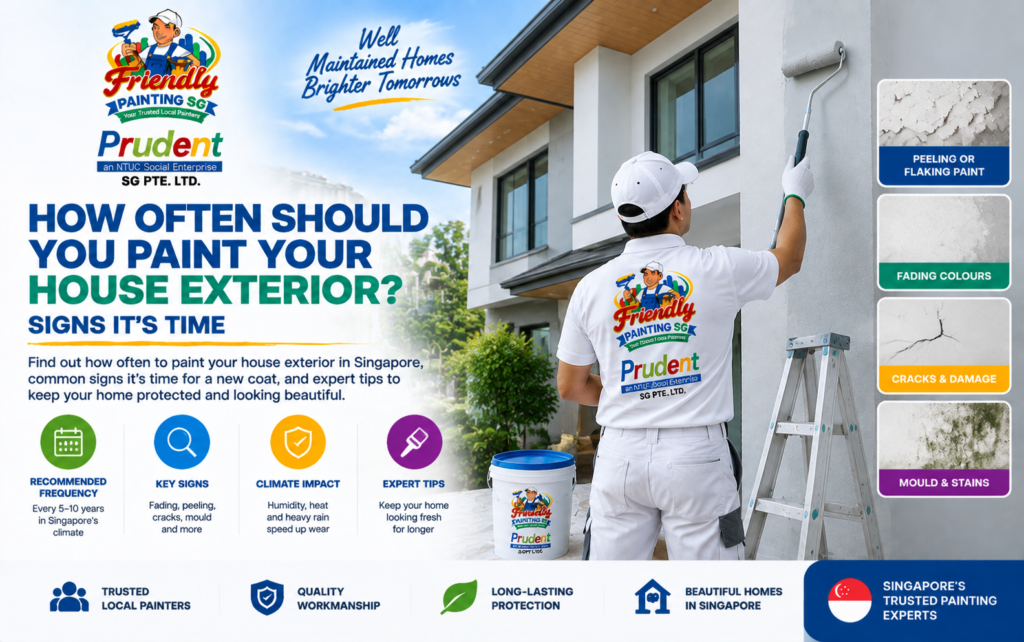
How often should you paint your house exterior? As a practical planning guide, many exterior paint systems should be assessed somewhere around the 5–10 year mark, but the actual repainting interval can be much shorter or longer depending on the wall material, previous preparation, paint system, sunlight, rain exposure, moisture, and condition of the existing coating.
For Singapore homes, the calendar should not make the final decision. A wall that still has a firm, even coating may not need repainting simply because several years have passed. Meanwhile, another façade may need attention much earlier if you can see chalking, fading, peeling, cracks, algae, water staining, or exposed substrate.
The better question is:
Does the existing exterior coating still protect the surface properly, or has it started to fail?
| What You See | What It Usually Means | Repaint Now? |
|---|---|---|
| Colour slightly faded but coating sound | Normal weathering | Monitor |
| Strong fading across exposed walls | Coating ageing | Consider repainting |
| Powder comes off when touched | Chalking | Prepare and repaint |
| Paint peeling or flaking | Adhesion failure | Repaint after preparation |
| Hairline cracks | Surface repair may be needed | Repair first |
| Mould or algae | Moisture/exposure issue | Clean and assess first |
| Water stains | Possible moisture problem | Investigate before painting |
| Bare plaster/concrete visible | Coating has failed locally | Repaint promptly |
| Rust on metal elements | Corrosion | Treat before coating |
How Often Should You Paint Your House Exterior in Singapore?
There is no single repainting schedule that works for every house.
A homeowner may hear rules such as “paint every five years” or “exterior paint lasts ten years,” but those numbers are only broad planning references.
The actual repainting interval depends on the exterior itself.
A sheltered wall under a deep overhang may remain in good condition much longer than a façade that receives strong afternoon sun and frequent wind-driven rain.
Likewise, a properly prepared wall with a compatible exterior coating can perform very differently from a wall that was painted over dust, moisture, loose old paint, or unstable plaster.
For that reason, Friendly Painting SG recommends thinking in terms of condition + exposure + coating performance, not just years.
Why Singapore Exterior Paint Can Age Faster
Singapore’s tropical climate exposes exterior surfaces to high humidity, frequent rain, strong sunlight, and warm temperatures throughout the year.
Those conditions can affect a painted exterior in several ways.
Sunlight gradually changes colour and surface appearance. Rain repeatedly wets the coating. Humidity can support algae or mould in shaded areas. Moisture can exploit cracks or weak points in the wall.
This does not mean every Singapore exterior will fail quickly.
It means the quality of surface preparation and paint selection matters significantly.
Fading Is Often the First Sign of Exterior Ageing
Exterior colour rarely stays identical forever.
Sunlight can gradually reduce colour intensity, particularly on highly exposed elevations.
At first, fading may only be cosmetic.
The wall can still have a sound coating even though the colour looks less fresh than when it was first painted.
However, repainting becomes more worth considering when fading is:
noticeably uneven, much stronger on one façade, accompanied by chalking, or part of wider coating deterioration.
A faded exterior can also make an otherwise well-maintained landed property appear older than it is.
What Is Chalking, and Does It Mean You Should Repaint?
Chalking occurs when a powdery layer develops on the surface of old paint.
You may notice it when you rub your hand across the exterior and see fine pigment or powder on your fingers.
A small amount of weathering does not automatically mean the wall has completely failed.
Heavy chalking is different.
New paint needs a stable surface to bond to. Painting directly over loose powder can create poor adhesion.
The wall may need cleaning, preparation, and an appropriate primer or sealer before the new exterior coating goes on.
Peeling Paint Means More Than Fading
Peeling is a stronger warning sign because it shows that part of the coating has lost adhesion.
Common reasons can include poor preparation, moisture, unstable old paint, powdery substrate, unsuitable coating layers, or deterioration beneath the paint.
A common mistake is:
peeling paint → apply new paint
That creates a new coating over an unstable base.
The correct sequence is closer to:
identify cause → remove loose coating → repair substrate → prepare → prime where required → repaint
If the peeling keeps returning in exactly the same location, investigate moisture or substrate problems rather than repeatedly covering the same area.
Hairline Cracks Should Be Checked Before Repainting
Exterior walls can develop small cracks over time.
Some are cosmetic.
Others continue moving or allow moisture into the wall.
Paint may make a fine crack less noticeable temporarily, but finishing paint is not a structural repair product.
Before repainting, the painter should check whether the crack is stable and suitable for normal surface repair.
A crack that is widening, repeatedly reopening, or associated with larger wall damage deserves more investigation.
Repainting should come after the wall becomes suitable for coating.
Mould and Algae Do Not Always Mean the Paint Has Failed
Green, dark, or patchy biological growth can appear on shaded exterior areas.
This can be more common where walls receive moisture but limited direct sunlight.
The presence of algae does not automatically mean the entire building needs repainting.
Sometimes cleaning and maintenance may be enough if the existing coating remains sound.
However, if biological growth appears together with peeling, damaged coating, cracks, or repeated moisture staining, the exterior may need more extensive preparation before repainting.
Painting directly over biological contamination can reduce adhesion and allow staining to return.
Water Stains Need Investigation Before New Paint
Exterior repainting should not be used to hide a water problem.
Look more carefully when the façade shows persistent:
dark patches, streaks, bubbling, staining around windows, peeling near cracks, or damp areas that repeatedly return.
Possible causes may include rain penetration, damaged sealant, cracks, drainage issues, or water coming from another part of the building.
The source should be addressed before the final paint system is applied.
A fresh colour can hide a stain.
It cannot stop an unresolved leak.
Does Wall Material Change How Often You Need to Repaint?
Yes.
Different exterior surfaces weather differently and require different preparation.
Concrete and Masonry Walls
Painted concrete and masonry are common on Singapore landed homes.
Repainting frequency depends on the condition of the surface and previous coating.
Typical issues include chalking, hairline cracks, moisture staining, peeling, and algae.
A stable wall can usually be prepared and recoated without major repair.
An unstable or damp wall needs more work first.
Plastered Exterior Walls
Plaster can develop cracks, powdering, loose areas, and patch repairs.
Before repainting, the plaster should be checked for stability.
If the material underneath the paint is weak, another topcoat will not solve the problem.
Timber Exterior Elements
Timber needs a different coating approach from masonry.
The condition of the wood, previous coating, moisture exposure, cracking, and surface movement all influence repainting.
Timber doors, decorative elements, or exterior features may need attention at a different interval from the main walls.
Metal Exterior Elements
Metal gates, railings, frames, and other exterior features should be checked for rust.
A faded metal coating and active corrosion are different problems.
Rust needs appropriate preparation and protection before the new finishing coat goes on.
The main exterior wall may still look good while metal elements already need repainting.
Which Side of a House Usually Needs Repainting First?
Not every side of a landed house receives the same exposure.
One elevation may receive stronger afternoon sun.
Another may remain shaded and damp.
A wall may also receive more direct rain because of its orientation and surrounding buildings.
This can create different failure patterns.
A sunny façade may show stronger fading and chalking.
A shaded wall may show more algae or mould.
A wall beneath a protected overhang may remain in better condition.
So when checking whether it is time for exterior repainting, inspect the entire property rather than judging from the most visible front wall alone.
Can You Repaint Only One Side of the House?
Yes, in some situations.
If one elevation has deteriorated much faster than the rest of the property, repainting only that section may be reasonable.
However, colour matching can become difficult.
Existing exterior paint gradually changes through weathering, so a newly painted wall may initially look noticeably fresher than adjacent surfaces.
Before choosing a partial repaint, consider:
the age of the other walls, how closely the colour can be matched, whether the same coating still exists, and whether other elevations are likely to need repainting soon.
If several sides are already ageing, completing the whole exterior together may create a more consistent finish.
Does Paint Quality Affect How Often You Need to Repaint?
Yes, but paint quality alone does not determine durability.
A premium exterior coating applied to a poorly prepared wall can still fail.
Long-term performance depends on the complete system:
surface condition → preparation → primer/sealer → finishing coating → application → exposure
A cheaper coating does not automatically fail quickly.
A more expensive coating does not automatically last forever.
The product must suit the substrate and environment.
Why Surface Preparation Has Such a Big Effect on Paint Life
Good exterior painting begins before the finishing coat.
Preparation may involve cleaning, scraping loose paint, repairing minor defects, sanding suitable areas, treating rust, allowing surfaces to dry, and applying primer where the substrate requires it.
Skipping these steps can leave the new paint attached to:
dust, chalking, loose previous coating, contamination, or unstable wall material.
In that situation, the topcoat may look good initially but begin failing earlier than expected.
This is why Friendly Painting’s landed house painting services include surface preparation as part of the painting process rather than treating it as an optional extra.
Does Exterior Colour Affect How Soon Repainting Is Needed?
Colour can influence how ageing appears.
Very strong or dark colours may show fading differently from lighter neutrals.
White and very pale colours may make dirt, algae, or rain streaks more noticeable.
Mid-tone colours may hide certain surface marks more effectively.
However, do not select colour only based on maintenance.
The exterior scheme should also coordinate with the roof, windows, gate, architecture, and surrounding finishes.
The quality and compatibility of the paint system still matter more than whether the wall is beige, white, or grey.
Should You Repaint When the Colour Still Looks Fine?
Possibly not.
If the coating remains:
firm, well-adhered, free from significant cracks, free from heavy chalking, and capable of protecting the surface,
there may be no urgent need to repaint simply because several years have passed.
Exterior maintenance should not become unnecessary painting.
On the other hand, some coating problems begin before the façade looks obviously terrible from the road.
Inspect the walls up close periodically.
Early local repairs can prevent larger areas from deteriorating.
How Often Should You Inspect Exterior Paint?
A quick visual inspection once or twice a year is a practical habit for landed homeowners.
You do not need specialist equipment for a basic check.
Look at areas around windows, corners, lower walls, exposed façades, metal elements, previous crack repairs, and shaded areas.
Also inspect after you notice water leakage, new cracks, exterior repair work, or unusual staining.
The goal is to spot deterioration before it becomes widespread.
Is Faded Exterior Paint Still Protecting the Wall?
Sometimes.
Fading mainly tells you that the coating has weathered visually.
It does not automatically prove total coating failure.
If the surface remains firmly bonded and shows no significant chalking, peeling, cracks, or exposed substrate, repainting may still be mainly an appearance decision.
However, strong fading often occurs alongside other signs of ageing.
That is why the wall should be assessed as a complete surface.
When Does Fading Become a Strong Repaint Signal?
Consider repainting when fading is accompanied by:
uneven colour, visible chalking, worn patches, exposed substrate, or widespread weathering.
A façade that looks noticeably tired can also affect the overall appearance of a landed house even if the coating has not completely failed.
Repainting before severe deterioration can make preparation more manageable than waiting until large areas start peeling.
Exterior Repainting vs Repair: Which Comes First?
Repair comes first when the wall itself has a problem.
Examples include:
| Condition | What Should Happen First |
|---|---|
| Stable faded coating | Repainting assessment |
| Hairline cosmetic cracks | Repair before repaint |
| Repeated/widening cracks | Investigate first |
| Peeling old paint | Remove unstable coating |
| Mould/algae | Clean and address cause |
| Active water staining | Investigate moisture |
| Loose plaster | Repair substrate |
| Rusting metal | Treat corrosion |
| Sound surface, colour outdated | Normal repainting |
This distinction helps prevent decorative paint from being used as a repair material.
Should You Wait Until Exterior Paint Starts Peeling?
No.
Peeling is a late-stage sign of coating failure.
You can often plan repainting earlier when you notice:
strong fading, increasing chalking, widespread surface deterioration, or repeated local defects.
Waiting until large sections peel can increase the preparation required.
However, repainting too early also creates unnecessary expense.
The ideal time is when the coating clearly shows meaningful ageing but the substrate has not yet suffered extensive deterioration.
Should You Repaint Before Selling a House?
Exterior repainting can make sense before selling when the current façade looks faded, patchy, heavily stained, or poorly maintained.
The exterior creates an immediate visual impression.
However, do not repaint simply to hide:
water problems, cracks, unstable plaster, or active coating failure.
Those defects should still receive proper preparation.
A clean, well-prepared exterior generally presents better than a rushed cosmetic cover-up.
Should You Repaint During a Larger Renovation?
If you are already planning exterior renovation, coordinate painting with the other work.
Painting should generally happen after jobs that may:
damage walls, create heavy dust, require drilling, replace windows, repair plaster, or alter external fixtures.
Otherwise, freshly painted surfaces may need extensive touch-ups.
A coordinated renovation sequence reduces duplicated work.
When Is Partial Touch-Up Enough?
A full repaint is not always necessary.
Touch-up may be enough when:
the damaged area is small, the surrounding coating remains sound, the original colour can be matched reasonably well, and the underlying defect has already been corrected.
Touch-up becomes less attractive when:
fading affects the entire façade, multiple walls show deterioration, the colour match is poor, or the coating is nearing the end of its useful condition across the property.
The decision should follow the overall surface, not the size of one visible defect.
Exterior House Painting and Roof Painting Are Different Jobs
The exterior walls and roof should not automatically share the same coating system or maintenance schedule.
Roof surfaces receive different levels of solar exposure, rain, heat, and moisture.
They may also use:
tiles, metal, concrete, or other materials.
If the roof needs attention, it should be assessed separately rather than assuming the exterior wall painter can use the same paint everywhere.
That separation also helps avoid confusing roof repainting with normal exterior façade maintenance.
What Should a Professional Exterior Painting Assessment Check?
Before repainting, a useful assessment should look at more than the colour.
The painter should consider:
existing paint adhesion, chalking, cracks, mould or algae, water staining, plaster condition, metal corrosion, previous repairs, wall exposure, and whether a primer or specialist preparation step is required.
The objective is to answer:
Can this surface receive paint now, or does something need fixing first?
That question has a much bigger effect on long-term results than simply choosing the next colour.
How Friendly Painting SG Approaches Exterior Repainting
For a landed-home exterior, the process should follow the actual wall condition.
A practical workflow is:
inspection → identify defects → cleaning → preparation → suitable repairs → primer/sealer where required → exterior coating → final inspection
Friendly Painting SG provides exterior work as part of its landed house painting services for Singapore properties.
The useful goal is not to repaint a home according to an arbitrary calendar.
It is to identify when the coating has aged enough that repainting will protect and refresh the exterior before deterioration becomes more extensive.
Final Thoughts
How often should you paint your house exterior?
Do not make the decision from age alone.
Use the condition of the coating.
A useful sequence is:
fading → chalking → local defects → widespread coating failure
Ideally, repaint before the exterior reaches the final stage.
For Singapore landed homes, strong sunlight, rainfall, humidity and differences in wall exposure can cause one façade to age faster than another.
That is why regular inspection matters.
If the exterior remains sound, there is no need to repaint simply because a fixed number of years has passed.
If you see widespread fading, powdering, peeling, repeated mould, exposed wall surfaces or deteriorating repairs, it is time to assess the exterior before the damage becomes more extensive.
Friendly Painting SG can inspect the wall condition and determine what preparation is needed through its landed house painting services for Singapore homeowners.
Frequently Asked Questions About Exterior Repainting
How often should you paint your house exterior?
Many homeowners use roughly 5–10 years as a broad planning range, but the actual interval depends on wall material, preparation, coating quality, sunlight, rain, moisture, and surface condition. Visible deterioration is a better guide than age alone.
How often should you paint a house exterior in Singapore?
Singapore’s sun, humidity and rainfall make regular inspection important. There is no fixed Singapore repaint interval; check for fading, chalking, peeling, cracks, mould and exposed substrate.
What are the signs a house exterior needs painting?
Strong fading, powdery chalking, peeling, flaking, recurring mould, exposed wall material, rusting metal and widespread coating deterioration are common signs.
Does humidity make exterior paint fail faster?
Persistent moisture and humid conditions can contribute to mould, algae and coating problems, particularly on shaded or poorly drying surfaces. Preparation and the correct exterior coating remain important.
Can I paint over faded exterior paint?
Yes, if the existing coating remains stable and suitable for repainting. The surface should still be cleaned and prepared before the new coating goes on.
Can I paint over peeling exterior paint?
Do not simply cover loose paint. Remove unstable coating and correct any underlying moisture or substrate problems before repainting.
Should cracks be repaired before exterior painting?
Yes. Suitable cosmetic cracks should be repaired before finishing coats. Repeated, widening or unusual cracks may need further investigation.
Is mould a sign that my exterior needs repainting?
Not necessarily. Mould or algae may require cleaning and moisture assessment. Repainting becomes more relevant when the coating itself has also deteriorated.
Can I repaint only one side of my house?
Yes, if only one elevation needs attention. However, weathered paint may make exact colour matching difficult, so compare the condition of the remaining façades first.
Does dark exterior paint need repainting more often?
Not automatically. Dark colours may show fading differently, but repainting frequency still depends on the coating system, preparation and exposure.
Should I repaint before exterior paint starts peeling?
Often, yes. Planning repainting when fading and chalking become widespread can reduce the amount of repair required compared with waiting for large-scale peeling.
Can Friendly Painting SG repaint landed-house exteriors?
Yes. Friendly Painting SG provides exterior painting within its landed-house painting service, including surface preparation and suitable repainting work based on property condition.