
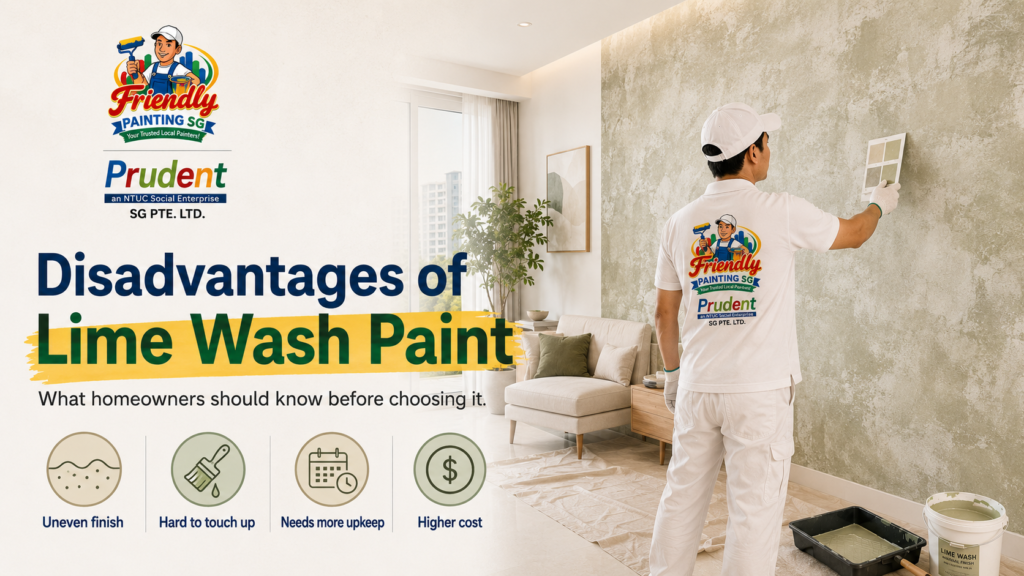
What are the disadvantages of lime wash paint? The main drawbacks are that true limewash needs a compatible surface, is harder to scrub clean than conventional washable paint, naturally produces colour and texture variation, requires more specialised application, may need periodic renewal, does not solve existing moisture problems, and can cost more to apply because the finish is labour-intensive.
Those disadvantages do not make limewash a bad choice. In fact, its soft, mineral, cloudy appearance can create a wall finish that ordinary flat emulsion struggles to imitate.
The problem comes when homeowners choose limewash for its appearance without considering where the wall is located, how often it will be touched, what coating is already on it, and how much maintenance they expect.
For Singapore homes, those practical questions matter even more because interiors operate in a consistently humid tropical climate. Singapore’s mean annual relative humidity is around 82%, according to Meteorological Service Singapore.
Here is the quick comparison.
| Limewash Advantage | Related Disadvantage |
|---|---|
| Natural, cloudy variation | Difficult to make perfectly uniform |
| Breathable mineral finish | Needs the right substrate and preparation |
| Soft matte appearance | Less suited to heavy scrubbing |
| Develops visual character | Touch-ups may remain visible |
| Can be layered and renewed | May require periodic maintenance |
| Distinctive handmade look | Application requires technique |
| Premium decorative effect | Labour can cost more than standard painting |
What Is Limewash Paint?
Traditional limewash is very different from ordinary wall emulsion.
Singapore’s National Heritage Board describes limewash as a coating made from slaked lime diluted with water. Rather than simply sitting on top of a suitable mineral surface, limewash penetrates the substrate and hardens through carbonation, reacting with carbon dioxide in the air to form calcium carbonate.
That chemistry produces its characteristic:
- soft matte surface
- mineral appearance
- tonal variation
- breathable character
Traditional limewash works particularly well on porous mineral surfaces such as lime plaster, lime render, stone and brick.
Modern decorative products sold as limewash may use proprietary primers, binders or application systems, so always follow the exact manufacturer’s instructions rather than assuming every product behaves identically.
And no—limewash is not simply ordinary paint watered down.
The material, curing process and interaction with the wall are fundamentally different.
1. Limewash Does Not Work Equally Well on Every Wall
This is probably the first disadvantage homeowners should understand.
Traditional limewash performs best when it can interact with a suitable porous mineral substrate. NHB specifically identifies traditional lime plaster, render, stone and brick as appropriate surfaces.
That can create complications in modern homes.
Many HDB flats and condos already have walls coated with:
- acrylic paint
- emulsion paint
- sealer
- skim coat
- previous decorative finishes
You should not assume that genuine limewash can simply be brushed directly over every existing coating.
Depending on the product, the wall may require:
- cleaning
- sanding
- repairs
- a compatible mineral primer
- a manufacturer-specified base coat
Why This Matters
If the substrate does not allow the limewash system to bond or cure correctly, the finished wall may appear:
- patchy
- weak
- powdery
- poorly bonded
- inconsistent
This is one reason surface preparation matters more with limewash than many homeowners initially expect.
Before choosing the finish, identify what is already on the wall.
2. Limewash Is Harder to Scrub Clean
The beautiful chalky, mineral surface is also one of limewash’s practical limitations.
Traditional limewash is not designed to behave like a highly washable acrylic wall coating.
NHB’s technical guidance notes that traditional limewash cannot simply be scrubbed clean because the lime-based coating itself can be removed through aggressive rubbing.
That makes location important.
Limewash may be less practical on walls exposed to:
- children’s hands
- greasy cooking residue
- frequent touching
- shoe marks
- luggage
- pets
- constant wiping
Where This Becomes a Problem
Consider a narrow HDB hallway.
People may regularly brush bags, hands or furniture against the wall.
A washable conventional coating may tolerate that environment better than a delicate decorative limewash finish.
By contrast, a bedroom wall behind the bed or a living-room feature wall receives much less physical contact.
That is a more natural location for limewash.
3. The Finish Is Not Perfectly Uniform—and That Is Intentional
If you want every square metre of wall to have the exact same tone and texture, limewash may frustrate you.
Its visual appeal comes partly from variation.
The brush movement and translucent mineral layers create:
- lighter areas
- darker areas
- overlapping strokes
- cloudy tonal changes
- depth that changes with lighting
URA describes traditional limewash as producing a breathable, matte finish with characteristic soft tones and a nuanced appearance.
For one homeowner, that variation looks sophisticated and handcrafted.
For another, it looks unfinished.
Before Choosing Limewash, Ask Yourself
Do you want:
A perfectly even painted wall?
or
A deliberately irregular decorative wall?
If the answer is the first, conventional paint may suit your expectations better.
Do not choose limewash from a highly edited interior photograph without first seeing a real sample.
4. Limewash Painting Technique Requires More Skill
Conventional emulsion painting is often based around rolling relatively uniform coats across a prepared surface.
Limewash is different.
Its appearance depends heavily on:
- brush movement
- dilution/product preparation
- coat thickness
- drying intervals
- substrate absorption
- overlap between sections
Traditional limewash can also require several thin coats. NHB notes that on new render, traditional limewash may require at least five coats to achieve satisfactory coverage because of its translucent nature.
Modern proprietary decorative limewash systems may specify fewer coats, so the exact product instructions take priority.
The broader point remains:
limewash is technique-sensitive.
Two people can apply the same colour to the same wall and produce noticeably different results.
Why DIY Can Be Difficult
A beginner can accidentally create:
- harsh brush lines
- obvious stopping points
- excessively dark sections
- areas with insufficient texture
- inconsistent overlap
The handcrafted effect should look intentional—not accidental.
5. Limewash Can Require More Maintenance
Limewash ages differently from modern synthetic paint.
That ageing can be part of its charm, but homeowners need realistic expectations.
URA notes that traditional limewash may need to be reapplied every few years, depending on exposure and condition.
NHB similarly identifies durability and periodic renewal as one of traditional limewash’s main limitations.
For interior decorative walls, maintenance needs will depend heavily on:
- product formulation
- substrate
- room use
- physical contact
- moisture
- application quality
A protected bedroom feature wall may age very differently from a high-traffic corridor.
Touch-Ups Can Also Be Visible
Because the wall contains intentional tonal variation, repairing one isolated area may not reproduce the surrounding texture perfectly.
Sometimes blending a larger section produces a more natural result than touching up one tiny mark.
So limewash owners should be comfortable with a finish that develops character rather than remaining visually identical forever.
6. Limewash Does Not Fix Damp or Moisture Problems
This is particularly important in Singapore.
Limewash is breathable, but breathable does not mean waterproof and it does not eliminate the source of moisture.
Singapore experiences high humidity throughout the year, with mean annual relative humidity around 82% and levels frequently exceeding 90% in the morning.
If a wall has:
- active water seepage
- persistent condensation
- plumbing leakage
- recurring damp patches
- unresolved mould
applying limewash should not be treated as the repair.
The underlying cause needs attention first.
Breathability Is Still an Advantage
Traditional limewash allows moisture vapour to pass through more readily than many synthetic coatings. URA highlights this breathable characteristic.
That is useful on suitable substrates.
But it should never be marketed as:
“Use limewash and your moisture problem disappears.”
Those are two separate issues.
7. Limewash Can Cost More Than Standard Wall Painting
The material itself is only part of the cost.
Limewash can require additional labour because of:
- surface assessment
- special preparation
- primer/base coat requirements
- brush application
- multiple layers
- technique-sensitive finishing
- longer working time
A conventional interior repaint can often cover a large wall efficiently with rollers.
A decorative limewash wall may require far more deliberate hand application.
That is why limewash painting cost should be compared according to the complete system rather than only the price of the paint container.
When the Extra Cost Makes Sense
The premium can make sense when the wall is intended to be a significant design element.
For example:
- living-room feature wall
- dining area
- bedroom wall
- entrance feature
- boutique commercial interior
Using limewash on every wall simply because it is trendy may not provide the best value.
Limewash Paint Pros and Cons
The disadvantages make more sense when compared with the strengths.
| Pros | Cons |
|---|---|
| Natural mineral appearance | Not perfectly uniform |
| Soft matte texture | Less washable |
| Breathable on suitable surfaces | Substrate-sensitive |
| Creates depth without wallpaper | Technique-sensitive |
| Can age attractively | Requires maintenance |
| Works well on feature walls | More labour-intensive |
| Distinctive decorative result | Not ideal for every room |
So the question is not whether limewash is good or bad.
It is whether its characteristics suit your particular wall and lifestyle.
Limewash vs Textured Paint: Are They the Same?
No.
True limewash creates visual texture largely through mineral material, translucency and brush application.
A textured or faux-limewash coating may use conventional paint chemistry and application techniques to imitate a similar cloudy effect.
That distinction matters because performance can differ in:
- washability
- surface preparation
- breathability
- maintenance
- application method
If you mainly want the look of limewash but need easier maintenance, a limewash-effect or textured coating may sometimes be worth comparing.
If the authentic mineral finish matters, true limewash is a different system.
Ask what product will actually be applied rather than relying only on the word “limewash.”
Where Does Limewash Work Best in a Singapore Home?
For interiors, limewash generally makes the most sense where its texture can be appreciated without constant physical contact.
Strong candidates include:
- living-room feature walls
- bedroom headboard walls
- dining areas
- entry feature walls
- low-contact decorative areas
It may require more consideration in:
- kitchens
- bathrooms
- narrow hallways
- children’s play areas
- heavily touched walls
The exact recommendation still depends on the product system.
Who Should Choose Limewash?
Limewash is worth considering if you value:
- organic variation
- a softer mineral look
- visible brush texture
- understated luxury
- walls that do not look factory-perfect
It is less suitable if your first priorities are:
- aggressive washability
- completely uniform colour
- extremely easy DIY application
- lowest initial painting cost
- minimal future maintenance
That decision framework is more useful than choosing limewash simply because it is currently popular.
Considering Limewash or Another Painting Finish in Singapore?
If you like the limewash look but are unsure whether it suits your walls, Friendly Painting SG provides professional painting services across Singapore for different property types and finishes. Its current services include HDB painting, condo painting, landed house painting, commercial painting, and dedicated limewash painting, alongside interior, feature-wall, anti-mould and wall-repair work.
For a limewash project, the useful first step is to assess the existing surface and decide whether genuine limewash, another decorative finish, or conventional washable paint better matches the room’s use.
Explore Friendly Painting SG’s limewash painting service
Final Thoughts
The disadvantages of lime wash paint are mostly the reverse side of what makes the finish attractive.
Natural variation means it will not look perfectly uniform.
Mineral surface contributes to its distinctive appearance but makes it less suitable for aggressive scrubbing.
Interaction with the substrate creates a genuine limewash effect, but that also means wall compatibility and preparation matter.
And its hand-applied character can look far more sophisticated than an ordinary flat wall, while also requiring more skill and labour to achieve properly.
For Singapore homeowners, the best approach is therefore not:
“Is limewash trendy?”
It is:
“Is this particular wall suitable for limewash, and does the way we use the room match the maintenance requirements?”
If the answer is yes, limewash can create depth and softness that conventional paint does not easily reproduce.
If the wall sits in a high-contact, frequently cleaned or moisture-affected area, another finish may be the more practical choice.
Frequently Asked Questions
What does limewash paint do?
Limewash creates a breathable, mineral, matte finish with natural tonal variation. Traditional limewash penetrates suitable porous substrates and hardens through carbonation rather than behaving exactly like conventional surface paint.
What are the biggest disadvantages of limewash paint?
The main drawbacks are surface compatibility, limited scrub resistance, natural colour variation, technique-sensitive application, periodic maintenance, moisture limitations and potentially higher labour cost.
Is limewash just watered-down paint?
No. Traditional limewash is made from slaked lime and water and hardens through carbonation. Ordinary emulsion paint uses a different binder system and forms a different type of coating.
Is limewash hard to clean?
Traditional limewash is less suitable for heavy scrubbing than modern washable wall paint. Aggressive cleaning can affect the coating itself.
How long does lime wash paint last?
There is no single lifespan for every application. Traditional limewash may require periodic renewal, while durability depends on substrate, exposure, product formulation and maintenance. URA notes that traditional limewash is typically reapplied every few years.
Can limewash be applied over painted walls?
Not automatically. Traditional limewash works best on porous mineral surfaces. Previously painted walls may require a compatible primer or preparation system specified by the limewash manufacturer.
Is limewash suitable for HDB walls?
It can be used decoratively in HDB interiors when the wall is properly prepared and the selected product is compatible with the existing substrate. Low-contact feature walls are generally easier applications than heavily touched surfaces.
Is limewash good for Singapore’s humid climate?
Its breathability can be useful on suitable surfaces, but limewash does not fix leaks, condensation or active dampness. Singapore’s high humidity makes surface condition and moisture assessment important before painting.
Is limewash better than textured paint?
Neither is universally better. Limewash offers a genuine mineral, nuanced finish, while some textured or faux-limewash paints may provide greater predictability or easier maintenance. Choose according to desired appearance and performance.
Is limewash worth it?
Limewash can be worth it when the distinctive handmade texture is an important design feature and the wall is suitable. Standard washable paint may be more practical for high-contact areas or households prioritising easy maintenance.