
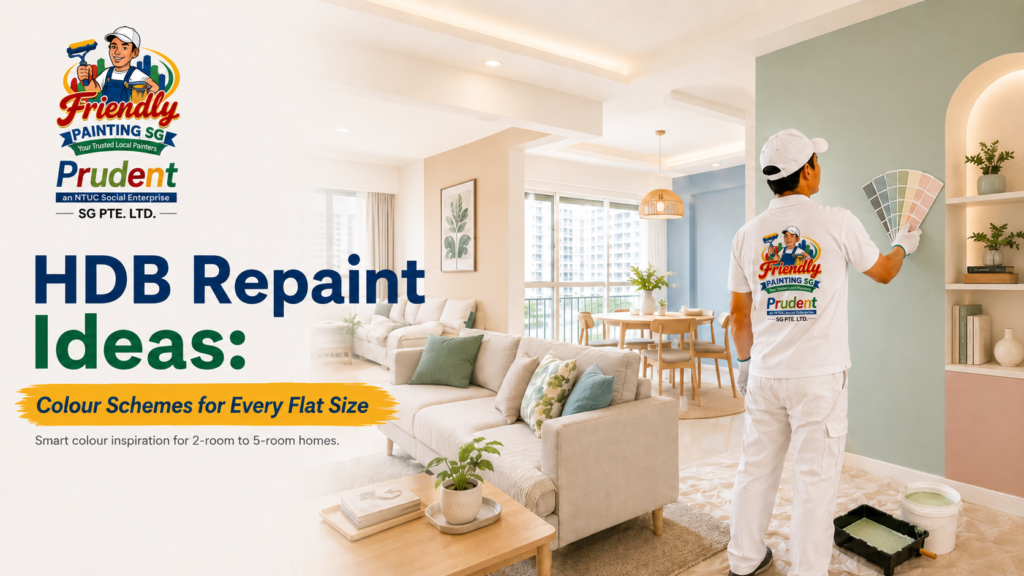
The best HDB repaint ideas depend on more than choosing a fashionable wall colour. A 2-room Flexi flat benefits from a tighter, lighter palette that keeps connected spaces visually open, while a 5-room flat can handle stronger zoning, deeper accent colours, and more variation between bedrooms and common areas.
For most Singapore HDB homes, a practical repaint starts with one main neutral, one supporting colour, and one controlled accent. Then adjust the balance according to flat size, natural light, flooring, built-in carpentry, furniture, and the condition of the existing walls.
If you are repainting rather than decorating a completely empty new flat, there is another rule:
Choose colours around the finishes you are keeping—not around a colour card in isolation.
The table below gives you a quick starting point.
HDB Repaint Ideas at a Glance
| Flat Type | Strong Starting Palette | Best Strategy | Avoid |
|---|---|---|---|
| 2-Room Flexi | Warm white + pale greige + soft sage | Keep most walls connected and light | Too many contrasting colours |
| 3-Room HDB | Off-white + warm beige + muted blue | Create continuity in common areas, personalise bedrooms | Breaking every wall into a different colour |
| 4-Room HDB | Warm white + greige + olive/blue accent | Use a coordinated 2–3 colour system | One strong feature wall in every room |
| 5-Room HDB | Warm neutral + taupe + deeper accent | Use colour to zone larger common spaces | Using large expanses of dark colour without testing light |
| Older / Resale HDB | Depends on flooring and fixed carpentry | Build the palette around what stays | Choosing paint before inspecting wall condition |
Recent HDB virtual-tour examples show why flat size deserves its own colour strategy. Depending on the project, 2-room Flexi units can be around 38–50 sqm, 3-room flats around 68–71 sqm, 4-room flats roughly 88–98 sqm, and 5-room flats around 113 sqm or more. Actual layouts vary by development, so use these as scale references rather than fixed dimensions for every HDB flat.
Why Repainting an HDB Is Different From Choosing Colours for an Empty Room
A repaint usually comes with constraints.
You may already have:
- Flooring
- Kitchen cabinets
- Wardrobes
- Sofa
- Curtains
- Dining furniture
- Doors
- Feature panels
- Existing lighting
Those fixed elements already contain colour.
Your new wall paint needs to work with them.
For example, a cool blue-grey that looked sophisticated in a showroom may feel disconnected beside warm cream flooring and walnut carpentry.
Likewise, a very yellow beige may clash with cooler grey tiles.
So before choosing paint, identify the dominant undertone already present in the room.
Ask:
- Is the flooring warm or cool?
- Is the wood reddish, yellow, grey, or neutral?
- Is the sofa the main colour feature?
- Are the curtains staying?
- Is the kitchen open to the living room?
The repaint should connect those elements rather than compete with them.
1. 2-Room Flexi HDB Repaint Ideas
A 2-room Flexi flat needs disciplined colour planning because the living, dining, kitchen, and circulation areas are visually close together.
Recent HDB project examples place 2-room Flexi units roughly in the 38–50 sqm range depending on type and development.
That does not mean everything must be white.
It means every colour should have a clear job.
Idea 1: Warm White + Pale Greige + Soft Sage
This is one of the safest modern combinations.
Use:
Warm white: most living walls and ceiling
Pale greige: bedroom or one secondary wall
Soft sage: small feature wall or study nook
Why it works:
Warm white keeps the main visual field open.
Greige introduces depth without creating a sharp colour break.
Sage gives the flat personality without dominating a compact layout.
This scheme pairs well with:
- Light wood
- Oak-look furniture
- Beige upholstery
- White cabinetry
- Black metal accents
Idea 2: Cream + Light Taupe
If your flooring has warm undertones, cream and light taupe can feel more harmonious than cool white and grey.
Use cream for the common space and slightly deeper taupe for the bedroom.
The effect is subtle rather than dramatic.
That is often exactly what a compact HDB needs.
Idea 3: One Colour in Different Depths
Instead of using several unrelated colours, choose one colour family.
For example:
- Very pale warm grey in living room
- Medium greige in bedroom
- Deeper taupe on one accent wall
This creates variation while preserving visual continuity.
What to Avoid in a 2-Room Flexi Flat
Avoid creating four or five colour zones just because the flat contains multiple functions.
A dark dining wall, blue living wall, green bedroom, yellow kitchen and pink study corner can make the space feel visually fragmented.
In smaller HDB layouts, continuity usually creates more impact than variety.
2. 3-Room HDB Repaint Ideas
A 3-room HDB gives you more flexibility because the bedrooms can develop their own identities while the living and dining areas remain connected.
Recent HDB examples show 3-room flats commonly around the high-60s to low-70s sqm range, although exact layouts vary.
A useful strategy is:
Common area = calm base
Bedrooms = controlled personality
Idea 1: Off-White Living Room + Muted Blue Bedroom
Use an off-white or very pale neutral throughout the living and dining areas.
Then introduce muted blue in one bedroom.
This works well because the stronger colour stays behind a door rather than interrupting the common-space flow.
Muted blue can work especially well with:
- White wardrobes
- Medium wood
- Grey upholstery
- Natural fabrics
Idea 2: Warm Beige + Terracotta Accent
For homeowners who dislike grey interiors, warm beige provides a softer foundation.
A restrained terracotta, clay, or muted rust accent can then add warmth to:
- Dining wall
- Bedhead wall
- Reading corner
Use the accent sparingly.
The goal is to create a focal point, not turn every wall into a statement.
Idea 3: Pale Sage + Warm White
Pale sage is useful when you want colour but still want the flat to feel calm.
Use warm white on ceilings and selected common walls, then sage on:
- Living feature wall
- Bedroom
- Study
If cabinetry is already green, however, adding another green may be unnecessary.
Again, fixed finishes should lead the repaint.
3. 4-Room HDB Repaint Ideas
The 4-room HDB is where colour planning becomes especially flexible.
Recent HDB project examples commonly place 4-room units around roughly 90–95 sqm, though some layouts differ.
There is enough space for variation, but the home can still feel disconnected if every room follows a different design trend.
A three-colour system works particularly well.
Idea 1: Warm White + Greige + Olive
Use:
Warm white: main common areas
Greige: bedrooms or corridor
Muted olive: one focal wall
Olive works well with:
- Warm timber
- Beige furniture
- Black accents
- Cream fabrics
It gives colour without the intensity of bright green.
Idea 2: Soft White + Blue-Grey
Blue-grey can create a clean contemporary interior, but test it carefully.
In a room with limited daylight, a very cool grey-blue can feel dull.
In stronger daylight, the same colour may appear fresher and lighter.
Use soft white beside it to prevent the space from becoming visually cold.
Idea 3: Neutral Living Area + Distinct Bedroom Palettes
A 4-room flat can support individual bedroom colours better than a compact flat.
For example:
Living/dining: warm white
Main bedroom: muted taupe
Bedroom 2: pale sage
Bedroom 3: soft blue
The trick is to keep all three bedroom colours at a similar saturation level.
If one room is pastel and another is extremely bright, the overall home can feel inconsistent.
Idea 4: A Proper Feature Wall
A 4-room living room often has enough visual space for a stronger feature wall.
Good locations include:
- TV wall
- Sofa wall
- Dining wall
- Bedhead wall
A feature wall should have a reason to exist.
It should frame furniture or architecture.
Do not choose a random wall simply because it is empty.
Friendly Painting Singapore already has a dedicated feature-wall service for homeowners who want a more intentional focal wall rather than repainting every surface in a strong colour.
4. 5-Room HDB Repaint Ideas
A 5-room HDB gives you the most freedom among the common flat types discussed here.
Many recent HDB examples sit around 113 sqm, with some developments offering slightly larger variants.
More space allows:
- Stronger colour zoning
- Deeper feature colours
- Distinct dining and living areas
- More personalised bedrooms
However, larger does not mean every surface should become bold.
Idea 1: Warm Neutral + Deep Taupe
Use a warm neutral throughout the main common area.
Then place deeper taupe on:
- TV wall
- Dining wall
- Long feature wall
Taupe provides contrast without becoming as severe as black or charcoal.
This works especially well when flooring and carpentry have warm undertones.
Idea 2: Cream + Deep Olive
A larger living room can handle deeper green more comfortably than a very small one.
Use cream on most surfaces and dark olive on one controlled focal wall.
Add:
- Light upholstery
- Warm timber
- Brass or black accents
The wall becomes a visual anchor.
Idea 3: Soft Neutral Common Area + Stronger Bedrooms
If you enjoy colour but want the living room to remain timeless, move stronger shades into the bedrooms.
Examples:
Main bedroom: dusty blue
Child’s room: muted peach
Study: sage
Common area: warm white or greige
This lets individual rooms develop personality without turning the whole flat into a colour catalogue.
Best HDB Living Room Repaint Ideas
The living room usually deserves the most careful colour decision because it connects multiple visual elements.
You may see:
- Sofa
- TV console
- Dining table
- Flooring
- Curtains
- Carpentry
- Kitchen entrance
all from one position.
That is why complicated colour schemes can become overwhelming.
Option 1: Warm White
Best when:
- Furniture already has strong colour
- The room receives moderate natural light
- You want flexibility
Warm white is not the same as yellow-white.
Choose a subtle undertone that complements existing materials.
Option 2: Greige
Greige sits between grey and beige.
It can be particularly useful in HDB interiors because it works with both:
- Cool finishes
- Warm wood
However, greige varies widely.
Some shades lean heavily beige; others look almost grey.
Always test.
Option 3: Pale Taupe
Taupe creates more depth than white while remaining neutral.
It is useful when a plain white living room feels unfinished.
Option 4: Muted Green
Sage, eucalyptus, or muted olive can introduce natural colour.
Pair them with quieter furniture rather than adding several other strong colours.
HDB Bedroom Repaint Ideas
Bedrooms can tolerate more personal colour because they are visually separated from the common area.
For a Calm Bedroom
Try:
- Muted blue
- Pale sage
- Soft taupe
- Dusty beige
- Warm grey
For a Warmer Bedroom
Consider:
- Cream
- Mushroom
- Muted terracotta
- Soft blush
- Warm greige
For a Dramatic Bedroom
A deeper shade can work effectively behind the bed.
Examples:
- Deep blue
- Forest green
- Charcoal
- Chocolate taupe
Keep the remaining walls lighter if you want the contrast without enclosing the room.
What Colours Make a Small HDB Look Bigger?
No paint colour physically increases floor area.
However, colour can change visual perception.
Light and low-contrast schemes often make boundaries feel less dominant.
Useful options include:
- Warm white
- Soft cream
- Pale greige
- Very light taupe
- Muted blue-grey
- Pale sage
Another effective strategy is reducing contrast between adjoining areas.
For example, painting the living and dining zones in the same colour can create a more continuous visual field than splitting them into two strongly different shades.
Should You Paint Everything White?
Not necessarily.
A very stark white can sometimes make warm flooring or carpentry appear disconnected.
A soft warm neutral may feel more cohesive while still maintaining brightness.
Can Dark Colours Work in an HDB?
Yes.
The idea that small flats can never use dark paint is too simplistic.
Dark colour can work well when applied strategically.
Good locations include:
- TV feature wall
- Bedhead wall
- Dining niche
- Study corner
- Recessed area
What matters is:
- Amount of dark surface
- Natural light
- Furniture colour
- Ceiling height
- Adjacent wall colour
A small dark wall can sometimes create depth rather than making the entire room feel smaller.
The mistake is applying a dark shade across several surfaces without checking how the room behaves in real light.
Feature Wall or Full-Room Colour?
This is one of the most useful decisions to make before repainting.
Choose a Feature Wall When:
- You like a bold colour but do not want it everywhere
- One architectural wall needs emphasis
- The room already has a clear focal point
- Furniture is relatively neutral
Paint the Whole Room When:
- The chosen colour is soft enough to surround the space
- You want a more immersive effect
- The room has sufficient light
- The furniture supports the palette
Do not automatically use a feature wall because it is common.
Sometimes four walls in a soft muted colour look much more intentional than three white walls and one random dark wall.
How Natural Light Changes HDB Paint Colour
Never finalise a repaint colour using only:
- Website image
- Phone screenshot
- Printed catalogue
- Showroom lighting
The same paint can look different at:
- 9 a.m.
- 3 p.m.
- 8 p.m.
Natural light, curtain colour, floor reflection, and artificial lighting all affect perception.
Strong daylight can make a pale colour appear much brighter.
Low-light rooms can make cooler greys or blues feel heavier.
Warm LEDs can pull beige, cream, and greige toward warmer tones.
Before repainting an entire flat, test shortlisted colours on actual walls and inspect them across the day.
Singapore Humidity and HDB Repainting
Singapore’s climate is consistently humid.
Meteorological Service Singapore reports mean annual relative humidity of around 82%, with humidity frequently exceeding 90% in the early morning and reaching 100% during prolonged rain.
This matters because repainting should not be used to hide an unresolved moisture problem.
If the existing wall has:
- Repeated mould
- Damp patches
- Peeling
- Water staining
- Bubbling paint
investigate the cause before applying a new decorative coat.
A different colour does not solve moisture.
Proper preparation comes first.
Repainting an Older or Resale HDB: Check the Wall Before the Colour
Older HDB walls often require more assessment than relatively new surfaces.
Before repainting, inspect for:
- Hairline cracks
- Nail holes
- Previous patch repairs
- Peeling
- Powdery surfaces
- Uneven old paint
- Water stains
- Mould
- Heavy dirt
A dark or higher-sheen finish can make surface defects more obvious.
Therefore, if you want a dramatic new colour, surface preparation becomes even more important.
Paint should be the final visual layer—not the material used to hide untreated problems.
Should the HDB Ceiling Always Stay White?
White is the safest ceiling choice because it maintains a bright, familiar appearance.
But it is not the only option.
You can use:
Soft Off-White
Useful when wall colours are warm.
Very Pale Version of the Wall Colour
This can make the room feel more cohesive.
Same Colour on Wall and Ceiling
This creates a more immersive effect, particularly in bedrooms.
However, darker ceiling colours require careful planning because they can visually lower the ceiling.
For most HDB common areas, white or a very light neutral remains the simplest choice.
How Many Colours Should You Use in an HDB Flat?
There is no fixed rule, but restraint usually produces stronger results.
A useful framework is:
2-Room Flexi
1–2 main colours + small accent
3-Room
2 main colours + 1 accent
4-Room
2–3 coordinated colours
5-Room
3 coordinated colours + optional bedroom variation
This does not include ceiling white or very small decorative elements.
The purpose of a palette is not to reach a certain number.
It is to create visual relationships.
6 Ready-to-Use HDB Repaint Colour Schemes
Scheme 1 — Warm Minimal
- Warm white
- Greige
- Light oak
- Black accents
Best for:
Modern, Scandinavian, uncluttered interiors.
Scheme 2 — Soft Nature
- Cream
- Sage
- Warm wood
- Off-white ceiling
Best for:
Relaxed living rooms and bedrooms.
Scheme 3 — Modern Cool
- Soft white
- Blue-grey
- Charcoal accent
- Light wood
Best for:
Contemporary interiors with cooler flooring.
Scheme 4 — Warm Contemporary
- Beige
- Taupe
- Terracotta accent
- Walnut
Best for:
Homes with warm flooring and carpentry.
Scheme 5 — Quiet Luxury
- Soft ivory
- Mushroom taupe
- Deep olive
- Dark timber
Best for:
4- and 5-room flats where deeper colours have more breathing room.
Scheme 6 — Clean Everyday
- Off-white
- Pale greige
- Muted blue
- Medium wood
Best for:
Homeowners who want easy room-to-room coordination.
Common HDB Repainting Mistakes
Choosing Paint Before Looking at Flooring
Flooring covers a much larger visual area than a paint sample.
Let it influence the palette.
Copying an Instagram Colour Exactly
Photos are affected by:
- Editing
- Camera exposure
- White balance
- Screen brightness
Use inspiration images for direction, not exact colour matching.
Using Too Many Feature Walls
A feature wall loses its purpose when every room has one.
Choosing Cool Grey Automatically
Some cool greys can feel flat in rooms with limited daylight.
Compare greige, taupe, and warmer alternatives.
Ignoring Existing Furniture
If the sofa, cabinetry, and curtains remain, they are part of the colour scheme.
Painting Over Damage
Repair first.
Choosing High Sheen Without Checking Wall Condition
More reflective finishes can make dents and uneven patches more noticeable.
How to Plan an HDB Repaint in 7 Steps
Step 1: Photograph Every Room
This helps you view the home as a complete palette rather than individual walls.
Step 2: List What Is Staying
Flooring, furniture, carpentry, curtains.
Step 3: Choose the Main Neutral
This should connect the common spaces.
Step 4: Add One Supporting Colour
Use it in bedrooms, corridors, or secondary walls.
Step 5: Decide Whether You Need an Accent
Do not force one.
Step 6: Test Physical Samples
Observe them morning, afternoon, and night.
Step 7: Inspect Wall Condition
Plan repairs and preparation before the final coats.
This sequence prevents a common problem: finding a beautiful wall colour first and then trying to force the rest of the flat to match it.
Final Thoughts: Which HDB Repaint Idea Is Right for Your Flat?
The strongest HDB repaint ideas are not the ones using the most fashionable colour.
They are the ones that fit the scale, light, fixed finishes, and daily use of the actual flat.
For a 2-room Flexi, visual continuity matters most. A warm neutral with one controlled accent can create personality without making the compact layout feel fragmented.
A 3-room flat offers enough separation to personalise bedrooms while keeping the living and dining areas connected.
A 4-room HDB gives you more freedom for coordinated colour families, feature walls, and distinct bedrooms.
A 5-room flat can handle deeper accents and stronger zoning, but the overall palette should still feel intentional.
Before repainting, also inspect the walls themselves. Singapore’s high humidity means repeated mould, dampness, peeling, or water staining should be investigated rather than hidden under a fashionable new colour.
The best process is therefore:
Existing finishes → room size → lighting → main neutral → supporting colour → accent → physical test → surface preparation → repaint.
If you reach the stage where you want help applying the final scheme, Friendly Painting Singapore provides HDB painting and surface-preparation support for flats across Singapore.
Frequently Asked Questions About HDB Repaint Ideas
1. What are the best HDB repaint ideas for a small flat?
Use a connected palette with one light main neutral and one or two supporting colours. Warm white, pale greige, light taupe, muted blue, and sage can work well depending on flooring and light.
2. What colours are good for a 3-room HDB?
A neutral common area combined with one muted bedroom colour works well. Examples include off-white with sage, warm white with blue-grey, or cream with light taupe.
3. What are good repaint ideas for a 4-room HDB?
A 4-room flat can support a coordinated three-colour palette such as warm white, greige, and muted olive. Bedrooms can use related shades without breaking the overall visual theme.
4. What colours work well in a 5-room HDB?
Larger common areas can handle deeper taupe, olive, blue, or charcoal accents more comfortably. Keep surrounding walls lighter if you want a balanced result.
5. What colour makes an HDB living room look bigger?
Light, low-contrast colours such as warm white, soft cream, pale greige, and very light taupe can make visual boundaries feel less dominant. Keeping connected living and dining areas in the same colour can also improve continuity.
6. Can I use dark paint in an HDB flat?
Yes. Dark colours can work effectively on one feature wall, dining niche, TV wall, or bedroom wall. Test them under actual room lighting before applying them broadly.
7. Should every HDB bedroom be the same colour?
No. Bedrooms can have individual colours, especially in 3-, 4-, and 5-room flats. Keeping similar saturation and undertones helps the overall home remain coordinated.
8. Should HDB ceilings always be white?
Not necessarily. White is the safest option, but off-white or a very pale version of the wall colour can also work. Dark ceilings require more deliberate design.
9. Can I repaint over old HDB paint?
Sometimes, but the existing surface should first be inspected for peeling, cracks, mould, dirt, moisture, and poor adhesion. Surface preparation may be necessary before new finish coats.
10. How should I test HDB paint colours?
Apply physical samples to the actual walls and observe them at different times of day under both natural and artificial lighting. Do not rely entirely on phone screens or catalogue images.